A 38% Return Amid Market Turmoil: Investment Report Showcases the Resilience of an AI Value Investing Portfolio


A 38% Answer Amid Market Turmoil — AI Value Investing Portfolio Daily Insight
On the morning of the last Monday of October, the market is in a chilly mood. The KOSPI fell to around 5,531, and the KOSDAQ slid 1.85%. U.S. markets were no better — the Dow dropped well over 1%, and Brent crude plunged 6% in a single day, amplifying macro unease. Yet amid this gray market backdrop, the 'AI Value Investing Portfolio' is maintaining a 38.5% return on its initial capital. The numbers tell just one story: selective strength can beat a weak market.
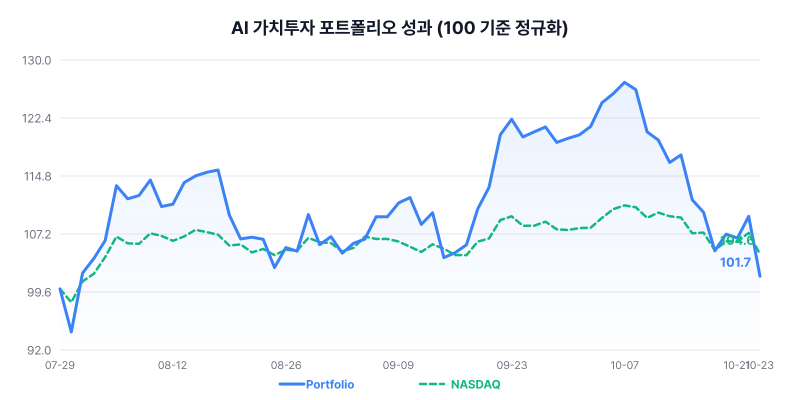
Defending Assets During a Sharp Decline — What It Means
The asset trend shows net assets fell by about $1,070 in a single day late last week. As of October 23, they stood at $13,853, a notable pullback from the $14,600 range a week earlier. However, holding on to gains of more than 38% during a period when the entire market is wobbling is no small feat. Especially given that cash amounts to only about $50 — nearly fully invested — this decline was withstood by the power of stock selection.
Portfolio Diagnosis — Semiconductors Remain the Backbone of Undervaluation
The backbone of this portfolio is still semiconductors. Micron, with earnings per share of $74 and a P/E of just 11, illustrates how cheap its stock is relative to its growth. Nvidia, with a growth-adjusted valuation ratio of 0.27 — well below the market average — continues to serve as a core stake in AI growth. AMD has surged roughly 155% from its purchase price and become the portfolio's main profit driver, but its P/E of 129 serves as a reminder that it is a candidate for harvesting concentrated gains. Intel remains loss-making, warranting a cautious approach until signs of recovery appear. Meanwhile, leveraged products like SOXL and TQQQ, with volatility amplified threefold, make position management the deciding factor in the current correction.
| Stock | Quantity | Purchase Price | Current Price | P/E |
|---|---|---|---|---|
| Broadcom | 5.67 shares | $326.03 | $323.24 | 43.2 |
| Amazon | 1.95 shares | $208.39 | $250.38 | 20.1 |
| Intel | 2.80 shares | $104.56 | $85.49 | - |
| Meta | 0.55 shares | $653.56 | $648.85 | 22.1 |
| SOXL | 13.92 shares | $71.22 | $82.11 | 18.6 |
| TQQQ | 1.13 shares | $76.34 | $66.42 | 27.0 |
| AMD | 6.82 shares | $198.62 | $507.93 | 129.6 |
| Nvidia | 24.00 shares | $184.21 | $212.21 | 26.8 |
| Micron | 1.30 shares | $930.96 | $856.49 | 11.5 |
Trade Review — Rebalancing Toward 'Cheaper AI'
The recent trading flow is consistent: harvesting some profits from Nvidia and AMD and shifting funds to Micron, the cheaper name within the same sector. From mid-September through last week, Micron was bought in four separate tranches — and notably, every move was a buy, not a sell. It was a strategy that reinterpreted the downturn as an 'opportunity.' At the same time, Nvidia's single-stock weight exceeded 38%, making trimming inevitable, and leveraged positions in TQQQ and SOXL were progressively scaled back during the correction. Even amid a sharp market drop, these were trades that adhered to principle.
| Date | Type | Stock | Quantity | Price |
|---|---|---|---|---|
| 2026-10-23 | Buy | Micron | 0.47 shares | $856.49 |
| 2026-10-23 | Sell | Nvidia | 1.26 shares | $212.21 |
| 2026-10-23 | Sell | AMD | 0.36 shares | $507.93 |
| 2026-10-16 | Buy | Micron | 0.31 shares | $931.24 |
| 2026-10-16 | Sell | Nvidia | 1.33 shares | $217.23 |
| 2026-10-09 | Buy | Micron | 0.11 shares | $1035.84 |
| 2026-10-09 | Sell | TQQQ | 0.06 shares | $80.23 |
| 2026-10-09 | Sell | SOXL | 0.73 shares | $142.52 |
| 2026-09-18 | Buy | Micron | 0.19 shares | $977.50 |
| 2026-09-18 | Sell | SOXL | 0.77 shares | $114.82 |
Market Outlook — Oil Plunge and the 5% Interest Rate Warning
The macro indicators remain troubling. The U.S. 10-year Treasury yield is brushing the 5% mark, and the volatility index is climbing. The sharp drop in Brent crude signals concerns about slowing demand, underscoring growing recession fears. That said, the Philadelphia Semiconductor Index rose and Nasdaq 100 futures edged higher, suggesting this selloff is less a broad risk-off move and more a sector rotation. The won's stabilization in the 1,320 range also eases pressure from foreign capital outflows. In short, short-term volatility is likely to persist, but this strategy — sticking with assets undervalued relative to growth — has ample room to make time its ally.
※ This report analyzes simulated trading records of the AI Value Investing Portfolio and does not constitute investment advice. Actual investment decisions should be made at your own judgment and responsibility.
Curious about the portfolio's detailed holdings?
Subscribe to the newsletter below to receive a detailed investment report every day.