Won-Dollar Exchange Rate Reverses Course, Falling to 1,441 Won After Hitting 1,542

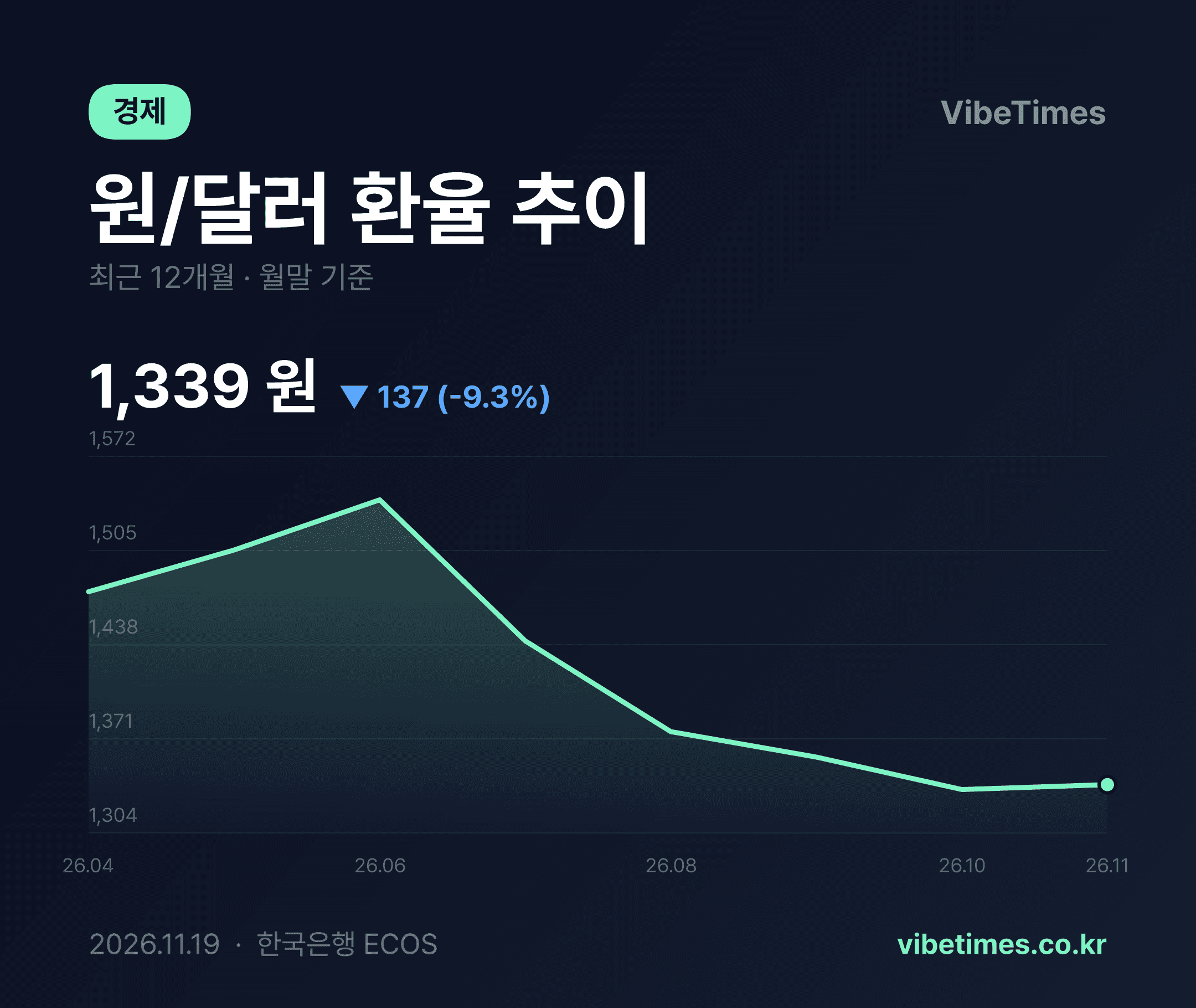
The won/dollar exchange rate has fallen more than 200 won from its yearly high of 1,542 won to 1,339 won over the past four months.
Month-end figures show a clear downward trend. The rate, which stood at 1,476 won in April 2026, climbed to 1,506 won in May and 1,542 won in June, marking the year's peak. However, it reversed direction in July to 1,441 won and continued to decline, dropping to 1,377 won in August, 1,358 won in September, and 1,335 won in October. In November it edged up slightly to 1,339 won, remaining about 13% stronger than its peak.
What the 1,542-Won Peak Tells Us
The June high of 1,542 won is the most notable point in this trend. Three consecutive monthly rises from April to June pushed the rate up 66 won, concentrating roughly 4.5% of won depreciation over just two months. Import prices and energy costs likely came under greater pressure during this period. When the rate exceeds 1,500 won, it is customary for the government and the Bank of Korea to respond with market-stabilizing statements or discussions of foreign exchange liquidity supply.
The subsequent reversal into decline signals something different. The 101-won drop in July alone was larger than the two-month climb, suggesting that structural forces such as a weaker dollar and improved domestic foreign exchange supply and demand played a bigger role than short-term speculative factors.
The Significance of Four Straight Monthly Declines
Four consecutive months of decline from July to October is the core of this data. In particular, the drop from 1,358 won in September to 1,335 won in October, breaking below the 1,340-won mark, carries strong psychological weight. With the rate returning from the 1,500-won range to the mid-1,300s, won appreciation pressure appears to have taken hold in the market.
Over the entire period, the rate fell 137 won from 1,476 won to 1,339 won, and 207 won from its peak. The average monthly decline was about 34 won, with the pace of decline slowing in later months. The 4-won uptick to 1,339 won in November is too small to suggest the downtrend has been reversed.
Implications for Exporters and Investors
A falling exchange rate is a burden for exporters. When dollar-denominated revenues are converted to won, each dollar translates into fewer won. The 13% appreciation of the won from its peak could erode currency-related gains in sectors such as semiconductors and automobiles, where dollar sales account for a large share of revenue. Conversely, airlines, distribution and energy importers, as well as overseas travelers, face correspondingly lower costs.
From an investment standpoint, approaches focused on export stocks with higher currency hedge ratios or beneficiaries of won appreciation could be effective. However, as November's modest rebound shows, bargain-buying demand for dollars may emerge in the early 1,330-won range, potentially limiting further appreciation.
Year-End Outlook
The direction of U.S. Federal Reserve interest rate policy and the pace of domestic export recovery are the key variables ahead. If the current trend continues, the rate is likely to move within a 1,320-1,360 won range through year-end. That said, the wide swing between this year's peak of 1,542 won and the current level shows the market has remained highly volatile, and the year is expected to close in a phase where managing volatility matters more than picking a direction.