November 18 Investment Report: AI Value Portfolio +24.8%


A Heavy Day for Leveraged Semiconductors, Shaken Alongside the KOSPI's -2.6% Slide
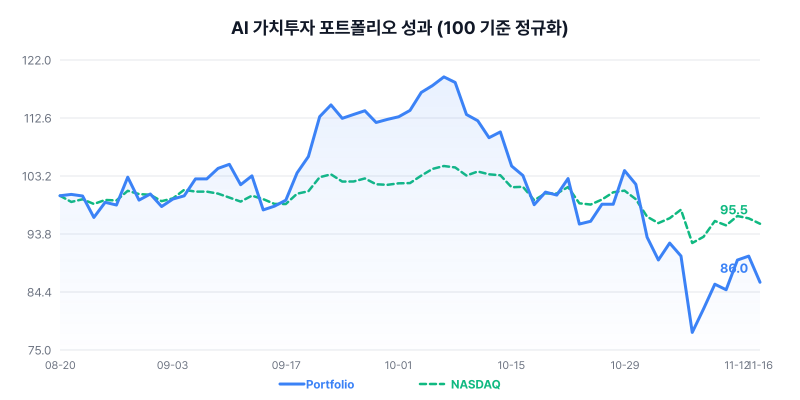
Seoul's stock market was mired in a heavy atmosphere on November 17. The KOSPI plunged 132 points (2.59%) in a single day to settle at 4,968, while the KOSDAQ fell 2.34%. The weakness that began in U.S. markets, fueled by the Philadelphia Semiconductor Index's steep 5% decline, dealt a direct blow to Korean markets. Amid the turmoil, the AI Value Portfolio is holding onto $12,484 with a cumulative return of +24.84%. Still, the asset trajectory over the past five days tells a darker story: after peaking at $13,099 on the 13th, the portfolio shed $615—about 4.7%—in a single day. The numbers lay bare just how sensitive this portfolio, concentrated in leveraged ETFs and semiconductors, is during periods of volatility.
Valuation Splits the Character of a Selloff
The portfolio's backbone remains semiconductors, but each stock's situation differs starkly. Micron trades at a single-digit forward P/E on next-twelve-month earnings, and its growth-adjusted valuation sits at just 0.16x—well short of market expectations. Given HBM4 price increases and memory demand in the AI inference era, the plunge can reasonably be seen as an opportunity to buy in tranches. AMD, by contrast, now trades above 114x earnings, showing that market expectations have run far ahead of results. Having reached $534—nearly 2.7 times the purchase price—this is the moment to trim the position. Nvidia has slipped below its purchase price at $162, yet its growth-adjusted valuation remains reasonable at around 0.2x. Intel, still loss-making and unattractive even on a PEG basis, warrants a wait-and-see approach.
| Stock | Shares | Purchase Price | Current Price | PER |
|---|---|---|---|---|
| Broadcom | 5.67 | $326.03 | $347.01 | 44.3 |
| Nvidia | 22.80 | $184.21 | $162.85 | 20.6 |
| AMD | 5.84 | $198.62 | $534.06 | 114.1 |
| Micron | 1.94 | $872.91 | $778.31 | 10.5 |
| Amazon | 1.95 | $208.39 | $266.66 | 21.6 |
| Intel | 2.80 | $104.56 | $59.66 | - |
| Meta | 0.55 | $653.56 | $641.69 | 21.9 |
| SOXL | 13.92 | $71.22 | $58.32 | 22.0 |
| TQQQ | 1.13 | $76.34 | $57.68 | 26.5 |
| TSMC | 0.44 | $431.81 | $398.73 | 25.8 |
Profit-Taking and Staged Buying: The Rhythm of Risk Management
A review of recent trades reveals a consistent principle. Each time gains on AMD approached 100%, a small portion was sold off. After partially selling at $566 in late October, additional profits were taken at $585 on November 13. The moment a single stock's weight exceeds a quarter of the portfolio, the center of gravity collapses—no matter how strong the growth story. Conversely, Micron was bought in tranches at $656 and $798, treating the selloff as an opportunity. Nvidia was handled the same way when CEO Jensen Huang's resignation wiped 240 trillion won off its market cap in a single day: core holdings were preserved while a portion was trimmed. CEO risk is a variable that can shake the foundations of a company's value, so adjusting exposure rather than selling outright was a measured choice. Widening losses on the leveraged ETFs SOXL and TQQQ were the main driver of the portfolio's 4.7% decline in this selloff. In a market with heightened volatility, managing the weight of these two holdings will determine future returns.
| Date | Type | Stock | Shares | Price |
|---|---|---|---|---|
| 2026-11-13 | Buy | Micron | 0.44 | $798.44 |
| 2026-11-13 | Sell | AMD | 0.31 | $585.30 |
| 2026-11-13 | Sell | Nvidia | 1.20 | $166.19 |
| 2026-11-06 | Buy | Micron | 0.20 | $656.39 |
| 2026-11-06 | Sell | AMD | 0.32 | $404.40 |
| 2026-10-30 | Buy | TSMC | 0.44 | $431.81 |
| 2026-10-30 | Sell | AMD | 0.34 | $566.42 |
| 2026-10-23 | Buy | Micron | 0.47 | $856.49 |
| 2026-10-23 | Sell | Nvidia | 1.26 | $212.21 |
| 2026-10-23 | Sell | AMD | 0.36 | $507.93 |
Futures Signal a Rebound; the Won and Oil Hold Firm
Even in this bleak landscape, there are hints of a turning point. Nasdaq 100 futures and S&P 500 futures rose 0.45% and 0.10% respectively, reflecting hopes of a rebound after the U.S. close. The volatility index fell 2% in a day, suggesting fear may have peaked. The won-dollar exchange rate edged up to 1,335 won but remains in stable territory, and gold rose 0.5% on safe-haven demand. Still, the U.S. 10-year yield moving in the 5.1% range remains a burden on growth-stock valuations. The semiconductor correction may not be over. Yet stocks whose prices are deeply discounted relative to growth have historically recovered their value over time. The current strategy—securing liquidity while steadily accumulating undervalued quality names—is rational enough to weather the turbulence.
※ This report analyzes the simulated operation of the AI Value Portfolio and is not investment advice. Actual investment decisions should be made at your own judgment and responsibility.
Want the full portfolio details?
Subscribe to the newsletter below to receive a detailed investment report every day.