Humanoid Robots Poised for Full Market Entry in 2026

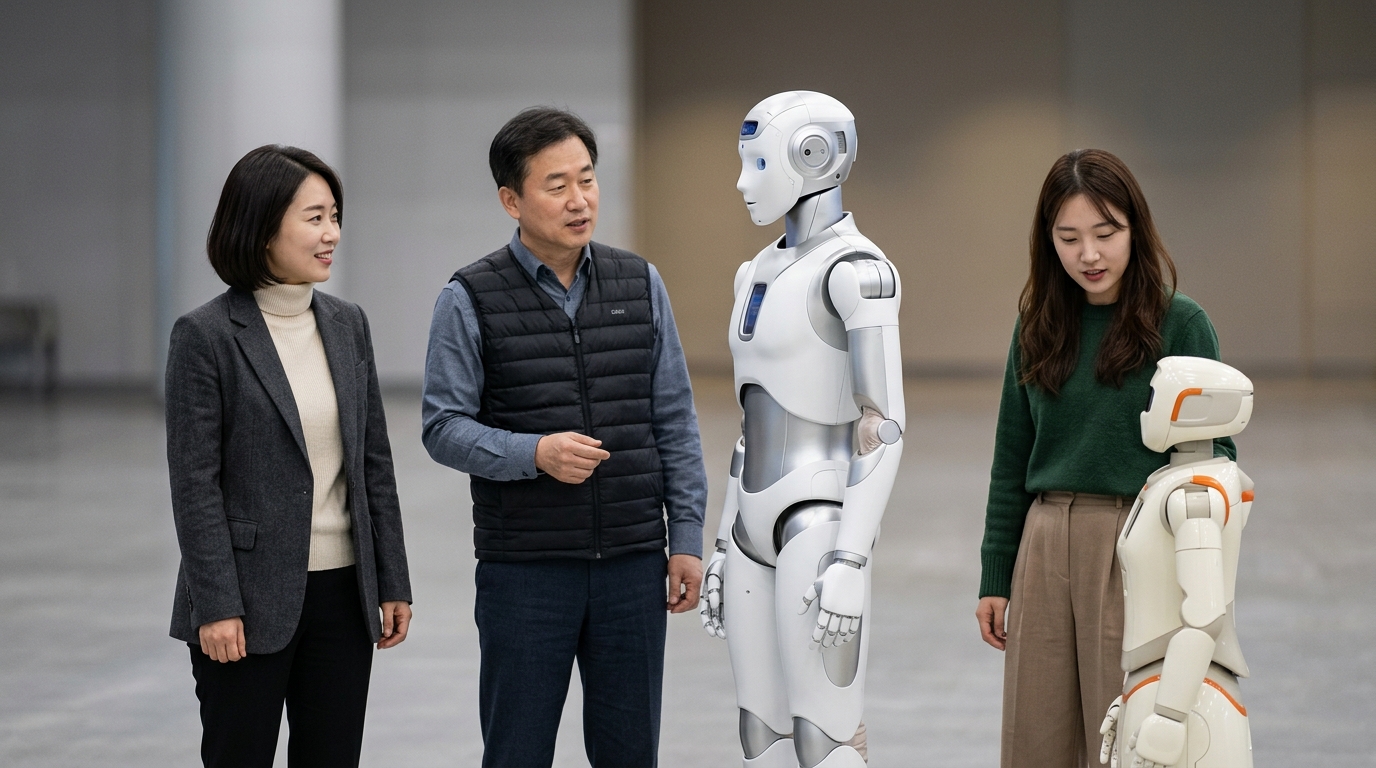
2026 is forecast to be the 'inaugural year of commercialization' for artificial intelligence (AI) robots, which will gain human-like bodies and actively operate in the real market. This signifies the dawn of the 'Physical AI' era, where AI moves beyond thinking to acting and operating like humans, pushing robot technology beyond mere research into actual sales and utilization. This information was revealed by the Korea Institute of Machinery and Materials (KIMM) in its 'Mechanical Technology Policy' Issue No. 122, published on the 8th.
The report suggests that the emergence of mass-producible models, such as Tesla's 'Optimus' and China's Unitree's 'G1', indicates that robots have reached a level ready for immediate deployment in factories and homes. Global market research firms predict rapid growth for the humanoid robot market. Bank of America (BofA) projects global humanoid robot shipments to grow from a cumulative 18,000 units in 2025 to an annual rate of 1 million units between 2030 and 2035. Goldman Sachs anticipates sales to reach 2.1 million units by 2035.
The backdrop to this market growth is a decline in manufacturing costs. With the establishment of mass production systems and optimized component design, the current manufacturing cost per unit, around $35,000, is expected to fall to between $13,000 and $17,000 within five years. Notably, Unitree's 2025 R1 model launch at $5,900 is driving price innovation.
In the national competitive landscape, the U.S. leads the industry, leveraging its Big Tech-driven AI foundation models and semiconductor design superiority. China, on the other hand, is rapidly dominating the market, with over 140 companies entering mass production competition and expected to capture approximately 70% of new models in 2025. Korea possesses hardware strengths in semiconductors, batteries, and communication infrastructure but is identified with weaknesses in AI foundational model technology and a fragile supply chain for dedicated humanoid robot components.
In response, KIMM proposes a 'two-track strategy' focused on 'technological self-reliance' through in-house development of core components and partnerships with Big Tech, alongside 'international cooperation'. To directly implement the strategies presented in this report, KIMM has set three major goals through its 'Autonomous Growth AI Humanoid Strategic Research Group': establishing a standard platform with mass-producibility and price competitiveness, developing an autonomous learning brain, and building an open data factory for joint academic, industrial, and research utilization.
Kim Hee-tae, a senior researcher at KIMM's Mechanical Policy Center, stated, "Simple technology demonstrations are over; the key now is how quickly robots can generate revenue in the field." He added, "The period until 2030 is a golden time that will determine technological and market hegemony. Korea urgently needs a strategic response, leveraging its world-class manufacturing infrastructure to overcome labor shortages due to low birth rates and an aging population with a robot economy, through domestic production of core components and absorption of AI technology."