James Webb Telescope's Achievements Drive New Space Exploration Technologies

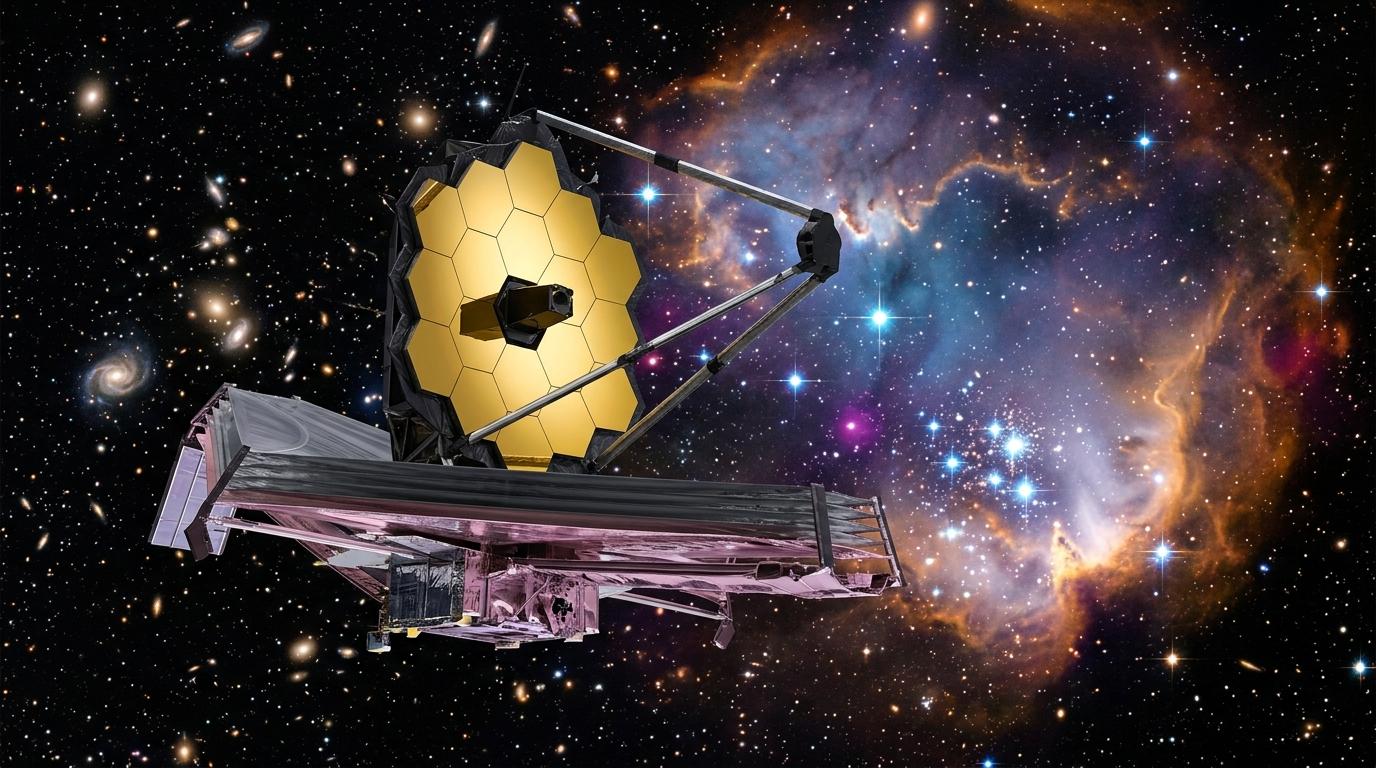
The groundbreaking achievements of the James Webb Space Telescope (JWST) are leading innovation at the forefront of space exploration, serving as a prime example of how rapidly evolving technologies and exploration methods in the 'New Space' era contribute to our future understanding of the cosmos. Recent scientific issues in space exploration are providing the momentum to satisfy human intellectual curiosity, drive scientific and technological development, and expand future survival possibilities.
JWST Redefines Cosmological Paradigms
Equipped with the capability to observe the early universe by capturing light beyond the redshift limit, the James Webb Space Telescope (JWST) surpasses the limitations of previous telescopes, delivering powerful observational performance in the near-infrared spectrum. This is crucial for capturing the light emitted by the first stars and galaxies formed shortly after the Big Bang, which has been stretched (redshifted) due to the expansion of the universe and reached current observable wavelengths. JWST's unique technological strengths allow us to explore the earliest moments of the universe's birth with unparalleled clarity.
JWST was brought to life through a complex design and technology, backed by an investment exceeding $10 billion. Notably, its primary mirror, composed of 18 hexagonal mirror segments, spans a total of 6.5 meters, vastly larger than the Hubble Space Telescope's 2.4-meter primary mirror. Along with this massive mirror, JWST is positioned at the Sun-Earth Lagrange point L2, approximately 1.5 million kilometers from Earth, in an environment shielded as much as possible from Earth's heat and light. This design is essential for accurately detecting the faint signals from the distant, early universe.
The data from JWST, which is challenging cosmological models by discovering early galaxies, is prompting a re-examination of existing cosmological frameworks. Scientists have confirmed the existence of far more numerous and brighter galaxies than expected in the universe's first few hundred million years. For instance, the discovery of galaxies estimated to have formed less than 300 million years after the Big Bang, which were difficult to observe previously, suggests the universe may have formed stars and evolved more rapidly from its initial stages. This provides fundamental insights that could transform our understanding of galaxy formation and early evolution.
These discoveries challenge the existing theoretical frameworks for the early history of the universe. Evidence that stars and galaxies formed much earlier and in more mature forms than anticipated in the early cosmos demands new explanations for how matter distributed and structures formed as the universe expanded. Researchers are exploring various theoretical models, including the roles of dark matter and dark energy, or subtle differences in the physical laws of the early universe, to explain these phenomena.
JWST is leading advancements in star system formation and exoplanet atmosphere analysis, offering unprecedented detail of the dusty disks around newly forming stars and planetary systems, thereby revealing the processes of star system formation with never-before-seen clarity. Furthermore, significant progress has been made in analyzing exoplanet atmospheres, detecting chemical indicators such as water, methane, and carbon dioxide that suggest the potential for life. This moves beyond mere celestial observation, bringing humanity one step closer to scientifically verifying the hypothesis that life may exist beyond Earth.
For example, JWST captured clear evidence of water in the atmosphere of exoplanet WASP-96b, providing crucial information for understanding the climate and atmospheric composition of such planets. Looking ahead, the goal is to detect direct indirect evidence of biological activity (biosignatures) like oxygen and methane in the atmospheres of Earth-like exoplanets. Such research brings the possibility of detecting extraterrestrial life into the realm of realistic scientific inquiry.
The 'New Space' Era Revolutionizes Exploration Economics and Accessibility
The dramatic reduction in space launch costs through rocket reusability technology, spearheaded by private companies like SpaceX, is transforming the paradigm of space exploration. Successful reuse cases of the Falcon 9 rocket demonstrate how reusable launch vehicles have drastically improved the cost-effectiveness of space missions. These technological advancements have enhanced space accessibility to levels previously unimaginable, laying the economic foundation for diverse scientific missions and commercial activities.
Rocket reusability is estimated to reduce launch costs by more than tenfold. This has resulted in significant cost reductions not only for satellite launches but also for human spaceflight missions. Unlike traditional rockets that are discarded after a single use, reusable rockets are refurbished and prepared for subsequent launches after landing. This improvement in economic viability provides opportunities for more countries, institutions, and private companies to enter the space exploration market, consequently accelerating growth and innovation across the entire space industry.
The rise of small satellites (CubeSats) and the proliferation of customized exploration missions have significantly lowered the barrier to entry for space exploration. Small size and relatively low cost enable mission designs to achieve specific scientific objectives. This has invigorated niche scientific research and Earth observation missions that were difficult to pursue with traditional large, high-cost projects.
CubeSats are typically composed of basic units (1U) measuring 10cm x 10cm x 10cm, and multiple units can be combined to perform more complex missions. This modular design significantly contributes to reducing development time and costs. University research teams and startups are developing their own satellites to conduct missions for various purposes, including Earth observation, communication testing, and space environment monitoring. This is significant in democratizing space exploration activities and providing a platform for testing new ideas and technologies.
The integration of AI and data analysis technologies maximizes exploration efficiency, making the use of artificial intelligence (AI) and big data analysis indispensable in space exploration processes. AI greatly contributes to increasing mission success rates and efficiency through autonomous navigation of probes, risk prediction and avoidance, and real-time processing and analysis of vast observational data. The enormous volume of data generated by advanced telescopes like JWST is difficult to translate into tangible scientific outcomes without AI-based analysis.
AI assists probes in independently coping with unexpected situations and making optimal decisions. For instance, Mars exploration rovers utilize AI for autonomous path planning, obstacle avoidance, and identifying geological features of high scientific value. Applying AI to astronomical data analysis enables automatic classification of millions of galaxies or stars and detection of rare celestial phenomena. This technological integration accelerates the pace of space exploration and enhances the potential for significant scientific discoveries that humans might otherwise miss.
Challenges and Infinite Prospects for Future Space Exploration
The establishment of lunar bases through the Artemis program and the use of the Moon as a staging post for deep space exploration are laying the groundwork for sustained human exploration beyond returning to the Moon in the 21st century. This plan aims to construct the Lunar Gateway space station, explore the lunar south pole, and ultimately utilize lunar resources (particularly water ice) as a forward base for deep space missions. These efforts demonstrate an ambition to build an economic and strategic foundation for future space activities, extending beyond simple scientific exploration.
The successful progression of the Artemis program focuses on creating an environment where humans can reside and operate on the Moon long-term. Water ice, believed to exist at the lunar south pole, is expected to be a key resource for self-sufficiency in lunar base construction and operation, as it can be used for drinking water, breathable oxygen, and rocket fuel production. Furthermore, the Gateway, to be constructed in lunar orbit, will serve as an intermediate base not only for lunar surface exploration but also for deep space missions to destinations like Mars.
The collaborative NASA and ESA project aiming to identify traces of life through a Mars sample return mission is one of the most complex and ambitious space exploration endeavors in human history. This mission, which safely brings rock and soil samples collected by the Perseverance rover on Mars back to Earth, is expected to play a pivotal role in understanding Mars' geological history and the possibility of past or present life. The sample return process requires sophisticated technologies across multiple stages, including sample collection on the Martian surface, launch into Mars orbit using a small rocket, docking with a return capsule, and Earth atmospheric entry and landing.
The returned samples will be meticulously studied in specialized research facilities equipped with state-of-the-art analytical instruments, potentially yielding groundbreaking scientific insights into Martian life or the conditions for life's origin. This mission could hold the key to answering fundamental questions about the origin of life itself.
Expanding exoplanet life detection and considering the ethical dilemmas that arise, future next-generation telescopes, going beyond JWST, will focus on discovering Earth-like exoplanets and detecting indirect evidence of biological activity in their atmospheres. Telescopes in conceptual study phases, such as LUVOIR or HabEx, are addressing the technological challenges for achieving these goals.
These exploration efforts pose significant ethical and societal questions: How should we react if extraterrestrial life is discovered? What consequences could contact with discovered alien life entail? How can a balance be struck between the freedom of scientific inquiry and potential risks? Contemplating these questions is essential for humanity to understand its place in the universe and establish a responsible attitude towards it. Future space exploration will serve as a catalyst for deepening not only technological advancement but also humanity's philosophical and ethical introspection.