22nd National Assembly: Ranking of Bills Proposed by Political Party

22nd National Assembly: Competition for a 'Working Assembly'… Democratic Party of Korea Leads Overwhelmingly in Bill Proposals
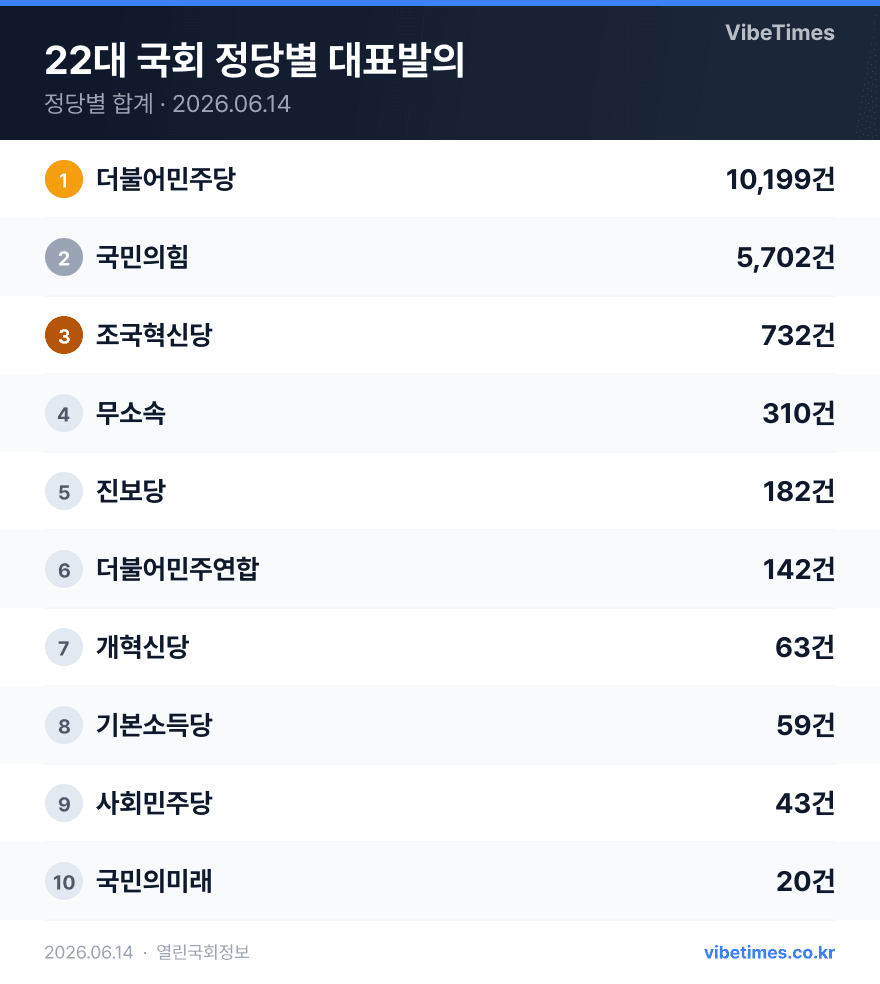
As of June 14, 2026, analysis of bills primarily proposed by political parties registered in the 22nd National Assembly shows the Democratic Party of Korea securing an overwhelming first place with 10,199 cases. This figure is approximately 1.8 times that of the People Power Party, which ranks second with 5,702 cases. The Cho Kuk Innovation Party placed third with 732 cases, demonstrating significant legislative activity despite being a relatively new party. Independent lawmakers recorded 310 primarily proposed bills, marking the fifth-highest number of legislative attempts. They were followed by the Progressive Party (182 cases), the Democratic United Alliance (142 cases), the Reform Party (63 cases), the Basic Income Party (59 cases), the Social Democratic Party (43 cases), and the People's Future (20 cases). These figures are based on the legislative bills directly submitted to the National Assembly by each party and independent lawmakers, and can be interpreted as an indicator of legislative activity, encompassing not only party-led proposals but also individual lawmaker bills. The number of proposed bills serves as a metric to gauge a party's policy implementation drive, the proactiveness of its parliamentary activities, and its efforts to reflect the demands from various sectors of society in the legislature. Therefore, this data serves as crucial foundational material for predicting each party's parliamentary performance and future policy direction. It offers a glimpse into the fierce competition among parties since the launch of the 22nd National Assembly to create a 'working assembly.' Notably, the data clearly shows that the main opposition party, the Democratic Party of Korea, is leading overall legislative activities based on its substantial number of seats. This suggests that the party's influence could strongly shape future bill passage and the direction of state administration.
Intensified Legislative Competition, 'Quantitative Advantage' of Major Parties Clear in Parliamentary Activities
The lineup of parties occupying the top ranks in bill proposals for the 22nd National Assembly reflects the current political landscape. The Democratic Party of Korea's overwhelming figure of 10,199 cases signifies that as a major party holding a majority of seats in the Assembly, it possesses the physical and policy-making foundation to propose numerous bills. This quantitative advantage can be interpreted as an active move to push its policy agenda through the legislature. It can be viewed as the result of efforts to legislate voters' demands or, conversely, as a strategic move to strengthen its role as the central pillar of parliamentary operations. The People Power Party, with 5,702 proposals, also demonstrates its role as a majority party by recording the second-highest number of proposals. The structure where the two major parties account for a significant portion of the total bill proposals reaffirms that parliamentary seats and policy-driving capacity remain the primary engines of legislative activity, despite intensified competition among multiple parties in Korean politics.
What is noteworthy is the rapid rise of the Cho Kuk Innovation Party, which has emerged as a significant force since the 2024 general election, jumping to third place with 732 primarily proposed bills. This indicates that the party is investing substantial resources into policy and legislative activities to exert political influence. The high number of proposals, despite its relatively small number of seats, is analyzed as a strategy to gain prominence by intensely focusing on specific policy areas or by quickly responding to issues of high public interest. This can also be linked to discussions about the role of third forces or minor parties within the National Assembly going forward. For instance, parties with fewer seats, such as the Democratic United Alliance (142 cases) and the Reform Party (63 cases), are consistently proposing bills according to their respective policy lines, voicing their stances on national agenda items.
The 310 bills proposed by independent lawmakers are also worthy of attention. This shows that individual lawmakers, not bound by party platforms, are actively pursuing legislation that represents their political convictions or the interests of their constituencies. However, when compared to the party rankings, it also indirectly reveals the significant influence of organizational power, like that of political parties, on legislative activities. In this way, the differences in the number of bills proposed by each party go beyond merely reflecting seat numbers; they serve as comprehensive indicators of each party's policy development capabilities, lawmakers' commitment to activity, and the party's political priorities, offering insights into economic and social policies overall. Legislative activity is, in essence, the process of laying the legal groundwork for societal change, and these figures provide clues as to which areas each party is focusing on and what reforms it seeks to pursue.
Bill Proposal Numbers Offer Insights into Investment and Industrial Policy Directions
The ranking of bill proposals serves as an important reference for predicting policy support or increased regulation in specific industrial sectors. For example, if a particular party is active in proposing bills related to environmental, energy, bio, or advanced technology fields, it suggests the possibility that future government policies or investment directions in those areas could fall under that party's influence. The extensive number of bills proposed by the Democratic Party of Korea means that policies led by this party could drive systemic changes across society. This could present opportunities for companies in related industrial sectors or signal the introduction of new regulations. For instance, if many bills are proposed with the aim of carbon neutrality, expanding renewable energy, or fostering specific industries, an increase in investment or growth of related companies can be anticipated. Conversely, a rise in bills aimed at easing labor market flexibility, strengthening fair trade, or introducing regulations on specific industries could lead to changes in the business environment for those industries.
When new parties like the Cho Kuk Innovation Party concentrate their bill proposals around specific issues, it is interpreted as a strategy to expand their support base and highlight their policy presence. If the bills proposed by these parties resonate with the public and influence policy discussions among other parties, they could bring about unexpected changes in the market or industrial ecosystem related to those issues. Investors can use these bill proposal trends as a tool to predict future market trends and adjust their investment portfolios. Furthermore, corporate management needs to proactively develop response strategies by understanding the status of bill proposals to anticipate regulatory risks or potential policy support. While bill proposals represent potential policy changes yet to be enacted into law, they become important arguments in parliamentary discussions, so their significance should not be overlooked. Therefore, this data goes beyond simply showing the quantity of parliamentary activity to offer deep insights into the direction of future economic policies and industrial development.
Transition to Qualitative Aspects of Legislative Activity, Ensuring Policy Effectiveness is Key
The ranking of bill proposal numbers in the 22nd National Assembly provides a quantitative assessment of each party's parliamentary activities, but the true evaluation should be based on the effectiveness of the proposed bills, their passage rate through the Assembly, and their actual positive impact on society. Although the Democratic Party of Korea records an overwhelming number of proposals, not all bills make it through the legislative process or translate into actual policies. Therefore, in the future, in-depth analysis and qualitative evaluation of the social and economic effects these bills will bring will become increasingly important. The concentration of bill proposals by major parties implies a greater responsibility for overall state administration. The efficiency of parliamentary operations to effectively review and pass a large number of bills also emerges as a significant challenge.
Furthermore, for parties that have recorded relatively fewer proposals, it is necessary to pay attention to the content and policy impact of the bills they propose. Even a small number of bills can serve as an indicator of a party's policy capabilities if they are impactful, such as protecting vulnerable populations or discovering future growth engines. Legislative activity should move beyond a mere competition to increase numbers, and instead focus on discovering and concretizing policies that have a tangible impact on people's lives. Particularly to achieve tangible results in areas such as economic growth, job creation, and livelihood stabilization, efforts are needed to meticulously review the feasibility and potential side effects of policies, starting from the bill proposal stage. It is anticipated that the 22nd National Assembly will shift its focus from quantitative achievements to enhancing the qualitative completeness of bills and the effectiveness of policies. This will, in turn, provide a foundation for a more predictable and stable policy environment for investors, businesses, and civil society alike.