Comparing Net Income by Annual Salary: Deductions for Four Major Insurances and Taxes

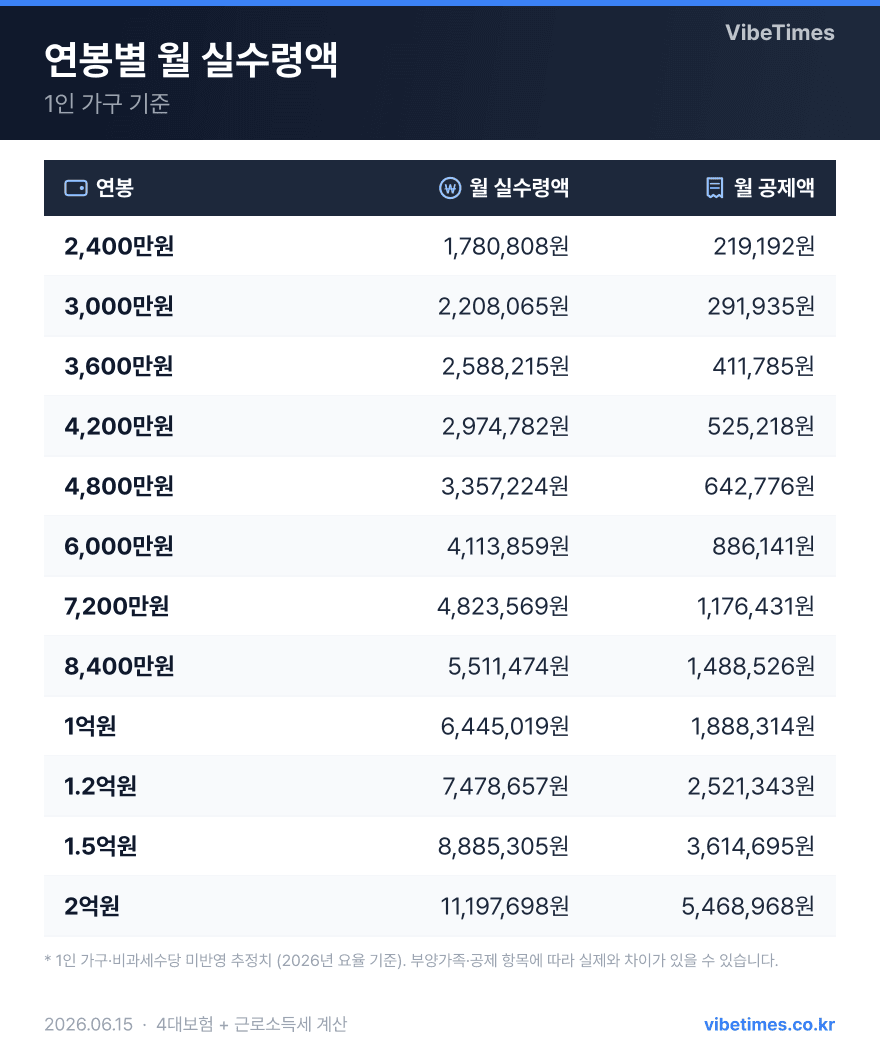
Detailed Analysis of Net Income and Deductions by Annual Salary
As of June 15, 2026, a detailed analysis of monthly net income by annual salary bracket, along with deductions for four major insurances and income tax, reveals that while net income increases with higher earnings, the amount of deductions also rises sharply. This suggests that the burden of taxes and social insurance premiums effectively grows for higher earners. For example, at an annual salary of 24 million won, the monthly net income is approximately 1.78 million won. However, when the annual salary jumps to 100 million won, monthly net income nearly quadruples to about 6.44 million won, while deductions for the four major insurances and taxes exceed 1 million won.
Increasing Deduction Patterns by Income Bracket
Looking at specifics, for annual salaries ranging from 24 million won to 42 million won, monthly net income increases by about 1.19 million won, while deductions for the four major insurances and taxes rise relatively moderately, between approximately 160,000 and 220,000 won. However, the pace of deduction increases becomes noticeable once the annual salary exceeds 48 million won. At an annual salary of 48 million won, monthly net income is about 3.35 million won, with deductions around 640,000 won. This figure climbs steeply, with deductions increasing by roughly 200,000 to 300,000 won for annual salaries of 60 million won (monthly net income 4.11 million won, deductions 880,000 won) and 72 million won (monthly net income 4.82 million won, deductions 1.17 million won).
The increase in deductions accelerates significantly from the point where annual income surpasses 100 million won. Between the 84 million won and 100 million won annual salary brackets, monthly net income rises by about 930,000 won, while deductions increase by approximately 330,000 won. This is due to the higher income tax burden as tax brackets increase. At an annual salary of 120 million won, monthly net income increases by about 1.03 million won, while deductions rise by approximately 550,000 won, meaning the proportion of deductions to the net income increase becomes even larger. In the 150 million won annual salary bracket, monthly net income increased by about 1.4 million won, but deductions rose by about 810,000 won, clearly showing a trend where the deduction growth rate outpaces the net income growth rate for higher earnings.
Slowing Net Income Growth for High Earners and Implications
Looking at the highest bracket, an annual salary of 200 million won, the monthly net income is approximately 11.2 million won, with deductions for the four major insurances and taxes reaching about 1.57 million won. Compared to the 150 million won annual salary bracket, monthly net income increased by about 2.3 million won, but deductions rose by approximately 670,000 won, a relatively larger increase. This is because the progressive income tax system imposes a heavier tax burden on additional income earned in higher income brackets. This pattern acts as a factor that slows the actual growth rate of disposable income.
This data offers significant implications for personal financial planning. Particularly, when annual income rises above certain thresholds, it is crucial to realistically estimate expected net income, considering the sharply increasing burden of taxes and four major insurance premiums. Furthermore, for high-income brackets, tax-saving strategies and sound asset management become even more essential for ensuring financial health. This directly impacts not only personal spending power but also the scale of funds available for investment.
Conclusion: The Gap Between Income Growth and Net Income
In conclusion, this analysis clearly demonstrates that an increase in annual salary does not necessarily lead to a proportional increase in actual net income. Especially for higher earners, not only the absolute amount of four major insurance premiums and taxes deducted but also the deduction ratio relative to income tend to increase. This aligns with policy objectives to promote income redistribution and ensure national fiscal stability. However, from an individual's perspective, it is paramount to recognize the gap between the expectation of wealth accumulation and improved living standards through increased income, and the actual net income growth, and to establish realistic economic activity plans based on this understanding.