Analysis of Top 5 US-Listed Companies by Net Profit

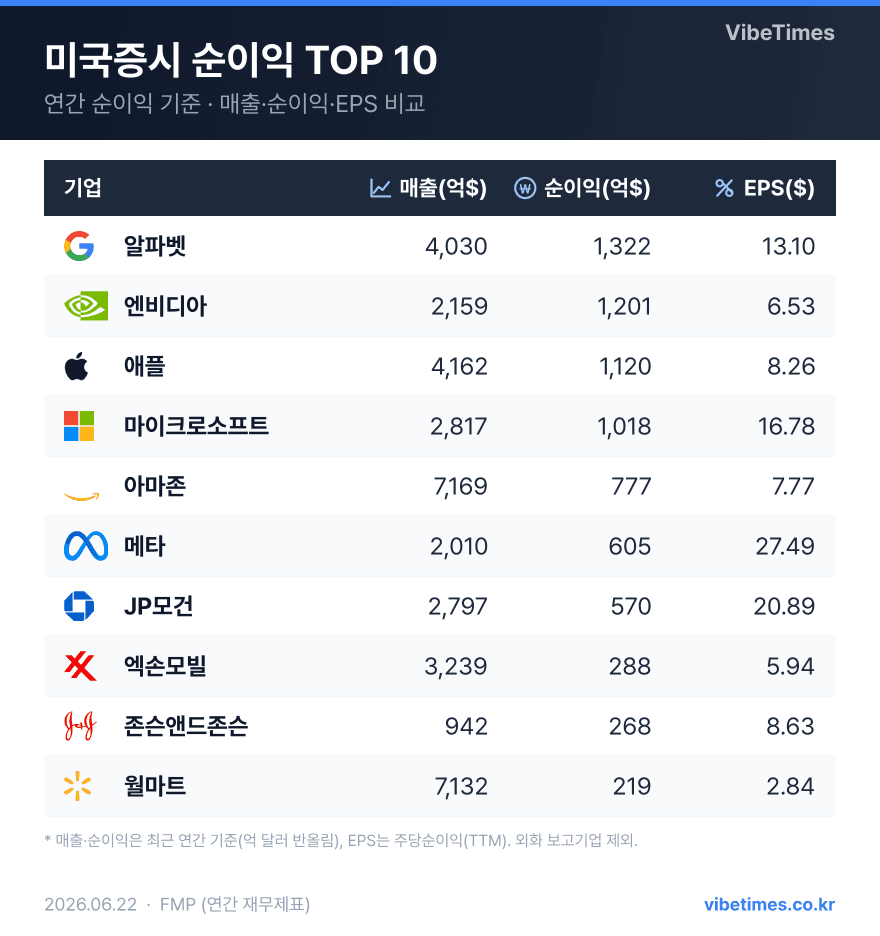
Analysis of Top US-Listed Companies by Net Profit: Tech Giants' Dominance and Resilience of Finance & Consumer Goods
As of June 22, 2026, the net profit performance of US-listed companies showcases a striking outcome with the dazzling achievements of cutting-edge technology firms and the steady profitability of traditional industrial powerhouses. This analysis is based on data from the top 10 companies by net profit, offering an in-depth interpretation of each company's financial performance and a multifaceted view of their market impact. Notably, while Big Tech companies like Alphabet, Nvidia, and Apple have dominated the top ranks, the finance and consumer goods sectors have also made their presence felt with robust results.
The most noteworthy trend is that the top tier of net profit is increasingly dominated by technology companies. Alphabet (GOOGL) leads the pack with an astounding net profit of $132.2 billion and a market capitalization of $4.49 trillion. This success is driven by its overwhelming platform influence, advertising revenue, and continuous growth in cloud services. Following closely, Nvidia (NVDA) achieved a net profit of $120.1 billion, underscoring the might of tech stocks with its market cap reaching $5.10 trillion. Nvidia, in particular, has spearheaded explosive growth by dominating the Artificial Intelligence (AI) chip market. Apple (AAPL) also demonstrated its enduring strength with a net profit of $112 billion and a market cap of $4.38 trillion. Microsoft (MSFT) recorded $101.8 billion in net profit, and Amazon (AMZN) posted $77.7 billion, securing the top five spots exclusively for tech companies. This clearly illustrates the immense economic value generated by digital transformation and AI technologies in the modern economy. The revenue figures for these companies are also astronomical, with Amazon reaching $716.9 billion, Apple $416.2 billion, and Alphabet $403 billion. This suggests that these companies are not merely highly profitable but have also built colossal revenue pipelines based on their market dominance.
Key Analysis: Overwhelming Profit Margins and Divergent Growth Drivers
A detailed look at the financial indicators of the top-ranking companies reveals a competitive edge that goes beyond mere economies of scale. Nvidia's net profit margin is particularly striking. With $215.9 billion in revenue and $120.1 billion in net profit, it achieved an incredible net profit margin of approximately 55.6%. This is attributed to its monopolistic position in the AI semiconductor market and high technological barriers to entry. In contrast, Alphabet and Apple, with revenues of $403 billion and $416.2 billion respectively, reported net profits of $132.2 billion and $112 billion, yielding net profit margins of about 32.8% and 26.9%. Their profits stem from diversified revenue sources, including advertising, services, and hardware sales, underpinned by extensive user bases. Microsoft also demonstrated a high profit margin of approximately 36.1% with $101.8 billion in net profit on $281.7 billion in revenue, a result of strong synergy between its cloud services (Azure) and enterprise software (Office 365).
The performance of non-tech companies within the top 10 net profit earners is also noteworthy. JP Morgan (JPM) ranked seventh, recording a net profit of $57 billion on $279.7 billion in revenue, achieving a net profit margin of approximately 20.4%. This is interpreted as a result of robust performance in core financial services and investment banking, even amidst fluctuating interest rate environments and market volatility. ExxonMobil (XOM) posted a net profit of $28.8 billion on $323.9 billion in revenue, with an 8.9% profit margin. This reflects stable production and operational efficiency, while earnings are directly influenced by global energy demand and crude oil price fluctuations. Walmart (WMT) recorded an impressive revenue of $713.2 billion, ranking among the top, but its net profit was $21.9 billion, yielding a profit margin of about 3.1%. This highlights the characteristic profit margin structure of a 'sell low, sell often' strategy and the burden of fixed costs associated with a massive retail network.
Earnings Per Share (EPS) is a crucial metric for understanding a company's profitability relative to its number of outstanding shares and its connection to shareholder value. In this ranking, Meta (META) garnered market attention by reporting the highest EPS at $27.49, despite a net profit of $60.5 billion. This signifies that the company achieved a high net profit with a relatively smaller number of shares outstanding, which can be interpreted in conjunction with shareholder value enhancement efforts such as shareholder return policies or share buybacks. Microsoft also proved its efficient operations and high profitability by recording a high EPS of $16.78. Alphabet reported an EPS of $13.10, and Apple $8.26. JP Morgan recorded a high EPS of $20.89 among financial institutions.
Market and Industry Impact: Strengthening Tech Hegemony and Reshaping Traditional Industries
The results of this ranking clearly show that technology companies are further solidifying their grip on the global economy. Particularly, the development and proliferation of AI technology have provided unprecedented growth opportunities for companies like Nvidia, creating ripple effects across the semiconductor industry and its entire ecosystem. Alphabet's strong net profit indicates sustained growth through innovation in search, advertising, cloud, and AI research. Apple maintains a stable profit structure through the growth of its services segment alongside hardware sales, while Microsoft is reinforcing its position as a leader in the enterprise IT market, leveraging the rapid growth of its cloud services.
The success of these tech giants has a profound impact on other industries. Walmart, a traditional consumer goods company, entering the top 10 with $713.2 billion in revenue demonstrates the continued importance of large retailers, coupled with the growth of the e-commerce market. However, its relatively low net profit margin suggests the need for strategic considerations to improve profitability. Oil company ExxonMobil's net profit once again highlighted its sensitivity to macroeconomic variables such as global energy prices and energy transition policies.
JP Morgan, in the financial sector, secured a spot in the top 10, showcasing its stable profit-generating capabilities even amid recession concerns. This implies that major banks are maintaining solid performance based on their core business competencies, despite changes in US Federal Reserve monetary policy and financial market uncertainties. However, the pace of net profit growth lags behind the explosive growth demonstrated by tech companies. This suggests that investors may need to balance growth potential in tech companies with the stability of traditional industries in their strategies going forward.
Outlook: Continued AI Era and the Search for New Growth Engines
The future trend of net profits for US-listed companies is expected to be closely tied to the pace of AI technology development. Companies like Nvidia, which specialize in AI semiconductors, as well as those successfully integrating AI into their services (such as Alphabet, Microsoft, and Meta), are likely to maintain robust performance for the foreseeable future. In particular, the emergence of new AI-based services or products holds the potential to reshape market landscapes. Alphabet's integration of AI into its search engine and cloud services to strengthen its competitive edge, and Microsoft's approach to targeting the enterprise market with AI-powered collaboration tools, exemplify this trend.
However, excessive valuations and regulatory risks could act as brakes on the upward trajectory of tech companies. Furthermore, as discussions deepen regarding the social and economic impacts of AI advancement, it is possible that supervision and regulation on related companies could intensify.
The finance and consumer goods sectors may experience increased volatility depending on economic cycles. Financial institutions like JP Morgan will be more sensitive to changes in the interest rate environment, while energy companies like ExxonMobil will see their earnings influenced by global geopolitical risks and the speed of energy transition policies. Retail companies like Walmart will face the challenge of managing profitability while responding to changes in consumer sentiment and inflationary pressures. Overall, as the innovation drive of tech companies continues, risk management tailored to each industry's characteristics and the discovery of new growth engines are expected to be decisive factors for future net profits and market positions. Investors should conduct thorough analysis of individual companies' intrinsic value and industry trends to make prudent investment decisions at this juncture.