National Assembly Data Analysis: Democratic Party's Min Hong-chul and People Power Party's Kwak Kyu-taek Show Legislative Behavior Diverging from Party Averages

Lawmakers Defying Party Averages
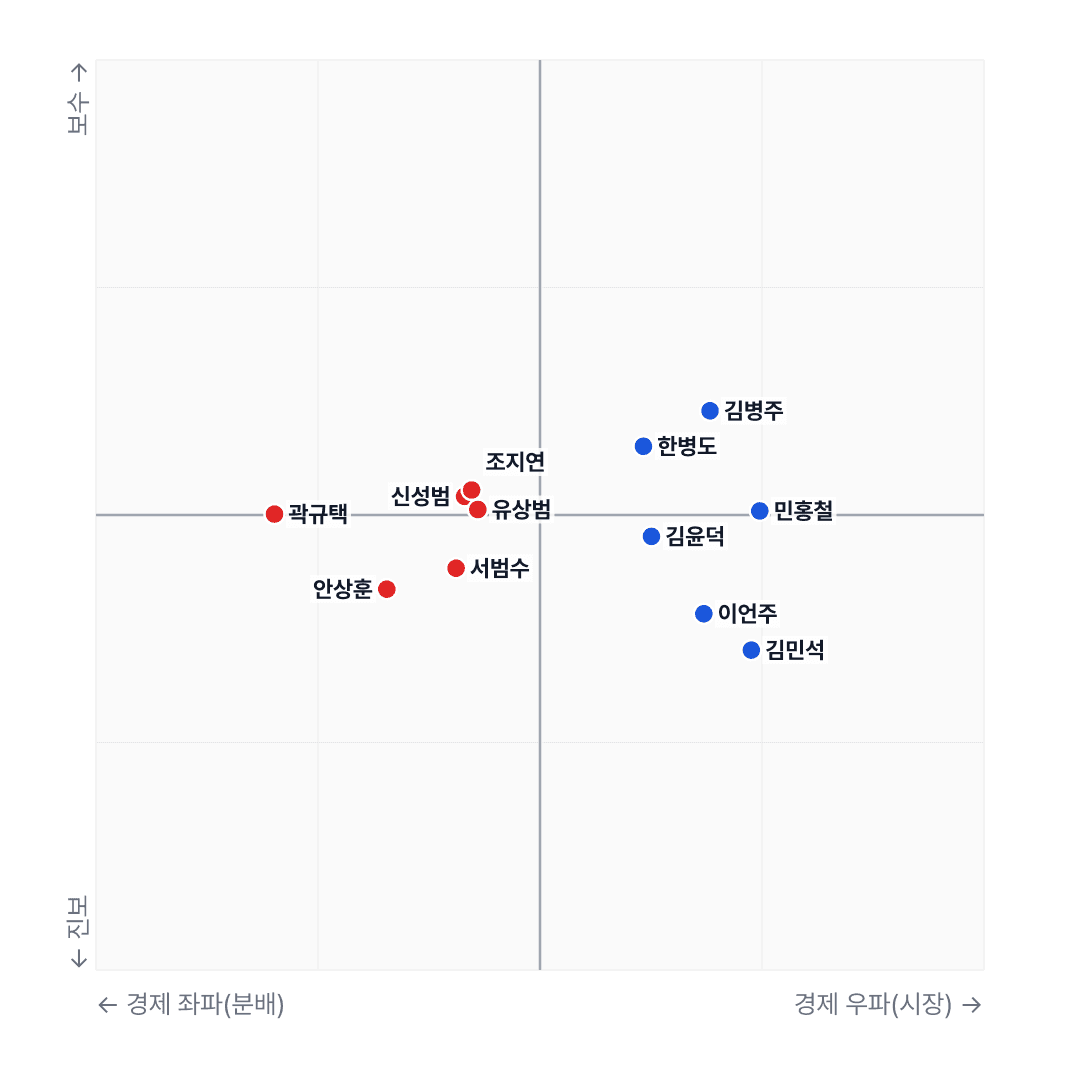
A quantitative analysis of individual lawmakers' bill proposals and voting records has confirmed the presence of legislators in both parties whose ideological coordinates differ from the overall tendencies of their affiliated parties. Ideological coordinates were calculated along two axes—economic and social—by analyzing bill content, and then centering the data on the midpoint between the Democratic Party and the People Power Party. More significant than the raw coordinates themselves is the relative distance from fellow party members.
Among Democratic Party lawmakers, six instances of distinctly right-leaning behavior were observed on economic issues. Rep. Min Hong-chul, while aligning with the party average on social issues, positioned himself significantly to the right of the Democratic Party average in the economic sphere. Rep. Kim Min-seok presents an exceptional case, showing right-leaning economic tendencies while maintaining a conservative stance on social issues. Reps. Kim Byeong-ju, Lee Eon-ju, Kim Yun-deok, and Han Byeong-do also exhibited a clear gap from the party average on the economic axis.
Conversely, divergent behavior in the opposite direction was observed within the People Power Party. Rep. Kwak Kyu-taek, close to the party center on social issues, recorded strong left-leaning behavior on economic issues, positioning him further left than even the Democratic Party average—a standout figure among his party colleagues. Rep. Ahn Sang-hoon also leaned left on the economic axis and was somewhat more moderate on the social axis compared to the conservative average. Reps. Seo Beom-soo, Shin Sung-beom, Jo Gi-yeon, and Yu Sang-beom also appeared centrist or center-left in the economic field.
The Roots of the Divide
In parliamentary politics, a lawmaker's legislative behavior is not determined solely by their party's platform. The industrial structure of their constituency is the first variable. Lawmakers from districts with a high concentration of manufacturing and self-employed businesses tend to support bills for deregulation or tax cuts, regardless of party lines. Rep. Min Hong-chul’s record of repeatedly proposing bills to improve regulations for SMEs aligns with his right-of-center economic coordinates.
The second factor is the composition of standing committees. Lawmakers active in the Trade, Industry and Energy Committee or the Land and Infrastructure Committee have more opportunities to reflect the voices of the industries they oversee in their legislation. As the frequency of sponsoring business-friendly bills increases, their economic coordinates naturally shift to the right. Conversely, when People Power Party lawmakers jointly co-sponsor bills protecting workers or relieving the burden on the working class, their coordinates are pulled to the left. This can be interpreted not as an ideological shift, but as a reflection of the interests related to their committee’s jurisdiction.
The third factor is cross-pressure. When the demands of the party leadership for votes conflict with the interests demanded by constituents, some lawmakers adopt a strategy of following the party in votes while reflecting their district's tendencies in bill proposals. In such cases, if one looks only at coordinates based on proposal records, they may appear to deviate significantly from the party average.
Potential Conflicts of Interest and Data Limitations
A point requiring close scrutiny is the overlap between the industries overseen by a lawmaker’s standing committee and their personal financial interests. When a lawmaker holding specific industry stocks, as disclosed in public asset reports, proposes a deregulation bill favorable to that industry, it is recorded as economically right-leaning. While this is not illegal, and asset growth after election may simply be the result of investment management, there remains a clear factual interest for voters to know: the potential for financial entanglement between the overseer and the industry being overseen. Since similar bill behavior favoring specific industry interests is observed on the opposite side of the aisle, this issue should be addressed as a task for checking the entire institution rather than targeting a specific party.
Implications of the 'Deviating' Lawmakers
The key finding overall is that the internal ideological spectrum of both parties is wider than commonly perceived. The fact that lawmakers who deviated on the economic axis often remained close to the party center on the social axis suggests that this deviation is a selective distancing on specific issues rather than a wholesale ideological defection. These lawmakers have the potential to serve as substantive negotiation channels when bipartisan cooperation is required.
However, as these coordinates reflect only official records of proposals and votes, there is a limitation that they may differ from media statements or public image. Since the act of putting one's name on a bill often includes promotional purposes, there is also a possibility that they are measured as more moderate than their actual ideology. Quantitative data holds the greatest value when used as a starting point to verify conventional wisdom, rather than as the final yardstick for evaluating lawmakers.
Lawmakers Mentioned in the Article
| Lawmaker | Party | Ideological Tendency | Notes |
|---|---|---|---|
| Min Hong-chul | Democratic Party | Economic Right · Social Conservative | Contrary to Party Line |
| Kim Min-seok | Democratic Party | Economic Right · Social Progressive | Contrary to Party Line |
| Kim Byeong-ju | Democratic Party | Economic Right · Social Conservative | Contrary to Party Line |
| Lee Eon-ju | Democratic Party | Economic Right · Social Progressive | Contrary to Party Line |
| Kim Yun-deok | Democratic Party | Economic Right · Social Progressive | Contrary to Party Line |
| Han Byeong-do | Democratic Party | Economic Right · Social Conservative | Contrary to Party Line |
| Kwak Kyu-taek | People Power Party | Economic Left · Social Conservative | Contrary to Party Line |
| Ahn Sang-hoon | People Power Party | Economic Left · Social Progressive | Contrary to Party Line |
| Seo Beom-soo | People Power Party | Economic Left · Social Progressive | Contrary to Party Line |
| Shin Sung-beom | People Power Party | Economic Left · Social Conservative | Contrary to Party Line |
| Jo Gi-yeon | People Power Party | Economic Left · Social Conservative | Contrary to Party Line |
| Yu Sang-beom | People Power Party | Economic Left · Social Conservative | Contrary to Party Line |