Administration and Security Committee Leads with 2,454 Bills… Analysis of Legislative Rankings by National Assembly Committee

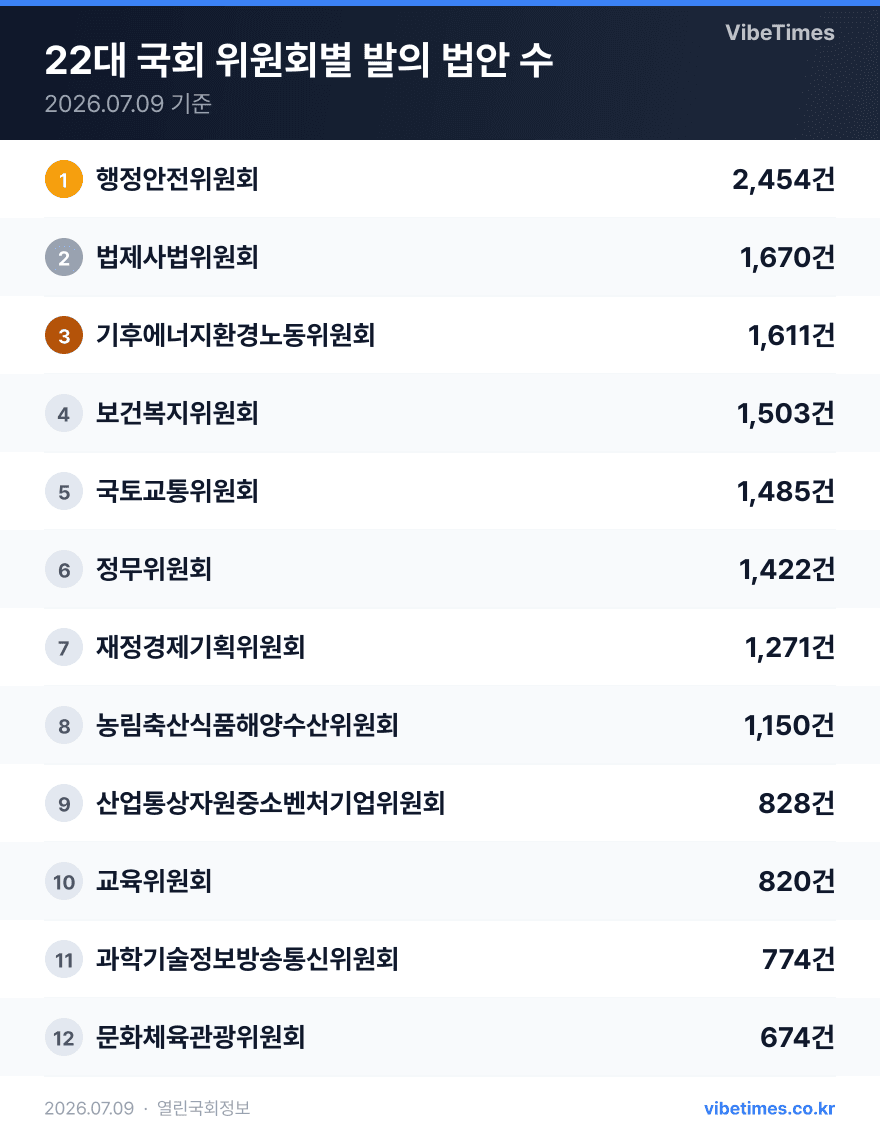
Admin & Security Committee Overwhelming No. 1… Surge in Livelihood and Administrative Issues
As of July 9, 2026, the Administration and Security Committee has claimed a overwhelming No. 1 spot in the status of bill proposals by standing committees of the National Assembly, with 2,454 bills. Compared to the Legislation and Judiciary Committee in second place with 1,670 bills, this represents a staggering gap of 784 bills. This demonstrates a distinct structural characteristic where legislative activity in the top tier of the overall rankings is concentrated in specific fields.
The background for the surge in bill proposals by the Administration and Security Committee is attributed to the broad inclusion of administrative issues directly connected to the public's daily lives, such as local government operation, public service personnel administration, and disaster and safety management. This is interpreted as the result of the continuous accumulation of demands for the enactment and revision of individual laws in the process of legislating diverse social demands. Ultimately, it can be analyzed that there is significant legislative demand for refining the basic framework of state operation, such as administrative cooperation between the central government and local governments and the construction of safety nets.
Fierce Competition for 2nd to 6th Places… Rivalry in Livelihood Legislation including Welfare, Land, and Politics
The middle to upper ranks, from 2nd to 6th place, are showing fierce competition around the 1,400-bill mark. Following the Legislation and Judiciary Committee (1,670 bills), the Climate, Energy, Environment, and Labor Committee recorded 1,611 bills, and the Health and Welfare Committee recorded 1,503 bills. The Land, Infrastructure and Transport Committee (1,485 bills) and the Political Affairs Committee (1,422 bills) also produced similar volumes of legislation.
This concentration phenomenon clearly indicates where the core agendas that a modern state must address lie. In the case of the Climate, Energy, Environment, and Labor Committee, the global carbon neutrality trend and structural changes in the labor market are interlocking, requiring a new institutional framework. The Health and Welfare Committee is seeing active discussions on pension and medical system reforms due to the progress of an aging society, while the Land, Infrastructure and Transport Committee is also facing ceaseless issues related to housing supply and transportation infrastructure expansion that directly affect the public. The Political Affairs Committee also appears to be translating multifaceted discussions on financial consumer protection and capital market system advancement into bill proposals.
Polarization in Lower Ranks and Implications of Delay in Industry-Specific Legislation
Meanwhile, the rankings of committees directly connected to industry and future strategy are relatively low. The Planning and Finance Committee ranked 7th with 1,271 bills, but the following Agriculture, Forestry, Livestock, Food, Marine and Fisheries Committee stayed in the late 1,000s with 1,150 bills. A particularly noticeable part is the 828 bills of the Industry, Trade, Energy, SMEs and Startups Committee in 9th place. Despite being in charge of industry trade and SME support as well as venture ecosystem creation—which are key drivers of the economy—this figure fails to reach even half that of the Health and Welfare Committee.
The Education Committee ranked 10th with 820 bills, and the Science, ICT, Broadcasting, and Communications Committee ranked 11th with 774 bills. The Culture, Sports and Tourism Committee remained at the bottom among the 12 standing committees with 674 bills. While the number of proposed bills does not immediately signify the importance of the industry, there is a clear gap in terms of the speed of legal backing. To secure new growth engines such as artificial intelligence, bio, and cultural content, proactive institutional reform is essential at this point. However, the fact that the legislative momentum of the Science, ICT, Broadcasting, and Communications Committee and the Culture, Sports and Tourism Committee, which oversee these areas, is significantly lacking raises concerns that this could act as a factor delaying the strengthening of industrial competitiveness.
The phenomenon where the National Assembly's legislative energy is concentrated on livelihood welfare and the construction of administrative safety nets suggests the construction of a desirable social safety net. However, it simultaneously exposes the structural limitation that the institutional foundations for technology and industrial sectors, which must guarantee the nation's future competitiveness, are relatively delayed. How the center of gravity in bill proposals is readjusted is expected to become a key variable determining the sustainable growth of the national economy in the future.