National Assembly Data Analysis: Democratic Party Scores 63 on Ideology Index, Centrist…Individuals Polarized Between Progressive and Conservative

The Disconnect Between Progressive Labels and Statistical Centrism
A data analysis quantifying the voting records and bill sponsorships of the 152 lawmakers belonging to the Democratic Party of Korea reveals that the party’s overall political leaning appears nearly centrist. In a numerical synthesis covering economic and social issues, the party-wide average was calculated at 63 out of 100. This result stands at some variance from the popular perception that the party is relatively progressive compared to the opposition. On internal gauges of ideological positioning, the party as a whole exhibited a moderate stance that did not stray far from the center axis in either the economic or social sectors. Notably, the party displayed a duality: showing slight pro-union and redistributive tendencies in the economic field while maintaining a conservative attitude in the social sector, seemingly mindful of popular voter sentiment.
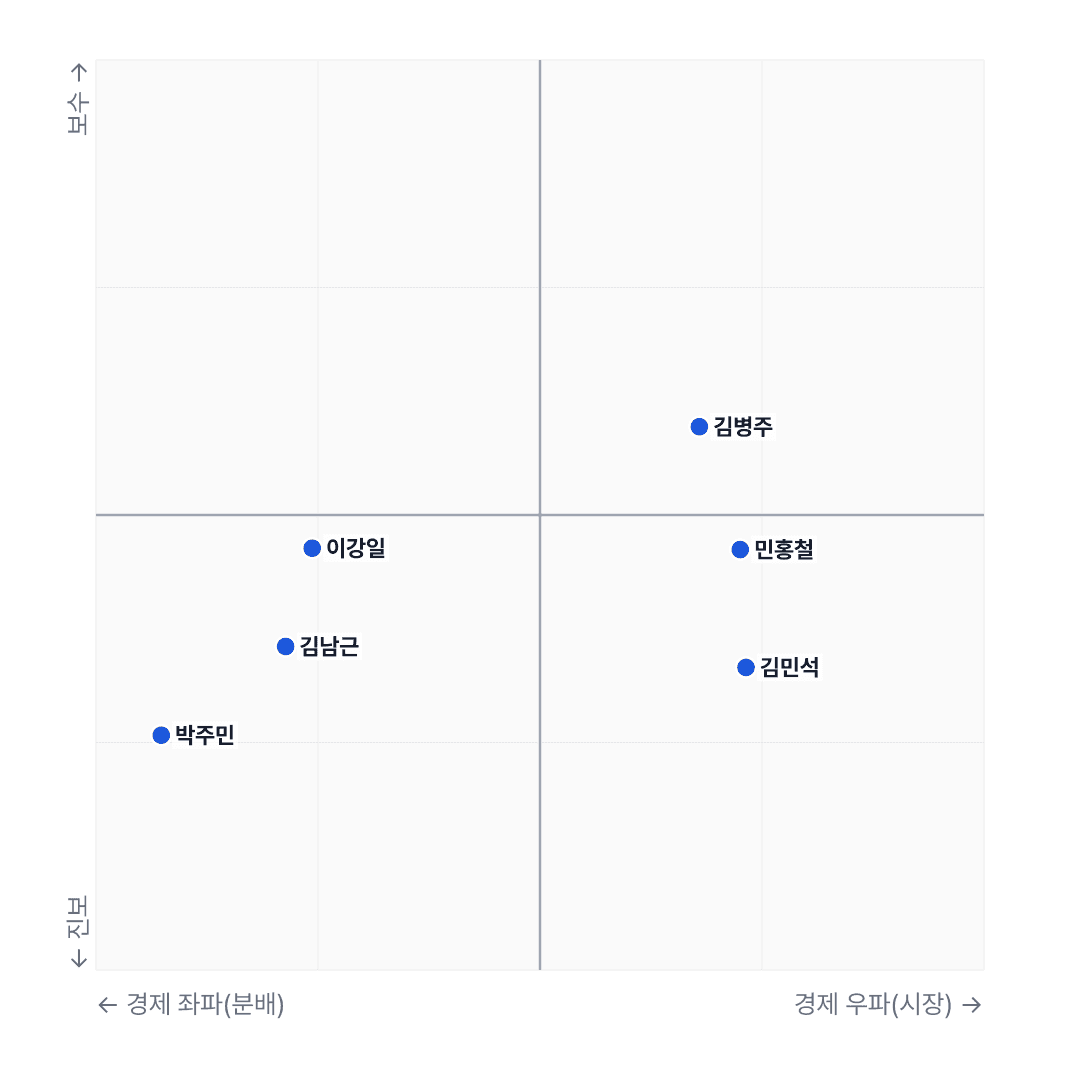
Of particular interest is the political interpretation offered by the ideological coordinates of individual lawmakers. The four lawmakers identified as belonging to the most progressive axis within the party are Park Joo-min, Kim Nam-geun, Lee Gang-il, and Baek Seung-ah. Their positions in bill sponsorship and voting processes were distinctly to the left of the Democratic Party average, indicating a strong advocacy for labor rights and wealth redistribution. In contrast, lawmakers such as Kim Min-seok, Min Hong-cheol, Kim Byeong-ju, and Lee Eon-ju exhibited clear conservative leanings that surpassed the Democratic Party average. Their voting patterns on economic and incident-related bills were right-wing enough to approach the average of the opposition People Power Party. Ultimately, this serves as quantitative proof that the labels of progressive and conservative arbitrarily defined by the media or within party primaries often diverge from the objective trajectory drawn by actual voting data.
The Significance of 1% Deviation from Party Lines and Conflicts of Interest in Small Industries
Analyzing the behavior of lawmakers who do not follow the party leadership’s guidelines offers a glimpse into the cross-pressures of politics. The lawmakers with the highest rates of deviation from the party line are Lee Kwang-jae, Park Seon-won, Park Hong-bae, and Lee So-young. These four violated the party line in only the 1% range, an extremely marginal proportion of total votes. While superficially summarized by an overwhelming adherence to party lines of over 98%, the fact that these few dissenting votes were concentrated on bills regarding deregulation or the expansion of labor flexibility demands deeper interpretation. Even if they agree with the overall policy direction, this can be analyzed as a rational action to represent the interests of their extraparliamentary constituencies or support bases when specific industries are involved.
This behavior points to the intersection where political voting directly leads to potential conflicts of interest. Despite the fundamental limitations of quantitative analysis based solely on bill sponsorship and voting data, the consistent attitude shown by certain lawmakers in industries overseen by their standing committees is noteworthy. For instance, public data confirms that some lawmakers belonging to the Standing Committees on Finance, Economy, or Trade, Industry and Energy hold a significant number of stocks directly linked to regulated industries or receive high-level donations from investors in those sectors. While this does not prove legal violations or corruption, it inevitably invites critical scrutiny regarding the intersection of public decision-making authority and private financial interests for representatives of the electorate. This is because there remains a concern that a politician’s voting behavior could be thoroughly transformed into a means of maximizing personal gain.
The Impact of Centrist Pragmatism on the Upcoming General Election
The disparity between public perception and actual legislative activity data is expected to serve as a significant variable in the future electoral landscape. The fact that the mainstream lawmakers, who hold a majority of the Democratic Party seats, mostly maintain a moderate centrist economic stance is interpreted as a sophisticated strategic calculation to absorb the votes of the middle class and conservative-leaning voters. This assessment is rooted in the belief that if the distinct progressive policies demanded by the party’s hardline supporters are consistently reflected in bill voting, the party cannot afford the loss of the centrist bloc. Consequently, on key economic issues such as labor law reforms that modify Supreme Court rulings or tax hikes for the wealthy, the party leadership is likely to favor gradual and pragmatic compromises over radical changes.
There is a clear limitation that this sample analysis is produced based on restricted behaviors such as bill sponsorship and voting. This is because the political alliances, statements, and messages delivered through media interviews outside the plenary session are not fully reflected in these figures. It must be noted that, unlike the macro political image presented to the public, the micro data derives results solely by tracking the fingerprints left on bills. Yet, as the ideological coordinates clearly indicate, if the axis supporting the ruling party is settled far more conservatively than expected, the nature of economic-related bills passing through the National Assembly in the future is likely to be colored with a market-friendly hue. This will ultimately serve as a key indicator directly influencing the corporate investment environment and the volatility of the capital market.
Lawmakers Mentioned in the Article
| Lawmaker | Party | Ideological Leanings | Notes |
|---|---|---|---|
| Park Joo-min | Democratic Party of Korea | Economic Leftist · Social Progressive | In-party Left |
| Kim Nam-geun | Democratic Party of Korea | Economic Leftist · Social Progressive | In-party Left |
| Lee Gang-il | Democratic Party of Korea | Economic Leftist · Social Progressive | In-party Left |
| Kim Byeong-ju | Democratic Party of Korea | Economic Rightist · Social Conservative | In-party Right |
| Min Hong-cheol | Democratic Party of Korea | Economic Rightist · Social Progressive | In-party Right |
| Kim Min-seok | Democratic Party of Korea | Economic Rightist · Social Progressive | In-party Right |