Analysis of Actual Take-Home Pay and Insurance/Tax Deductions by Salary Bracket, from 24 Million to 48 Million Won

Tax Burden and Minimum Take-Home Pay for Ultra-Low Income Earners
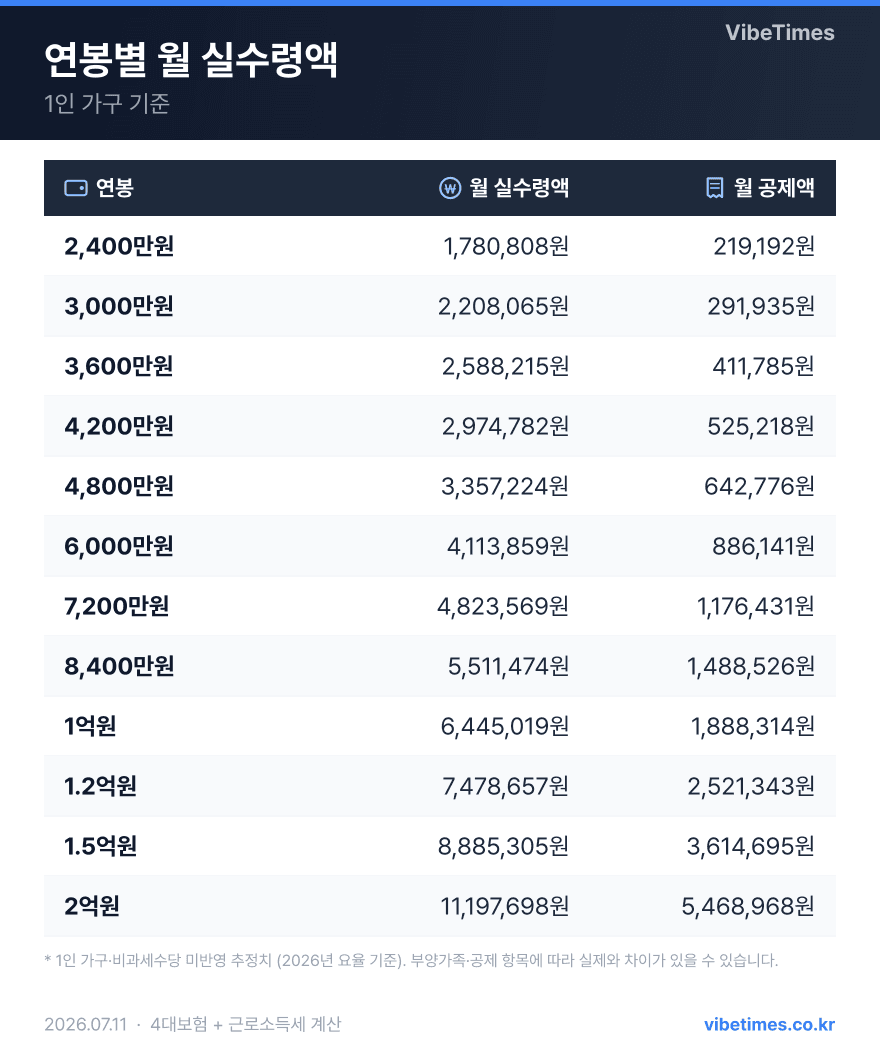
For a worker earning an annual salary of 24 million won, the monthly take-home pay comes to 1,780,808 won. From the monthly salary, 188,082 won is deducted for the four major insurances, and 31,111 won is deducted for taxes such as income tax. In lower nominal income brackets, the burden of mandatory social insurance premiums accounts for a significantly larger proportion than taxes. This suggests that the four major insurance premium rates are just as critical a variable as the tax rate schedules in determining the disposable income of workers.
If the annual salary rises to 30 million won, the take-home pay increases to 2,208,065 won. Examining the deductions, the four major insurance premiums amount to 235,102 won, while taxes total 56,833 won. Although the nominal wage rises by 25% compared to the 24 million won level, the actual take-home pay increases by only about 23.9%. A phenomenon begins where the progressive tax rate and rising insurance premium assessment standards, which increase with income, suppress the growth rate of what actually goes into the worker's pocket.
Deepening Deduction Rates and Squeezed Disposable Income in Middle-Income Brackets
In the 36 million won annual salary bracket, the monthly take-home pay is 2,588,215 won, with payments of 282,122 won for the four major insurances and 129,663 won in taxes. At an annual salary of 42 million won, the monthly take-home pay is confirmed at 2,974,782 won; here, the tax deduction surges to 196,075 won, reaching 60% of the 329,143 won insurance premiums. Upon reaching the 48 million won mark, the worker receives 3,357,224 won monthly and pays 266,613 won in taxes. This marks a turning point where the pace of increase in tax burden begins to overtake the pace of increase in social security insurance premiums.
This trend becomes even more pronounced in the 60 million won annual salary bracket. Workers receive a monthly take-home pay of 4,113,859 won, with 470,204 won deducted for the four major insurances and 415,938 won for taxes. As the gap between tax and insurance deductions narrows significantly, the marginal utility of disposable income gradually decreases. By the time the annual salary reaches 72 million won, the tax burden hits 612,187 won against a monthly take-home pay of 4,823,569 won, finally seeing the tax deduction amount overtake the 564,245 won insurance premiums.
Progressive Tax Effects for High-Income Earners and Analysis of Post-Tax Income Growth Rates
The effect of progressive taxation becomes quantified in earnest starting from the over 84 million won bracket. A worker earning 100 million won annually has a monthly take-home pay of 6,445,019 won. They pay a high monthly tax of 1,192,991 won, showing a state where the tax burden is significantly greater than the 695,323 won in insurance premiums. Upon reaching 120 million won, the tax expenditure rises to 1,744,286 won against a take-home pay of 7,478,657 won. The intuitive reason that a doubling of income does not result in a proportional increase in take-home pay lies precisely in these accumulated tax deductions.
An analysis of the gap between the 150 million won and 200 million won brackets clearly illustrates the end of this income redistribution structure. A worker earning 150 million won records a monthly take-home pay of 8,885,305 won and pays 2,715,036 won in taxes. Conversely, if the income rises by 50 million won to 200 million won, the take-home pay only reaches 11,197,698 won. In this bracket, a whopping 4,364,972 won in taxes and 1,103,996 won in insurance premiums are deducted. The tax authority's collection rate relative to the nominal wage increase accelerates sharply, indicating that the marginal tax burden in the ultra-high-income bracket will significantly limit the increase in actual take-home pay.
Given the progressive tax structure on earned income, excess taxes increase non-linearly as income class rises, so projecting household cash flow based solely on nominal salary hikes is dangerous. Actual consumption capacity should be evaluated based on post-tax take-home pay.
Ultimately, converting a nominal salary increase into actual purchasing power gains is essential rather than relying on absolute figures. In middle-income brackets, the burden of social insurance premiums must be considered, while in high-income brackets, tax expenditures due to progressive rates are key variables. Workers need to closely reflect these changing deduction rate trends when negotiating salaries or deciding to change jobs, recalibrating their financial planning and the actual amount of money entering their accounts.