National Assembly Data Analysis: Political Implications Revealed by Legislative Data

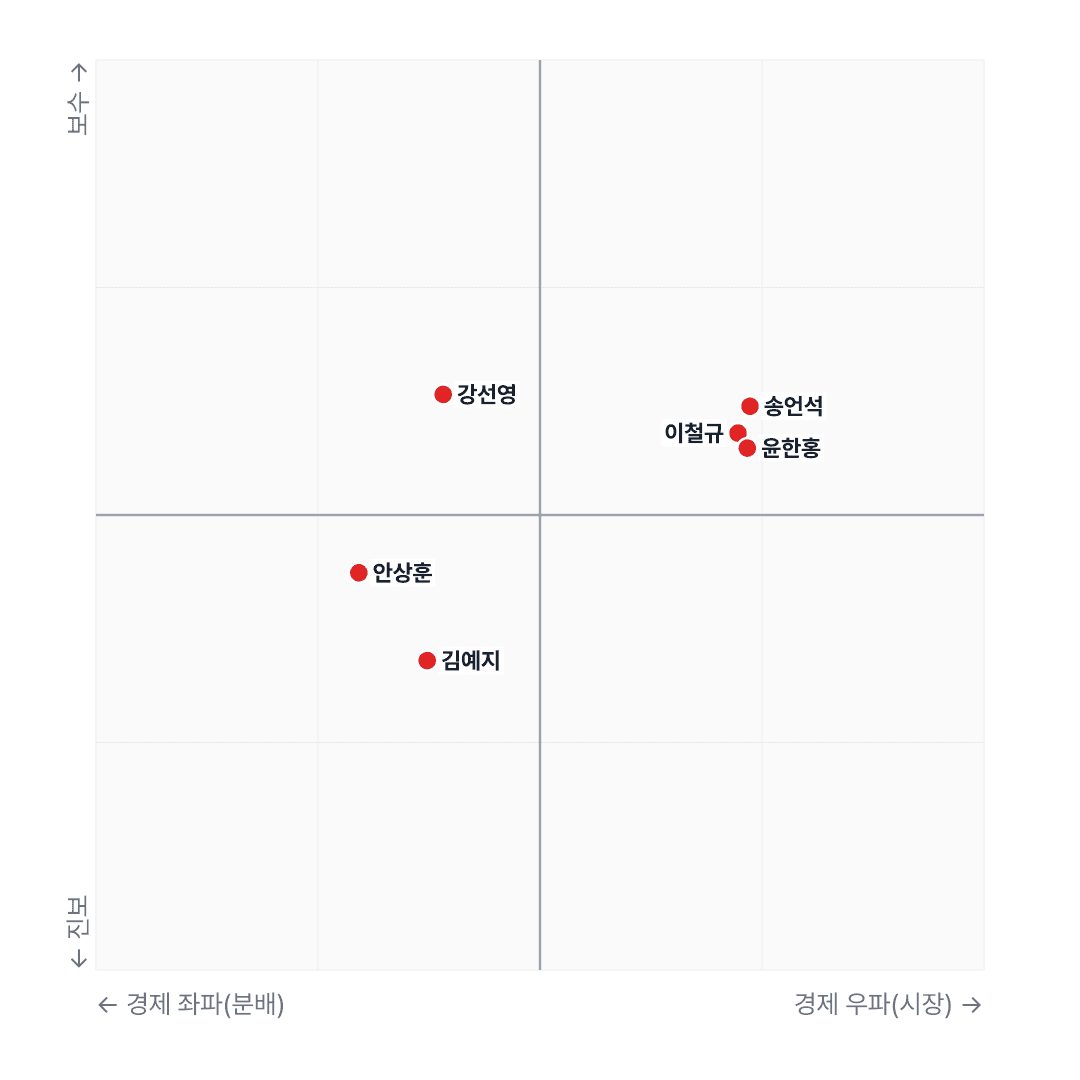
Core of the PPP's Ideological Landscape: Intra-Party 'Temperature Gap' Over a Slight Rightward Shift
An analysis of the ideological leanings of 105 People Power Party (PPP) lawmakers, based on the content of bills they sponsored and voted on, reveals indicators for the main opposition party that differ somewhat from public perception. While the overall average shows a conservative leaning in both economic and social issues, the absolute values are positioned very close to the center. Calculated by calibrating the two major parties to a zero point, these indices suggest that the bill activities of the conservative party are maintaining a practical and center-right trajectory rather than an extreme right-wing line. This phenomenon is interpreted to mean that legislative activities, such as bill sponsorship, are conducted while reflecting broad public sentiment. In particular, given the nature of the quantitative indices derived based on bill sponsorship and voting behavior, it is necessary to acknowledge the limitation that there may be subtle discrepancies from the lawmakers' macroscopic public image.
A Conservative Cabinet Without Fracture… The Intersection of Economic Interests and Social Conservatism
An intriguing point is the 'temperature gap' within the party's landscape across economic and social sectors. According to the data, within the PPP, the divergence in economic倾向 between the two parties tended to be wider than that in social倾向. While there exists a relatively diverse spectrum in the economic sector regarding market intervention or deregulation, political behavior shows a relatively convergent attitude on social issues. This implies that a complex dynamic is at work within the conservative camp, where pragmatic and ideological approaches coexist regarding economic policy direction. Figures derived by calculating the weighted average of bill contents analyzed via deep learning technology accurately reflect the reality where opinions diverge even among party officials.
Deviations from Party Lines and Stances Defying Convention… The Actions of Individual Lawmakers
A detailed analysis of the 105 affiliated lawmakers placed Reps. Song Eon-seok and Yoon Han-hong at the forefront of the right-wing spectrum. Reps. Lee Cheol-gyu and Kang Seung-kyu were also classified as key figures in the conservative camp, having participated in the design of bills with distinct conservative tendencies. These lawmakers have engaged in legislative activities emphasizing traditional free-market economic principles and strongly upholding social conservatism. However, as this is a quantitative analysis, it is difficult to simply categorize them as exclusive to a specific camp.
Conversely, Rep. Ahn Sang-hoon was tallied as showing the most progressive legislative activity within the party, followed by Reps. Kim Ye-ji and Kang Seon-young, who displayed stances close to the Democratic Party's average. Rep. Park Su-min was also analyzed to be positioned distinctly to the left compared to the conservative party average. Their actions, which are difficult to predict based solely on general political conventions or external images, are highly likely to be the result of actively reflecting the unique public sentiment of their constituencies. This phenomenon of maintaining a subtle distance from the party line also appears clearly in bill voting records. Rep. Han Gi-ho recorded a 3.4% deviation from the party line vote, followed by Rep. Kang Seon-young at 3.0%. Reps. Kim Gi-hyeon and Kim Seung-su also showed deviation rates of 2.8% and 2.6%, respectively, demonstrating legislative behavior that prioritizes personal convictions or regional public opinion over party lines. This serves as evidence of the substantial cross-pressure that exists behind the unified voice of the affiliated party.
Political Implications Shown by Legislative Data
The ideological distribution of the 105 lawmakers derived based on sponsored bills provides important clues for forecasting the power dynamics in the National Assembly moving forward. The fact that the PPP's overall position remains center-right, compared to the zero point of the major parties, provides a logical basis for the opposition party to aggressively court the practical centrist vote during election cycles such as presidential or general elections. Simultaneously, the variance in intra-party distribution across economic and social issues presents a challenge for future candidates who must establish key policy platforms during party primaries or presidential nomination processes. Ultimately, the disclosed parliamentary data clearly demonstrates that a single party's ideology cannot be painted with one color. The ability to coordinate between lawmakers standing at both ends of the ideological spectrum is expected to become the key variable gauging the conservative camp's political competitiveness in the future.
Lawmakers Mentioned in the Article
| Lawmaker | Party | Ideological Leanings | Note |
|---|---|---|---|
| Ahn Sang-hoon | People Power Party | Econ Left · Social Progressive | Intra-party Left |
| Kim Ye-ji | People Power Party | Econ Left · Social Progressive | Intra-party Left |
| Kang Seon-young | People Power Party | Econ Left · Social Conservative | Intra-party Left |
| Lee Cheol-gyu | People Power Party | Econ Right · Social Conservative | Intra-party Right |
| Yoon Han-hong | People Power Party | Econ Right · Social Conservative | Intra-party Right |
| Song Eon-seok | People Power Party | Econ Right · Social Conservative | Intra-party Right |