Defensive Strength Shines Amid Market Chill: Investment Report Proves 55% Return


[Daily Market Insight] Valuation Defense Shines Amid Semiconductor Slump… Quality Picks in 'AI Value Investing'
As the KOSPI and KOSDAQ plunged by a dreadful 5% respectively, triggering panic, the U.S. stock market also saw the artificial intelligence (AI) sector broadly stall, with the Philadelphia Semiconductor Index tumbling 4.25%. While the Nasdaq Composite fell 0.64%, the Dow Jones rose 0.46%, highlighting a pronounced flight to traditional value stocks. Even as global markets reeled in unison, the session underscored the defensive resilience of an 'AI Value Investing Portfolio,' which generated a 55.05% return on an initial capital of $10,000.
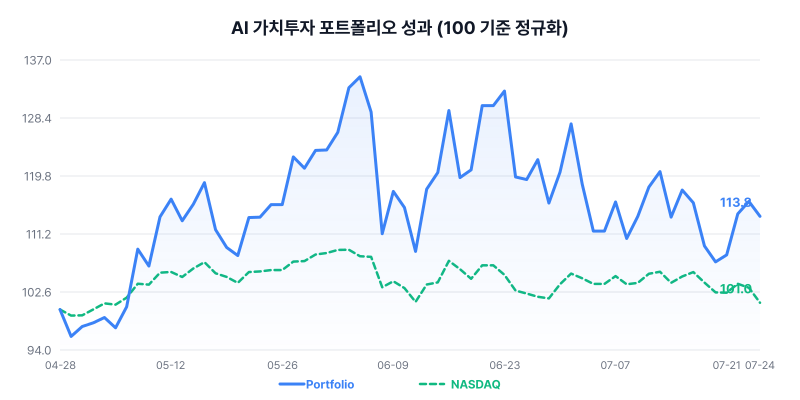
Performance Trajectory: Solid Asset Growth Weathering the Plunge
A closer look at the portfolio's asset trajectory reveals how it absorbed market volatility. Assets started at $14,585 on the 20th and trended upward to $15,806 by the 23rd, recording robust upward momentum. Although it paused amid the global market weakness on the 24th, closing around $15,505, the stock selection—based on transparent valuation metrics—superbly neutralized downward market pressure, firmly securing excess returns. The full-invest strategy of maintaining a zero cash balance essentially proves confidence in the valuation of core blue-chip stocks.
Portfolio Diagnosis: Undervalued Appeal and Intrinsic Value Shining Amid the Rout
Even as market storm clouds gathered, the driving force behind this strategy's defensive prowess lies in its strict fundamental valuation. Amid the semiconductor sector's plunge, Micron (MU) boasts overwhelmingly undervalued metrics—a P/E ratio of 22.4 and a PEG ratio of 0.14—defying market fear. This proves its stock price is extremely cheap relative to its growth potential. Furthermore, Nvidia (NVDA), a portfolio mainstay, maintains a P/E of 32.0 and a PEG of 0.57, still holding substantial upside potential considering the explosive surge in AI chip demand.
However, Broadcom (AVGO) records a P/E of 66.2 alongside a PEG of 0.43, reflecting the market's high earnings growth expectations while firmly establishing itself alongside Nvidia as the twin pillars of 'AI infrastructure.' Meanwhile, Meta (META) recently shows a balanced P/E of 22.0, but with expanding short-term volatility in its stock price, a capital rotation into sectors with less overvaluation risk is imminent. Microsoft (AMZN) maintains an adequate premium with a P/E of 29.3 and a PEG of 1.30, adding stability to the portfolio.
| Ticker | Shares | Purchase Price | Current Price | P/E |
|---|---|---|---|---|
| Broadcom (AVGO) | 5.671 | $326.03 | $392.47 | 66.2 |
| AMD | 7.174 | $198.62 | $539.69 | 185.5 |
| Micron (MU) | 0.250 | $996.00 | $990.21 | 22.4 |
| Nvidia (NVDA) | 25.755 | $183.15 | $208.76 | 32.0 |
| Amazon (AMZN) | 1.954 | $208.39 | $233.66 | 29.3 |
| TQQQ | 2.005 | $76.34 | $66.30 | 34.0 |
| Meta (META) | 0.754 | $653.56 | $606.10 | 22.0 |
| SOXL | 17.367 | $67.30 | $157.50 | 26.8 |
Recent Trade Recap: Interplay of Offense and Defense Through Sector Rotation
A review of recent trading activity reveals that this portfolio employs meticulous sector rotation rather than merely relying on stock price appreciation. Trimming the Meta (META) position (partial sale) on the 24th was an excellent preemptive risk management move to alleviate concerns over intensifying competition in the advertising market and delays in AI monetization. Simultaneously, shares of TQQQ (Nasdaq Leveraged ETF) were also sold to brace for weakening momentum.
Where did the secured capital go? It was aggressively reallocated and concentrated entirely into the semiconductor sector (SOXL). Based on the extremely low figure compared to the underlying asset's fair PEG, the temporary semiconductor correction was proactively interpreted as an opportunity to 'maximize leveraged returns.' Previously, on the 10th, buying TQQQ captured the strength in large-cap tech stocks, but the portfolio demonstrated agility by shifting capital direction without hesitation once market nuances changed.
| Date | Type | Ticker | Shares | Price |
|---|---|---|---|---|
| 2026-07-24 | Buy | SOXL | 1.071 | $157.50 |
| 2026-07-24 | Sell | META | 0.133 | $606.10 |
| 2026-07-24 | Sell | TQQQ | 0.859 | $66.30 |
| 2026-07-17 | Sell | META | 0.046 | $664.54 |
| 2026-07-10 | Buy | TQQQ | 2.864 | $76.34 |
| 2026-07-10 | Sell | SOXL | 0.857 | $192.45 |
| 2026-07-03 | Sell | AMZN | 0.102 | $242.67 |
| 2026-07-03 | Sell | META | 0.049 | $582.90 |
| 2026-06-26 | Buy | NVDA | 1.288 | $195.74 |
| 2026-06-19 | Sell | SOXL | 0.902 | $279.29 |
Market Outlook: VIX at 18.58, Opportunities Lurking in Fear
Macroeconomic indicators are sending mixed signals, with oil prices (WTI) plunging 3.12% and the KRW/USD exchange rate dropping by over 1% (a stronger Korean Won) on the day. The Volatility Index (VIX), a gauge of market sentiment, settling at 18.58 leaves room to interpret this downturn not as extreme panic, but rather as a healthy correction and profit-taking phase among overheated sectors. In particular, as the U.S. 10-year Treasury yield records 4.679% showing stabilizing movements, Goldman Sachs futures are rising 0.60%, indicating unusual supply and demand dynamics for alternative investment assets.
In conclusion, rather than being swayed by short-term market turbulence, the shortcut to boosting the win rate is to maintain solid bets centered on robust intrinsic value (undervalued stocks with a PEG under 1). The valuation appeal of sufficiently adjusted AI infrastructure companies will soon act as a powerful magnet, drawing global smart money back in.
※ This report analyzes the simulated trading performance of an AI Value Investing portfolio and does not constitute investment advice. Actual investments should be made at your own discretion and risk.
Curious about the portfolio details?
Subscribe to our newsletter below to receive detailed daily investment reports.