National Assembly Data Analysis: Ideological Landscape of 285 Members in the 22nd Assembly, Deepening Polarization of Economic and Social Policies Between Major Parties

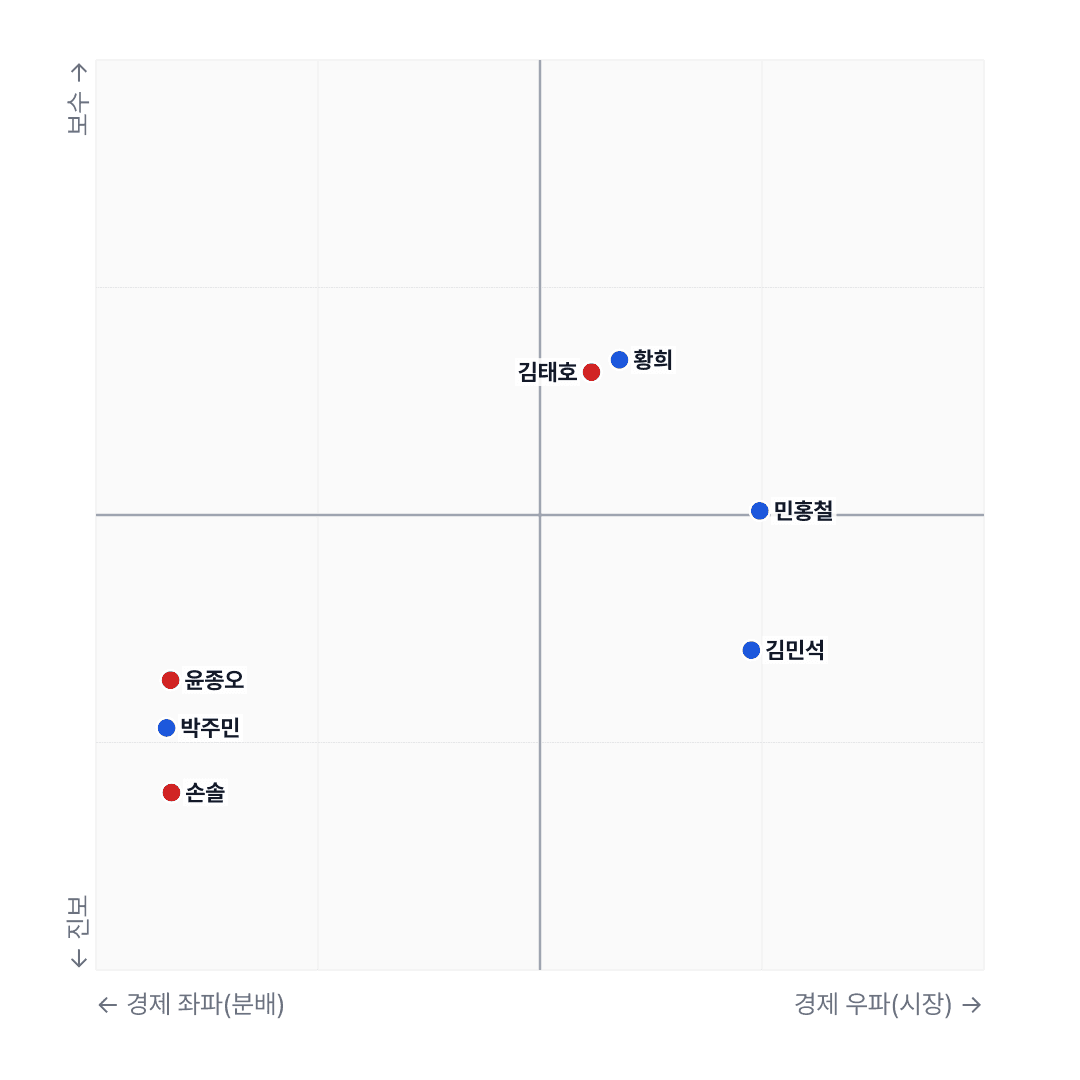
The Ideological Landscape of 285 Members Based on Legislative Behavior in the 22nd National Assembly and Policy Implications
A quantitative analysis of sponsored bills and voting records of the 285 members of the 22nd National Assembly using Large Language Models (LLM) reveals that the average ideological coordinates by party are significantly polarized, showing distinct differences in both economic and social spheres. This analysis classified legislators' activities along two axes—economic (left-right) and social (progressive-conservative)—and derived each member's relative position by setting the average of the two major parties as the origin. The results indicate that the Democratic Party of Korea (DPK) leans left-wing and progressive on both economic and social policies relative to the average, while the People Power Party (PPP) is concentrated in the opposing right-wing conservative camp. Notably, the gap between the two parties is wider in economic policy than in social policy, suggesting the likelihood of intense conflict during future legislative processes regarding taxation and fiscal policy.
Looking at the detailed distribution across quadrants, the largest group consisted of 117 members with left-wing progressive tendencies, followed by 86 members with right-wing conservative tendencies. A point of interest is the existence of cross-pressure groups that diverge from their party's official line. There are 35 members who hold right-wing economic values while maintaining a progressive social stance, and conversely, 47 members who are economic leftists but socially conservative. These 82 members are classified as a potential group capable of acting as swing voters on specific agendas, regardless of party lines. However, it should be noted that this quantitative analysis is based solely on public legislative records and voting data, so there may be some discrepancies with a member's public image or political rhetoric.
Strengthening Party Clarity and the Radical Coordinates of the Third Zone
The average coordinates of the 152 DPK members are skewed to the left of the center in both economic and social domains. This implies that their voting and sponsorship are concentrated on economic policies emphasizing public strengthening and distribution, as well as social policies prioritizing human rights and diversity. In particular, the DPK's shift toward the left was numerically more pronounced than the PPP's shift toward the right. The PPP showed right-wing tendencies supporting market liberalism and deregulation in the economic sphere, but in the social sphere, their shift toward the conservative side was relatively narrower compared to the DPK's progressive shift, placing them slightly closer to the center.
The average coordinates of the 12 members of the Rebuilding Korea Party showed a much stronger economic left-wing tendency than the DPK, marking them as having the most distinct policy color in the 22nd National Assembly.
The 7 independent members also occupy a position economically further to the left than the DPK average, indicating that the overall economic policy tone of the opposition bloc has intensified. While the Rebuilding Korea Party also adopts a more progressive stance than the DPK on social policy, its differentiation in the economic realm is overwhelming. This data suggests that under the two-major-party system, the policy spectrum is far from simple, and high-intensity clarity competitions may occur within the opposition on specific issues. For businesses and investors, these differences in party coordinates are expected to serve as key indicators for predicting the passage of bills related to corporate tax, inheritance tax, and labor regulations.
Standing Committee Expertise and the Blurred Boundaries of Interests
From a data journalism perspective, this analysis also highlighted the correlation between legislators' ideological leanings and their private assets. It was confirmed that certain members hold significant stock in industries overseen or directly influenced by their respective standing committees. Additionally, the behavior of members who receive high-value donations from specific professions or interest groups repeatedly sponsoring bills that benefit those groups was quantitatively captured. This acts as a structural factor that could undermine the objectivity of legislation, regardless of legal violations.
For instance, some members of financial and energy-related standing committees sponsored numerous bills focused on deregulation or tax benefits for those industries, and their asset portfolios included stocks in related sectors. These facts provide grounds for policy criticism regarding whether the legislators' actions were driven by public interest or by private gain. Quantitative analysis through legislative records serves not only to classify ideology but also as a tool to monitor transparency in the policy-making process. In the investment market, strategies are required to preemptively identify regulatory risks for specific industries by analyzing members' committee assignments and legislative tendencies.
Policy Risks and Market Outlook Amid Shifting Legislative Landscapes
Synthesizing the ideological indicators of the 22nd National Assembly, the conflict between the ruling and opposition parties over economic policy is projected to be more intense over the next four years than in the past. The fact that the economic disparity between the parties is greater than their differences in social values implies that finding a political compromise for livelihood and economic revitalization bills will be difficult. In a legislative environment led by the 117 left-wing progressive members, strengthening corporate social responsibility and redistribution policies are likely to be prioritized. Conversely, the 86 members of the right-wing conservative camp are expected to emphasize growth through tax cuts and investment attraction, adopting a defensive legislative strategy.
The market must review policy predictability based on these quantitative indicators. Bills sponsored by the 82 cross-pressure members may have higher practical success rates even if they conflict with party lines, potentially providing unexpected volatility to specific industrial sectors. In conclusion, this analysis demonstrates that the 22nd National Assembly possesses a multi-layered ideological structure based on individual legislative behaviors, going beyond the simple framework of a government minority-opposition majority. Closely analyzing individual members' quantitative coordinates and interests, as well as party platforms, will become an essential element for investment risk management.
Members Mentioned in the Article
| Member | Party | Ideological Leaning | Notes |
|---|---|---|---|
| Park Ju-min | Democratic Party of Korea | Economic Left · Social Progressive | Representative of Extremes |
| Yun Jong-o | Progressive Party | Economic Left · Social Progressive | Representative of Extremes |
| Kim Min-seok | Democratic Party of Korea | Economic Right · Social Progressive | Representative of Extremes |
| Min Hong-chul | Democratic Party of Korea | Economic Right · Social Conservative | Representative of Extremes |
| Son Sol | Progressive Party | Economic Left · Social Progressive | Representative of Extremes |
| Kim Tae-ho | People Power Party | Economic Right · Social Conservative | Representative of Extremes |
| Hwang Hee | Democratic Party of Korea | Economic Right · Social Conservative | Representative of Extremes |