AI Value Investment Report Stays Resilient Amid Market Plunge, Recording 57% YTD Returns


[Market Insight] "Blue Chip Volatility: Uncovering 57% Alpha Amidst the Turmoil"
As the CBOE Volatility Index (VIX) on Wall Street crosses 15, heightening investor tensions, the KOSPI market recorded a 'shock' on August 19th, plunging over 7% and falling back to the 6,400 range. While major U.S. indices, led by the Nasdaq, underwent a correction, this portfolio responded calmly based on technical valuation indicators. Consequently, it has surged a remarkable 57.51% since the beginning of the year, demonstrating a selective trend that defies the market's broader downturn. The 'AI Value Investment Portfolio' has displayed a paradoxical ability to turn a sharp market decline into an opportunity.
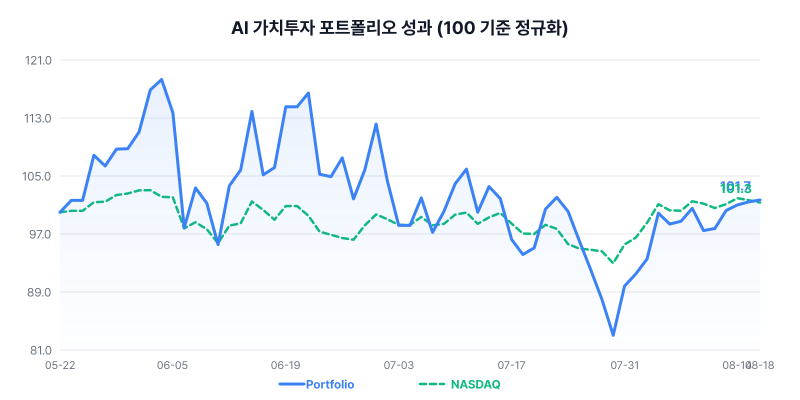
Performance Blossoming in a Market Crash
Examining asset trends over the past 5 days, total assets, which stood at $15,140 on the 12th, have risen to $15,750 as of the 18th. This represents a very strong performance, contrasting sharply with the KOSPI's approximate 6% nosedive and the Nasdaq's 1.3% decline during the same period. Rather than simply tracking indices, this portfolio focused on assets with a valuation advantage by strictly analyzing individual stocks' PEG (Price/Earnings-to-Growth) ratios, allowing it to maintain a robust trajectory despite the market slump.
Diagnosing Holdings via Valuation
Current holdings appear to be standing at the crossroads of 'high growth and undervaluation.' Broadcom (AVGO) and NVIDIA (NVDA) currently have PERs of 65.4 and 34.5, respectively, which may seem numerically high. However, with PEG ratios of just 0.44 and 0.62, respectively, it can be deduced that stock prices remain undervalued relative to future growth potential. In particular, Micron (MU) is expected to lead a technical rebound, dispelling market concerns with overwhelming figures—a PER of 22.9 and a PEG of 0.14.
Conversely, Intel (INTC), recently purchased, presents a paradoxical case where earnings per share (EPS) are in the negative (-2.11). This is interpreted as a strategic position anticipating improved PER-linked returns following the recovery of the AI supply chain and a revaluation of the company. Leverage ETFs like TQQQ and SOXL are serving to amplify index volatility, acting as a multiplier for the portfolio's overall returns amid temporary market swings.
The Winning Move of Strategic Sector Rotation
The core philosophy revealed in recent trading records is 'bold profit-taking and reduction of opportunity costs.' The decision to sell part of the Meta (META) holdings is viewed as a savvy move to proactively manage risk factors—such as intensifying ad market competition and delays in AI monetization—while reallocating funds to the AI and semiconductor sectors, where growth is more certain.
Notably, the partial sales of TQQQ and SOXL on August 7th and 14th to adjust portfolio deltas, followed by funneling the liquidity into Intel (INTC), draws attention. This demonstrates sophisticated operational capabilities that consider both valuation and momentum to hedge risks while growing the return curve, rather than blindly following semiconductor sector sentiment. The buy-in strategy in late July, which concentrated positions in SOXL based on the judgment that the semiconductor index (SOXX) was undervalued compared to the market average, remains valid and has yielded high returns.
Market Outlook: Opportunity Amidst Chaos
While U.S. 10-year Treasury yields maintaining levels around 4.7% may constrain the valuation expansion of growth stocks, semiconductor valuations with a PEG below 1 remain attractive. The current upward momentum of the soaring semiconductor sector is still valid, though managing daily volatility is essential. The KOSPI's underperformance is expected to persist for now, but the U.S. semiconductor and technology sectors—where tangible earnings improvements and AI demand are confirmed—are poised to maintain a floor and retain upside potential.
We are at a moment where we must capture the true 'value' spoken by charts and figures, rather than getting lost in market noise.
Current Holdings
| Ticker | Qty | Avg Cost | Cur Price | PER |
|---|---|---|---|---|
| AVGO (Broadcom) | 5.67 | $326.03 | $392.43 | 65.4 |
| AMD (Advanced Micro Devices) | 7.17 | $198.62 | $506.00 | 131.4 |
| MU (Micron) | 0.25 | $996.00 | $1,011.75 | 22.9 |
| NVDA (NVIDIA) | 25.76 | $183.15 | $225.01 | 34.5 |
| AMZN (Amazon) | 1.95 | $208.39 | $261.31 | 21.1 |
| META (Meta) | 0.64 | $653.56 | $568.97 | 21.4 |
| TQQQ (ProShares UltraPro QQQ) | 1.19 | $76.34 | $76.40 | 34.8 |
| SOXL (Semiconductor Bull ETF) | 17.09 | $71.22 | $151.53 | 53.4 |
| INTC (Intel) | 2.80 | $104.56 | $103.49 | - |
Recent Major Transactions
| Date | Type | Symbol | Qty | Price |
|---|---|---|---|---|
| 2026-08-14 | Buy | INTC (Intel) | 2.80 | $104.56 |
| 2026-08-14 | Sell | SOXL (Semiconductor Bull ETF) | 0.90 | $145.36 |
| 2026-08-07 | Sell | SOXL (Semiconductor Bull ETF) | 0.95 | $132.33 |
| 2026-08-07 | Sell | TQQQ (ProShares UltraPro QQQ) | 0.51 | $72.03 |
| 2026-07-31 | Buy | SOXL (Semiconductor Bull ETF) | 1.57 | $114.72 |
| 2026-07-31 | Sell | TQQQ (ProShares UltraPro QQQ) | 0.30 | $63.30 |
※ This report analyzes the simulated operating history of the AI Value Investment Portfolio and does not constitute investment advice. Actual investment should be conducted at your own judgment and responsibility.
Curious about the portfolio details?
Subscribe to the newsletter below to receive detailed daily investment reports.