10-Year Treasury Bond Yield Rises to High 4.2% Range... Analysis of Causes and Impact

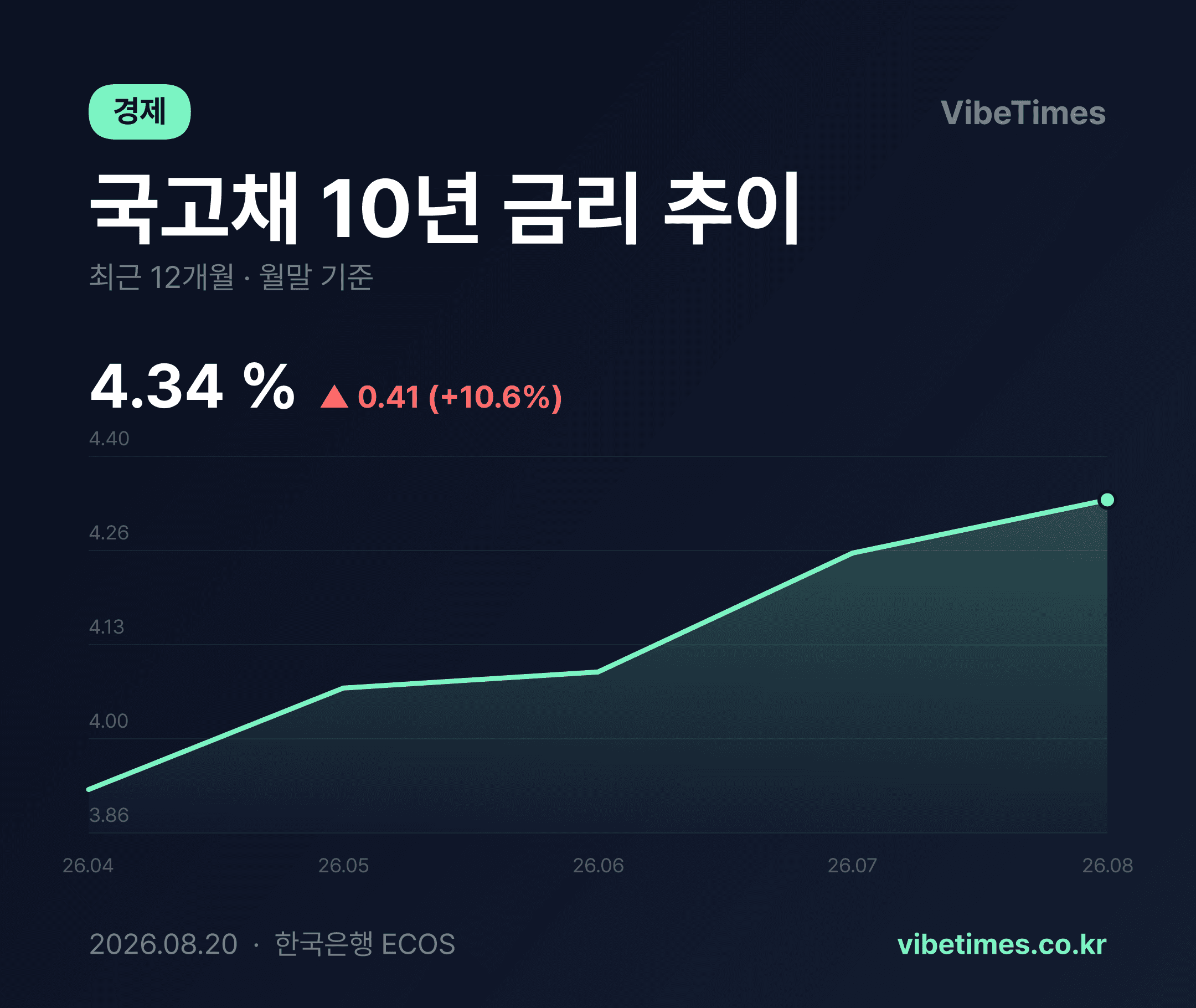
The yield on the 10-year benchmark Korean Treasury bond has risen from 3.92% at the end of April 2026 to the high 4.3% range as of August 20. This marks a 0.41 percentage point increase in the benchmark interest rate over five months. The core of this trend is the accelerating pace of the rise, with a 0.17 percentage point jump occurring in July alone.
The Structure of Rising Rates: A Steepening Slope
Trends based on month-end figures show 3.92% in April, 4.07% in May, 4.09% in June, and 4.26% in July. While the rise stalled at 0.02 percentage points between May and June, it surged again by 0.17 percentage points in July and reached 4.34% in August. This is interpreted not as a short-term adjustment, but as a re-establishment of the upward trend.
The Treasury bond yield represents the return demanded by the market from buyers. When yields rise, bond prices fall. In other words, five consecutive months of rising yields imply that market participants have been selling off Korean long-term bonds or have begun demanding higher returns. This flow typically appears when concerns over inflation, fiscal burdens, and rising overseas interest rates overlap.
Why Long-Term Interest Rates Continue to Rise
The first backdrop for rising long-term rates is inflation expectations. If the inflation rate remains higher than the Bank of Korea's target, investors demand higher interest rates to compensate for the loss of future value. The second factor is the fiscal deficit and the volume of Treasury bond issuance. As the government releases more bonds into the market, an oversupply pushes interest rates up.
The third factor is the trend of U.S. interest rates. The direction of the U.S. Federal Reserve's rate policy or a rise in the 10-year U.S. Treasury yield directly transmits to domestic long-term rates. If the interest rate gap between Korea and the U.S. widens, pressure for capital outflow increases, leaving domestic rates no choice but to follow suit. The steep rise in July and August appears to be the result of these external and domestic factors working simultaneously.
Impact on Markets and Industries
The first sector to react when long-term rates rise is the lending market. Since bank lending rates, including mortgage loans, are determined based on market rates, a 10-year Treasury yield in the mid-4% range directly raises funding costs for households and businesses. As the interest burden grows, it could lead to a contraction in consumption and facility investment.
It is also a burden for companies. As corporate bond issuance conditions deteriorate, the possibility of shifting funding away from the bond market towards bank loans or paid-in capital increases. In particular, highly leveraged companies may see their financial structures deteriorate more quickly during a rising rate period, leading to an expected increase in credit rating adjustments going forward.
Valuation losses for bond funds and banks purchasing bonds also warrant attention. Bonds bought at the 3.92% level would now result in valuation losses at current market prices. However, yields in the 4.3% range offer relatively attractive returns for new investors, creating a situation where short-term losses and medium-term appeal coexist.
Outlook and Investment Implications
The future direction depends on the Bank of Korea's benchmark rate decisions and inflation trends. If inflationary pressure persists and fiscal expansion continues, the 10-year yield could rise further towards 4.5%. Conversely, if signals of growth slowdown become clear and inflation enters a stabilization path, the upward momentum could break.
For investors, basic principles during a rising rate environment are crucial. Since bond prices fall when rates rise, short-term instruments or products less sensitive to interest rate fluctuations are more advantageous than short-term trading. A strategy of buying long-term bonds when rates are judged to be nearing their peak can also be considered. However, whether the current yield in the high 4.3% range represents a further upward phase or is near the peak must be confirmed through inflation and Bank of Korea monetary policy meeting results.
In short, the five-month consecutive rise in the 10-year Treasury bond yield is a result of the market pricing the value of long-term funds in reflection of inflation, fiscal burdens, and the external interest rate environment. As current levels exceeding 4.2% impact lending rates, corporate funding costs, and the broader asset market, it is a time when both households and businesses need to prepare for an expanding interest rate burden.