Value Investing Report Amid Kosdaq Plunge, AI Portfolio Logs 45% Cumulative Return


[Daily Market Insight] "Kosdaq in Freefall, Semis are 'Eagles'"... Hands Finding Value Amidst Sharp Swings
August 21, 2026—the early morning global markets are marked by a subtle sense of dissonance. A massive exodus of liquidity on the surface intersects with concentrated interest in specific sectors. While the Kosdaq index plummeted nearly 5%, striking fear into investors, the KOSPI rose 0.88%, vividly illustrating a market of "the rich get richer." Amidst this volatility, the **AI Value Investing Portfolio** maintained a steady conviction, recording a cumulative return of 45.19%. As Bitcoin surged over 7% and a storm of volatility blew through, this strategy chose not the scorching heat but rather a calm balance of value and growth.
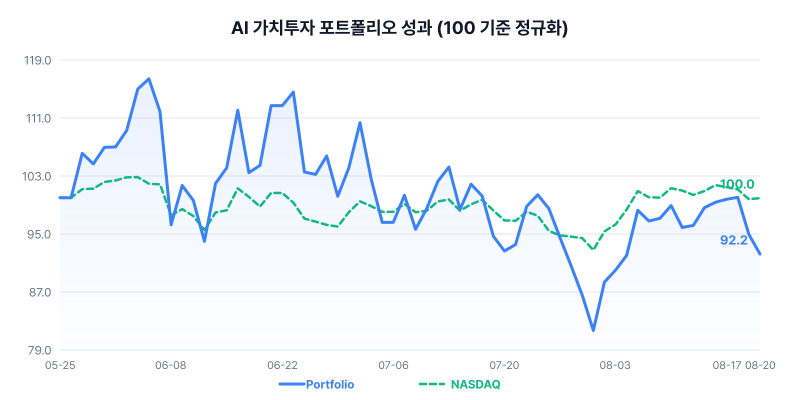
Steadfast 45% Returns Between Plunge and Surge
The asset flow of this portfolio over the last five days appears to be breaking out of a trading box and solidifying its upper base. After hitting a peak total asset value of $15,750 on the 18th, it underwent a slight correction on the 20th to settle at $14,519. The key determinants of the overall portfolio valuation are the PER (Price-to-Earnings Ratio) and PEG indicators. The crux of this strategy is not simply to hold undervalued stocks, but to capture companies whose growth potential is underestimated at a reasonable price. The current portfolio achieved a 45% return while riding the mega-trend of AI semiconductors without engaging in high-wire acts, serving as a shield during the market downturn.
Holdings Diagnosis: Broadcom's Value, Micron's Growth
The valuation of current holdings is intriguingly multi-layered. The most noticeable stocks are Broadcom (AVGO) and Micron (MU). Broadcom records a PER in the 60x range, but its PEG is a mere 0.44, suggesting the market is significantly undervaluing its growth potential. Nvidia (NVDA), the standard for semiconductor investment, also maintains an attractive band with a PER of 33.3x and a PEG of 0.62.
Conversely, Advanced Micro Devices (AMD) has a somewhat burdensome PER of 123.4x, but its PEG of 1.10 indicates it still harbors growth potential. Intel (INTC), recently bought in, does not have a calculated PER due to poor performance (negative EPS), but it shows the market is betting on an AI supply chain recovery. In this rough market environment where gold prices surged 2.2% and US 10-year Treasury yields jumped to 4.696%, the semiconductor sector's relative undervaluation and strong momentum serve as the portfolio's most solid support.
Major Holdings Status
| Ticker | Qty | Bought At | Current Price | PER |
|---|---|---|---|---|
| AVGO (Broadcom) | 5.67 | $326.03 | $362.48 | 60.2 |
| AMD (AMD) | 7.17 | $198.62 | $466.42 | 123.4 |
| MU (Micron) | 0.25 | $996.00 | $937.11 | 21.2 |
| NVDA (Nvidia) | 25.76 | $183.15 | $217.56 | 33.3 |
| AMZN (Amazon) | 1.95 | $208.39 | $265.84 | 21.4 |
| META (Meta) | 0.64 | $653.56 | $546.03 | 20.6 |
| SOXL (Semiconductor Leveraged) | 17.09 | $71.22 | $120.74 | 42.6 |
| INTC (Intel) | 2.80 | $104.56 | $92.80 | - |
Strategic Moves: Trim Meta, Clutch 'Semiconductor Leverage'
Looking at recent trading history, one can see how thoroughly this portfolio adheres to the principle of "selection and concentration." From late July to mid-August, the weightings of Meta (META) and TQQQ (Nasdaq Leverage) were drastically reduced, and the capital was moved into SOXL (Semiconductor Leverage) and individual semiconductor stocks. This followed the judgment that the PEG of the AI-centric semiconductor index (SOXX) is far more attractive than traditional Big Tech-driven indices like the QQQ. Specifically, the analysis from the July 31 trading note that "Semiconductors (SOXX) PEG is 0.625, significantly undervalued compared to the fair PEG (1.54), suggesting immense room for further upside via the leverage effect" cuts to the core of this strategy.
Additionally, the aggressive entry into Intel on August 14, despite its recent surging momentum, is worth noting. Based on valuation indicators, once the judgment is made that a stock is cheap, the portfolio engages in aggressive rebalancing to lower opportunity costs, even if it means selling off other high-return stocks (like SOXL).
Recent Major Trading History
| Date | Type | Symbol | Qty | Price |
|---|---|---|---|---|
| 2026-08-14 | Buy | INTC (Intel) | 2.80 | $104.56 |
| 2026-08-14 | Sell | SOXL (Semiconductor Leverage) | 0.90 | $145.36 |
| 2026-08-07 | Sell | SOXL (Semiconductor Leverage) | 0.95 | $132.33 |
| 2026-08-07 | Sell | TQQQ (Nasdaq Leverage) | 0.51 | $72.03 |
| 2026-07-31 | Buy | SOXL (Semiconductor Leverage) | 1.57 | $114.72 |
| 2026-07-31 | Sell | TQQQ (Nasdaq Leverage) | 0.30 | $63.30 |
| 2026-07-31 | Sell | META (Meta) | 0.11 | $539.03 |
'Value' in a Rising Rate Environment, Dodging the Volatility Blade
Currently, the VIX (Fear Index) has risen over 7% to 16.01, and the US 10-year Treasury yield is approaching 4.7%, putting global financial markets on high alert. This signals headwinds for growth stocks. However, this portfolio's defensive power comes from selecting 'true growth stocks.' As asset prices like Bitcoin and gold soar, the attitude of not being overwhelmed by their dominance but strictly adhering to the semiconductor sector's PEG valuation will serve as an excellent compass for navigating the treacherous August market.
※ This report analyzes the simulated operating history of the AI Value Investing Portfolio and does not constitute investment advice. Actual investment should be undertaken under your own judgment and responsibility.
Want to know the detailed portfolio status?
Subscribe to the newsletter below to receive detailed daily investment reports.