Inflation at 2.9%, Yet the Benchmark Rate Stays Frozen at 3%

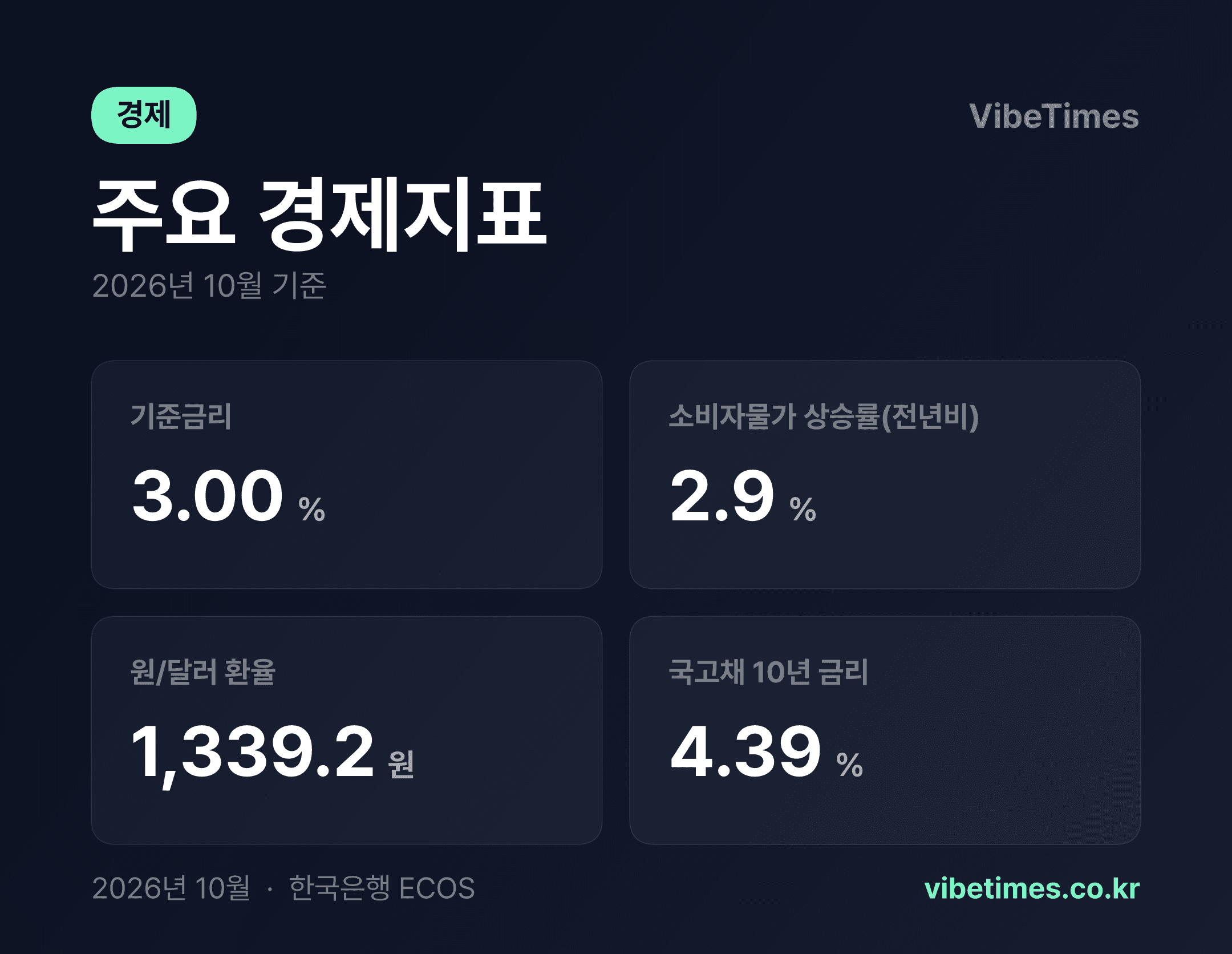
With inflation at 2.9% and the policy rate at 3.00%, the real interest rate sits effectively at zero.
The Bank of Korea's benchmark rate of 3.00%, consumer inflation of 2.9%, the won-dollar exchange rate of 1,339.2 won, and the 10-year government bond yield of 4.39% — these are the key macro indicators as of October 10, 2026, laid out in a single line. What stands out in this configuration is that inflation and the policy rate are nearly identical. It means the real interest rate — nominal rate minus inflation — is a mere 0.1 percentage point. In effect, there is virtually no real return on savings.
What the Rate-Price Balance Tells Us
The benchmark rate of 3.00% overlaps with the 2.9% inflation rate. Central banks typically do not hesitate to cut rates when inflation hovers around the 2% target. But with prices still running 0.9 percentage point above target at 2.9%, the Bank of Korea appears to remain in a phase where further rate cuts are hard to justify.
It is also noteworthy that consumer inflation has stalled just below the 3% threshold year-on-year. Above 3%, perceptions of high inflation tend to spread; in the late 2% range, it can be read as a sign of cooling. At 2.9%, the economy sits just below that line — a reading that suggests not a spike or a collapse, but sticky inflation.
Market Rates 1.39 Points Above the Policy Rate
The 10-year government bond yield of 4.39% is a full 1.39 percentage points above the benchmark rate. That long-term market rates so far exceed the policy rate signals that investors expect elevated rates to persist. Sellers of bonds are effectively saying they need that much of a premium to absorb inflation and currency risks.
The won-dollar exchange rate of 1,339.2 won reinforces this structure. When the won hovers in the late 1,300s, import price pressures mount, which in turn stirs domestic inflation. The fear that cutting rates could weaken the won further acts as a brake on the Bank of Korea. The market's placement of the 10-year yield in the mid-4% range appears to reflect this twin constraint of exchange rates and prices.
Implications for Consumers and Investors
In an environment where the real interest rate is near zero, deposits alone can hardly protect your assets. While prices rise 2.9%, interest income stops at 3.00%. Once taxes are factored in, real purchasing power is essentially flat — or slightly declining.
For businesses and household borrowers, by contrast, this is a phase where expecting further rate cuts is difficult. The long-term rate of 4.39% underpins mortgage lending and corporate bond issuance, signaling that funding cost burdens are unlikely to ease anytime soon.
Variables and Outlook
The direction ahead depends on where inflation goes from 2.9%. If prices ease into the mid-2% range, real interest rates will naturally turn positive, giving the Bank of Korea room to cut rates. Conversely, if the won breaks past 1,350 to the dollar and pushes up import prices, rate cuts move further out of reach.
In short, today's numbers depict a 'long war against inflation.' This is not an urgent adjustment phase, but the market has already priced in higher future costs with long-term rates in the 4% range. The pace at which inflation returns to target will be the single most important variable in the months to come.