Investment Report Holds Firm at +31.01% Cumulative Returns Amid Market Crash


The Basket of Uncertainty Grows Heavier
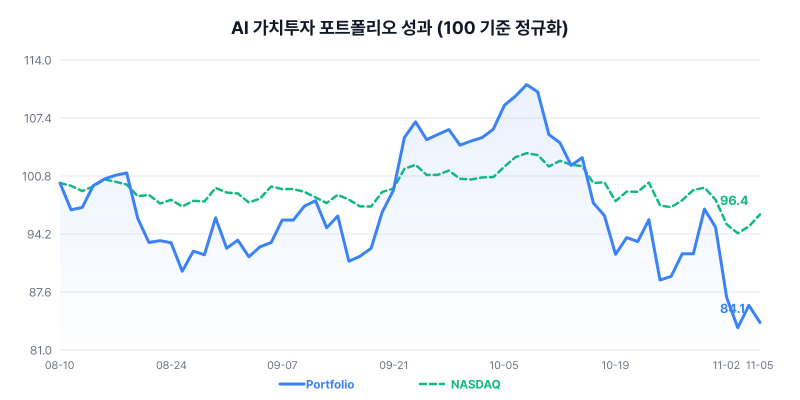
On the 5th, when the KOSPI plunged more than 5% in a single day and the Nasdaq crashed nearly 5%, global markets moved in unison to shed risk assets. As the Philadelphia Semiconductor Index posted a double-digit decline, this portfolio—concentrated in AI earnings-related stocks—became a hot potato as well. Even so, its cumulative return held at +31.01%, keeping total assets above the $13,100 mark. It was a day for taking stock of what remains amid the storm.
$1,700 Evaporates in Five Days... But the Framework Survives
The asset trajectory makes the shock vivid. Total assets, which had soared to $14,789 on October 30, shed nearly $1,700 in just a week. Still, after dipping to $13,008 on November 3, the portfolio repeatedly rebounded, consolidating its base even during a correction phase. Gains of 30%-plus built during a bull market only prove their mettle by how well they survive a downturn—which makes the current phase a true test of this strategy's durability.
Holdings Checkup: Semiconductor Concentration as a Double-Edged Sword
This portfolio's character is unmistakable. Semiconductor and AI-related stocks such as Nvidia, Micron, AMD, and TSMC make up the bulk of holdings, so the semiconductor index's 10% plunge translated directly into a drop in total assets. Yet individual stock valuations remain attractive. Micron's PEG ratio—a measure of share price relative to growth—stands at a mere 0.16, suggesting the market is pricing the stock quite conservatively despite HBM demand. Nvidia, at a PEG of 0.25, also carries little price burden relative to growth. By contrast, AMD's PER above 100 indicates the market has priced in expectations in advance, while Intel, with negative EPS, is still too early a stage for a value judgment.
| Stock | Quantity | Purchase Price | Current Price | PER |
|---|---|---|---|---|
| Broadcom | 5.67 shares | $326.03 | $325.48 | 41.6 |
| Amazon | 1.95 shares | $208.39 | $266.03 | 21.5 |
| Intel | 2.80 shares | $104.56 | $58.27 | - |
| Meta Platforms | 0.55 shares | $653.56 | $630.00 | 21.5 |
| SOXL | 13.92 shares | $71.22 | $66.68 | 25.1 |
| TQQQ | 1.13 shares | $76.34 | $62.24 | 28.6 |
| Nvidia | 24.00 shares | $184.21 | $200.13 | 25.3 |
| Micron | 1.30 shares | $930.96 | $795.23 | 10.7 |
| AMD | 6.47 shares | $198.62 | $488.78 | 104.4 |
| TSMC | 0.44 shares | $431.81 | $395.75 | 25.6 |
Trade Review: The Rhythm of Staged Buying and Profit-Taking
A look back at recent trades shows the principle of "crashes are opportunities" working consistently. When Nvidia's weight exceeded 38% in mid-October, part of the position was sold to secure cash, which was then allocated to Micron and TSMC—extremely undervalued by PEG standards. Even as AMD's gains swelled from 155% to 185%, the portfolio kept selling and rotating funds into undervalued names within the sector. Trimming leveraged products TQQQ and SOXL first in response to the correction also reflects a downside risk management perspective. It is the product of discipline: rebalancing weights according to metrics, unswayed by market sentiment.
| Date | Type | Stock | Quantity | Price |
|---|---|---|---|---|
| 2026-10-30 | Buy | TSMC | 0.44 shares | $431.81 |
| 2026-10-30 | Sell | AMD | 0.34 shares | $566.42 |
| 2026-10-23 | Buy | Micron | 0.47 shares | $856.49 |
| 2026-10-23 | Sell | Nvidia | 1.26 shares | $212.21 |
| 2026-10-23 | Sell | AMD | 0.36 shares | $507.93 |
| 2026-10-16 | Buy | Micron | 0.31 shares | $931.24 |
| 2026-10-16 | Sell | Nvidia | 1.33 shares | $217.23 |
| 2026-10-09 | Buy | Micron | 0.11 shares | $1,035.84 |
| 2026-10-09 | Sell | TQQQ | 0.06 shares | $80.23 |
| 2026-10-09 | Sell | SOXL | 0.73 shares | $142.52 |
Market Outlook: In a Volatile Regime, the Metrics Are the Answer
The VIX surged more than 40% in a single day to 23.9, and the flight to safe havens became pronounced. Gold futures and oil prices rose together, reflecting overlapping inflation and geopolitical risks, while the exchange rate climbed to the upper 1,350-won range, potentially raising import price pressures. That said, the slight dip in the U.S. 10-year Treasury yield suggests financial conditions have not yet tipped into a deteriorating phase. Stock selection grows harder in such conditions, but assets with reasonable prices relative to growth are more likely to weather the correction. Short-term volatility will persist, but as long as the valuation rationale holds, watching and responding in stages—rather than selling—seems the wiser course for now.
※ This report analyzes the simulated performance of an AI value investment portfolio and does not constitute investment advice. Actual investment decisions should be made at the reader's own discretion and responsibility.
Want the full portfolio details?
Subscribe to the newsletter below to receive detailed investment reports daily.