The Weight on Korea's Economy: Exchange Rate at 1,357 Won and Interest Rates at 3%

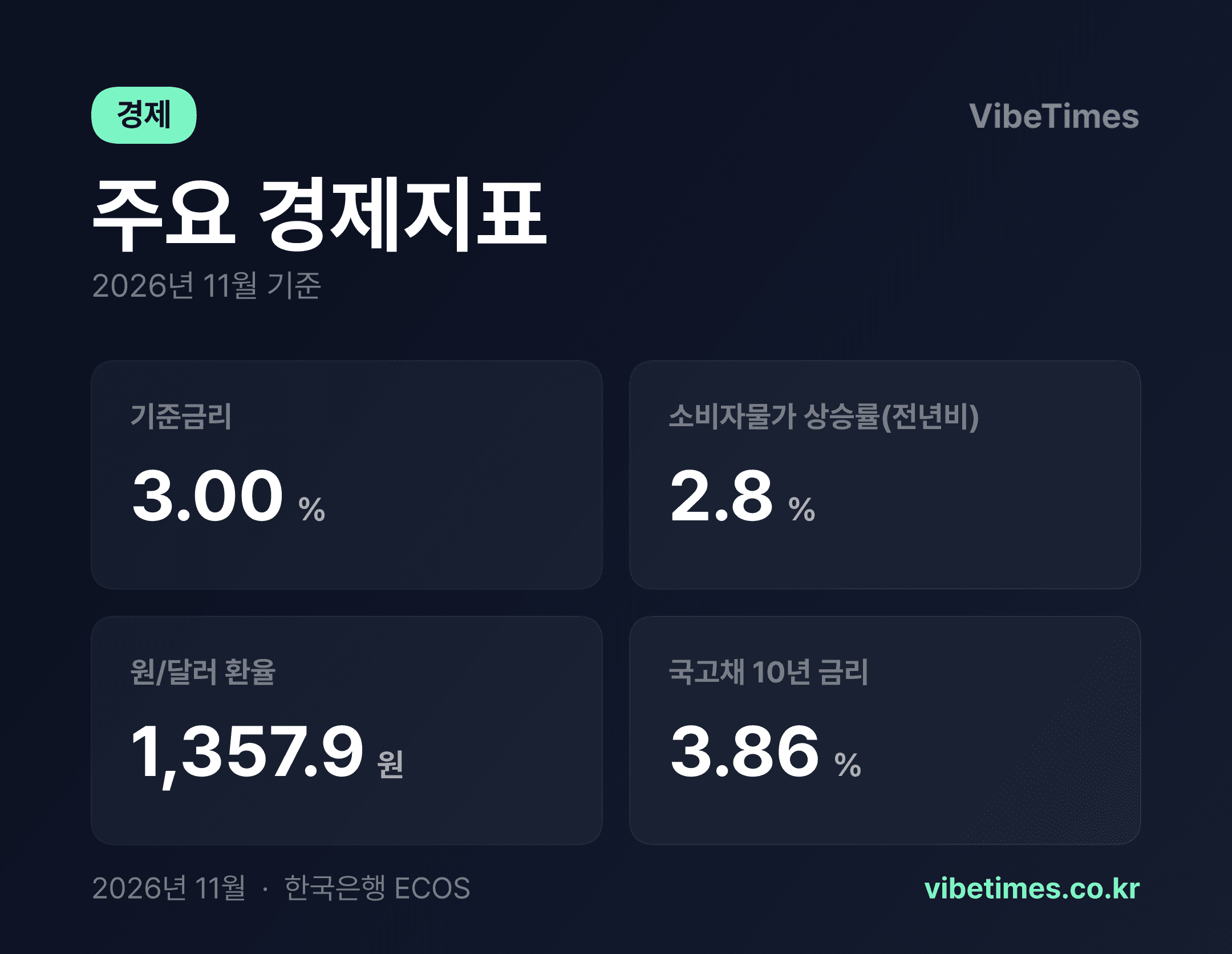
The 0.2 percentage-point gap between the 3.00% base rate and 2.8% inflation represents the weight Korea's economy must carry.
As of November 10, 2026, the Bank of Korea's base rate stood at 3.00%, while consumer price inflation was recorded at 2.8% year-on-year. The real interest rate—nominal rate minus inflation—is a mere 0.2% annually. The won-dollar exchange rate stands at 1,357.9 won, and the 10-year government bond yield is at 3.86%. Placing these four indicators side by side reveals how narrow the terrain is on which financial authorities stand.
What the 0.2 Percentage-Point Gap Between Rates and Inflation Means
The Bank of Korea's base rate of 3.00% is just 0.2 percentage points higher than the 2.8% inflation rate. This means the real interest rate is nearly zero—deposits barely outpace rising prices. Normally, the base rate targets price stability defined as consumer inflation of around 2%. The current 2.8% exceeds that target by 0.8 percentage points.
This gap allows for two interpretations. One is that there is limited room to cut rates. Lowering the base rate while inflation remains above target could revive inflation expectations. The other view holds that, given burdens on the financial and household sectors, even the current 3.00% may be difficult to sustain. The fact that the 10-year government bond yield sits at 3.86%—0.86 percentage points above the base rate—suggests the market is pricing in long-term inflation and fiscal risks more than expectations of short-term rate cuts.
The Shackle a 1,357-Won Exchange Rate Places on Rate Policy
The won-dollar exchange rate of 1,357.9 won is itself a constraint on monetary policy. A persistently high exchange rate pushes up import prices and drags consumer prices higher. Given Korea's economic structure, which relies on overseas purchases of crude oil, grain, and other goods, an exchange rate in the late 1,300-won range acts as a structural burden on price management.
Here lies the dilemma. Lowering the base rate reduces the appeal of won-denominated assets, prompting capital outflows and potentially pushing the exchange rate even higher. Conversely, keeping rates high to ease exchange-rate pressure increases the interest burden on households and businesses. The rate gap with the United States is another variable. Policies that narrow the Korea-US rate differential could trigger capital outflows and a weaker won, inevitably narrowing the Bank of Korea's policy options.
Three Takeaways for the Market
First, the bond market. The 10-year government bond yield of 3.86% carries a thick premium over the base rate, reflecting inflation shortfalls from target and fiscal demands. Downward pressure on long-term yields is expected to remain limited unless inflation falls back to the mid-2% range or below.
Second, the stock market. A real interest rate of 0.2% boosts the relative appeal of equities over deposits. However, an exchange rate in the 1,357-won range benefits exporters' won-denominated earnings while imposing cost burdens on sectors heavily dependent on raw material imports. Divergence across sectors is likely to widen more than movements in the index itself.
Third, the exchange rate itself. At 1,357.9 won, the level is not low by the standards of recent years' trading ranges. Combined with 2.8% inflation, it suggests inflation will not be easily curbed through the import price channel.
Outlook: Striking a Balance on a Narrow Path
The future direction of indicators rests with inflation and the exchange rate. If consumer inflation falls back to the low-2% range, the Bank of Korea gains grounds for deeper rate cuts. But if the won weakens toward 1,400 per dollar, any cut will be delayed. As the 10-year bond yield of 3.86% indicates, the market already assumes a gradual easing path—any shock deviating from those expectations is likely to heighten volatility in bond and currency markets.
Ultimately, the 3.00% base rate is the point of balance among three forces: inflation, growth, and the exchange rate. The pace at which 2.8% inflation returns toward the target range will determine the timing of the next policy move.
