AI Value Investing Portfolio Holds +13% Return in Investment Report Despite Semiconductor Correction


'AI Value Investing Portfolio' Gives Back Gains Amid Semiconductor Correction… Ends at +13%
While the Nasdaq and the Philadelphia Semiconductor Index continued their strength in the U.S. market, the Korean market was heavy from the start. On the 9th, the KOSPI fell 0.89% to 5,014.55, fighting to defend the 5,000 mark, while the KOSDAQ also dropped more than 1%. Amid these headwinds, the AI value investing portfolio is recording a cumulative return of +13.04%. However, a look at the five-day asset trend shows a sharp decline from $13,405 on November 4 to $11,303 on November 6, meaning roughly 15% of assets evaporated in a short period. Gains built up during the bull market were severely shaken by the chill of the semiconductor sector correction.
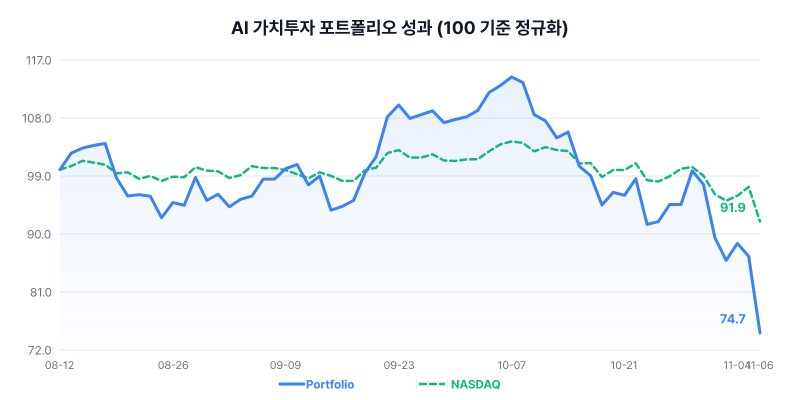
The Weight of the Plunge Erodes Cumulative Gains
Until last month, the portfolio was cruising along, maintaining assets of around $13,500. However, in November, regulatory concerns over the semiconductor sector as a whole flared up, sending core holdings like Micron and TSMC into double-digit declines, with the declines in the 3x leveraged products SOXL and TQQQ even more extreme. It is fortunate that the portfolio has still preserved double-digit returns relative to its initial $10,000 capital, but the loss is by no means light, as it can be read as a signal that market skepticism about AI earnings stocks is gaining traction.
Holdings Diagnosis: Is the Undervaluation Thesis Still Valid?
From Mitsui to Tokyo, the defensive backbone of this portfolio still rests on 'undervaluation relative to growth.' Nvidia, with a price-to-earnings ratio of 23x and a PEG of 0.24, is at levels not overly demanding for an AI bellwether. Micron, with a PER of 8.8x and a PEG of 0.16, can be interpreted as priced excessively low relative to earnings if HBM demand remains robust. On the other hand, Intel is still struggling with negative EPS and lackluster results, while AMD, at a PER of 86.4x and a PEG of 0.48, has limited valuation headroom despite its high growth rate. For the undervaluation thesis to hold, future earnings must meet expectations.
| Stock | Quantity | Purchase Price | Current Price | PER |
|---|---|---|---|---|
| Broadcom | 5.67 shares | $326.03 | $291.53 | 37.2 |
| Micron | 1.50 shares | $894.69 | $656.39 | 8.8 |
| Amazon | 1.95 shares | $208.39 | $260.21 | 21.0 |
| Intel | 2.80 shares | $104.56 | $52.25 | - |
| Meta Platforms | 0.55 shares | $653.56 | $605.08 | 20.6 |
| SOXL | 13.92 shares | $71.22 | $40.87 | 15.4 |
| TQQQ | 1.13 shares | $76.34 | $50.47 | 23.2 |
| Nvidia | 24.00 shares | $184.21 | $181.60 | 23.0 |
| TSMC | 0.44 shares | $431.81 | $353.10 | 22.9 |
| AMD | 6.15 shares | $198.62 | $404.40 | 86.4 |
Trade Review: Staggered Buying and Profit-Taking in a Slumping Market
Recent trade records clearly reveal the strategy's direction. As Nvidia's weighting exceeded 38% starting in October, portions of the position were repeatedly sold to reduce single-stock concentration risk, and the proceeds were reallocated in staggered purchases of Micron, which trades at real-earnings-based valuations in the 4–5x PER range. On November 6, part of the AMD position was sold at $404 to lock in profits while adding to the slumping Micron position. This rotation—moving funds from an overvalued winner to an undervalued candidate within the same sector—is a classic value-investing response, clearing froth from a rising market and eyeing opportunities in a falling one.
| Date | Type | Stock | Quantity | Price |
|---|---|---|---|---|
| 2026-11-06 | Buy | Micron | 0.20 shares | $656.39 |
| 2026-11-06 | Sell | AMD | 0.32 shares | $404.40 |
| 2026-10-30 | Buy | TSMC | 0.44 shares | $431.81 |
| 2026-10-30 | Sell | AMD | 0.34 shares | $566.42 |
| 2026-10-23 | Buy | Micron | 0.47 shares | $856.49 |
| 2026-10-23 | Sell | Nvidia | 1.26 shares | $212.21 |
| 2026-10-23 | Sell | AMD | 0.36 shares | $507.93 |
| 2026-10-16 | Buy | Micron | 0.31 shares | $931.24 |
| 2026-10-16 | Sell | Nvidia | 1.33 shares | $217.23 |
| 2026-10-09 | Buy | Micron | 0.11 shares | $1035.84 |
Outlook: Declining Volatility Is Encouraging, but Interest Rates Remain a Burden
There are positive signals. The VIX plunged 9% in a single day to 25.6, and the Philadelphia Semiconductor Index surged 4.21%, suggesting signs of stabilization in semiconductor stocks. However, with the U.S. 10-year yield continuing to climb at 4.86%, high-valuation growth stocks still face pressure. The won-dollar exchange rate, at 1,358 won, is also an obstacle to foreign capital inflows. Whether this portfolio holds and expands its 13% return ultimately depends on whether AI-related companies can dispel market doubts in their fourth-quarter earnings. Corrections are an opportunity for value investors, but if earnings collapse, undervaluation becomes a trap. The next earnings season will tell.
※ This report analyzes the simulated operation of an AI value investing portfolio and is not investment advice. Actual investments should be made at your own judgment and responsibility.
Want the full portfolio details?
Subscribe to the newsletter below to receive detailed investment reports every day.