Hana Securities Sees KOSPI Bottom at Around 4,300

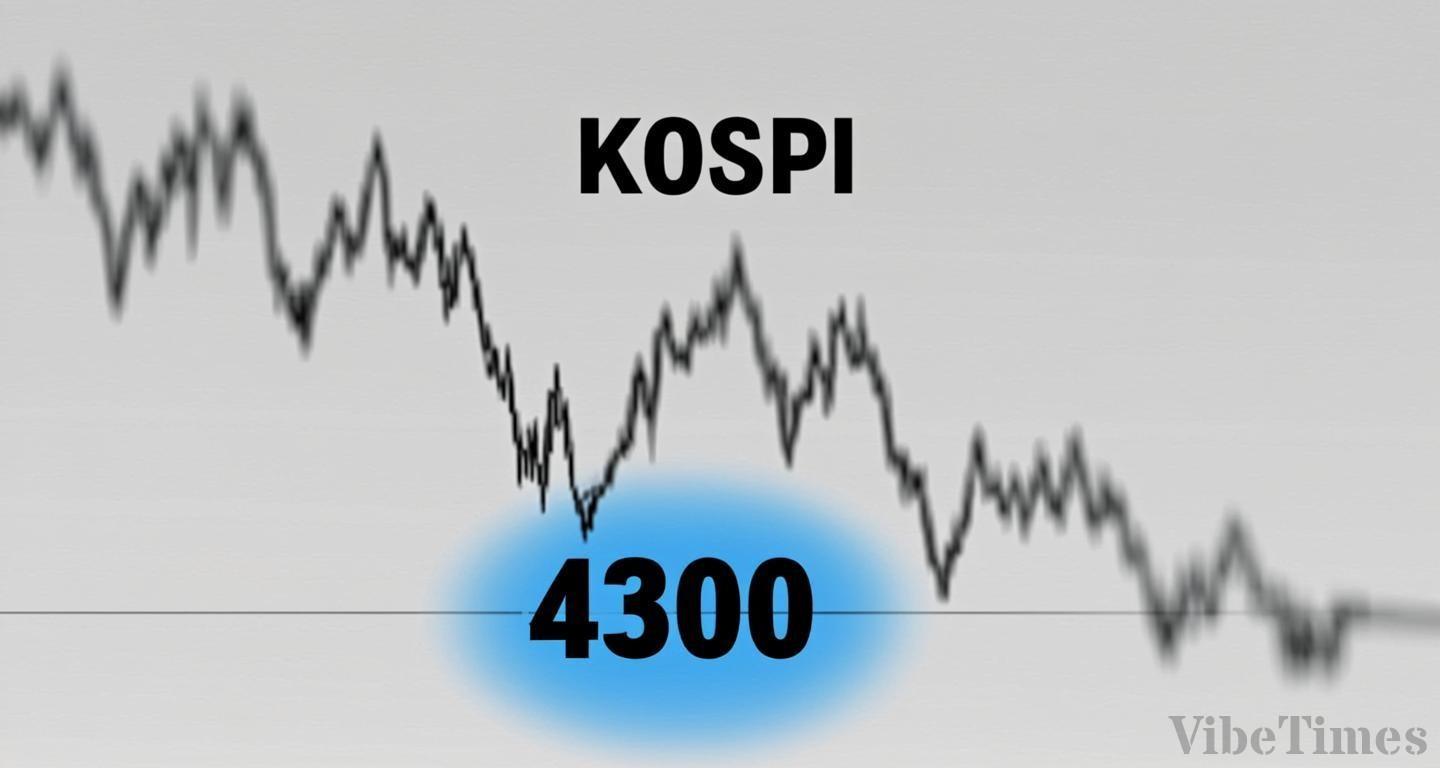
Hana Securities estimates the bottom of the KOSPI, which fell sharply in the wake of Nvidia's stock decline, at around 4,300. Foreign investors have net sold about 168 trillion won worth of stocks over the past seven months, accounting for 4.3% of market capitalization (the total value of listed companies' shares) — a scale comparable to the global financial crisis. The U.S. stock market has also seen steep declines.
Lee Jae-man, a researcher at Hana Securities, said, "The S&P 500 and Nasdaq indexes have plunged 12% and 18%, respectively, from recent highs, marking their steepest declines since the reciprocal tariff announcement in April last year," adding, "The volatility index (VIX), a gauge of market anxiety, also rose to 36, exceeding its average ceiling of 24."
U.S. semiconductor stocks have already priced in a negative scenario. According to Hana Securities, semiconductors' share of S&P 500 market capitalization has fallen to 12.4%, back to June 2024 levels. The researcher noted, "Semiconductors accounted for 7.0–7.5% of S&P 500 net profits in the first and second quarters of last year, with 2027 estimated at 20–24%," and added, "The current market-cap share is similar to what would be assumed under an extreme scenario where next year's profit estimates are cut by 70%."
The KOSPI is in a similar situation. Of this year's decline in KOSPI market capitalization, Samsung Electronics and SK Hynix account for as much as 68%. The researcher analyzed, "The two stocks' combined market-cap share has fallen to 49%, but that is still above the 24% of June last year," adding, "As they are likely to determine overall volatility, it appears difficult for the VKOSPI (53.2) to fall quickly."
Stocks other than semiconductors show a similar pattern. Among KOSPI 200 constituents, 81% of stocks have fallen more than 40% from their highs — a figure comparable to 88% during the financial crisis and 85% during the COVID-19 pandemic. Lee Jae-man explained, "The KOSPI's 12-month forward price-to-book ratio (PBR) stands at 0.91x, or 0.78x excluding Samsung Electronics and SK Hynix," and "on a trailing PBR basis, the figures are 1.07x and 0.74x, respectively."
Hence the bottom estimate. Assuming the trailing PBR falls to 0.94x — the level of August 2024, just before semiconductors came into the spotlight — that translates into an index level of 4,300. The KOSPI closed at 4,869.96 on the 20th, the previous trading day.
Falling market interest rates were cited as the rebound driver. The researcher said, "The index plunge could push market rates lower as well," and "if earnings outlooks don't actually deteriorate significantly, falling market rates could trigger an index rebound." He added, "Since trailing PBRs have plunged, oversold sectors such as automobiles, secondary batteries, defense, retail, distribution and construction — which have fallen to August 2024 levels — could attract attention."
