Micron Tops US Market With One-Year Return of 566%

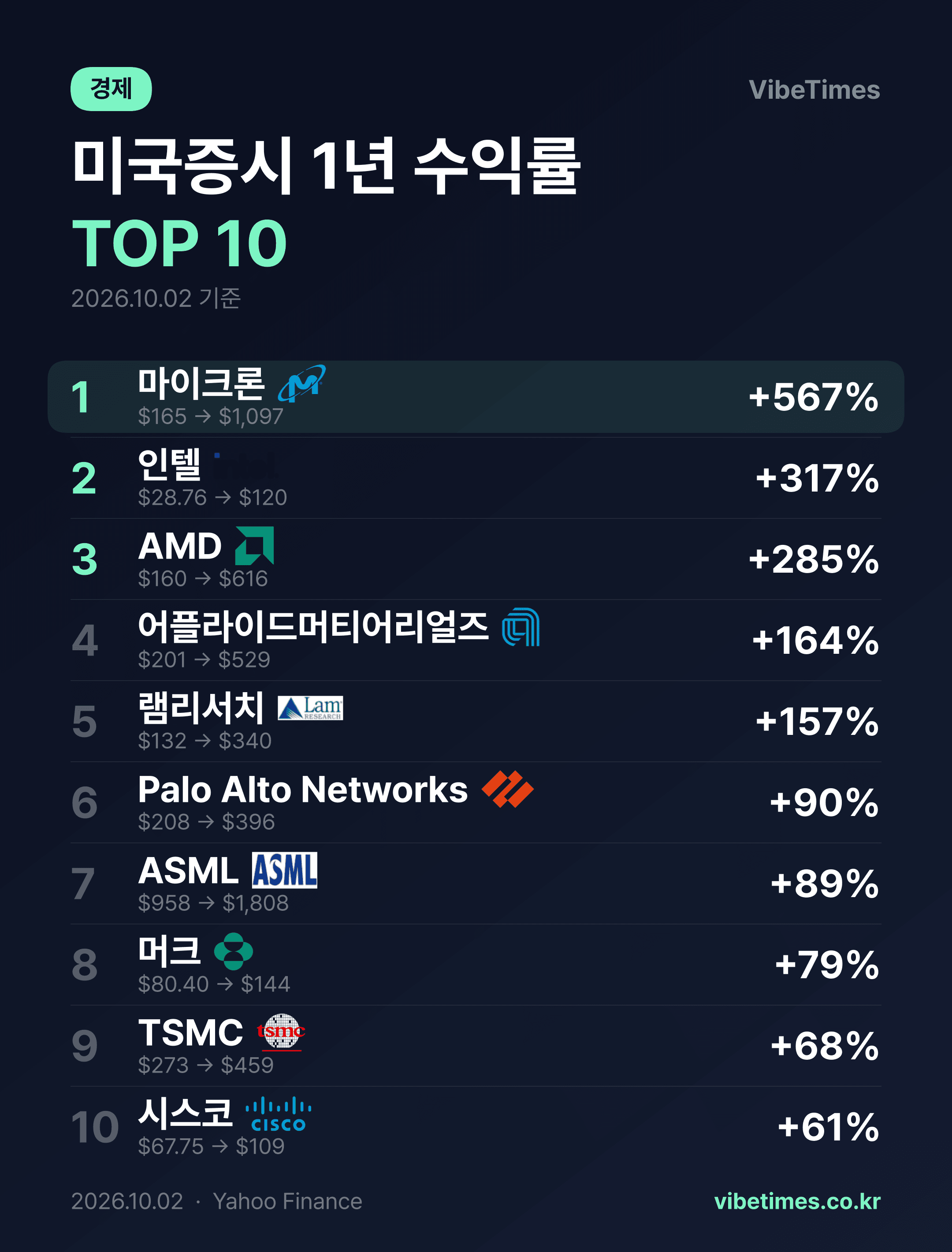
Micron's share price surged more than 566% in a single year, placing it at the top of US stock market return rankings.
According to a tally of the 10 best-performing US stocks by one-year return as of October 2, 2026, Micron rose from $165 to $1,097 per share, posting a return of +566.6%. Its market capitalization now stands at $1.20 trillion, second among semiconductor companies only to TSMC ($2.37 trillion). Stock prices ultimately speak for themselves. Just as those who neglect small truths cannot be trusted with larger ones, the essential question posed by this ranking is whether even soaring individual stocks must be backed by earnings that justify the gains.
Semiconductors Dominate the Top Ranks
Semiconductor-related companies claimed 7 of the top 10 spots, from first through fifth as well as seventh and ninth. Intel ranked second at +317.2% ($28.76 to $120), followed by AMD in third at +285.3% ($160 to $616). Applied Materials (+164.0%) in fourth and Lam Research (+157.3%) in fifth are both wafer fabrication equipment makers, showing how directly the demand to expand semiconductor production capacity has fed into their share prices. It is also notable that the two equipment makers' market capitalizations are nearly identical, at $405.8 billion and $411.1 billion, respectively.
Micron's +566.6% in particular is an overwhelming figure, more than 250 percentage points ahead of second-place Intel. One interpretation is that as companies moved to secure inventories during a period of rising memory chip prices, demand for memory—including HBM (high bandwidth memory)—exploded. Intel's +317.2%, meanwhile, should be viewed in light of a rebound from a low base: the stock's slide to $28.76 created a low baseline that inflated its percentage return.
The Significance of Non-Semiconductor Stocks
Three non-semiconductor stocks made the list. Palo Alto Networks in sixth (+90.3%) reflects the structural growth in cybersecurity demand, while Merck in eighth (+78.9%) reflects a steady revaluation of the pharmaceutical sector. Cisco in tenth (+60.5%) can be read as a signal that network equipment replacement demand has returned. By market capitalization, Cisco stands at $424.3 billion and Merck at $358.5 billion—significant because both are large caps that nonetheless achieved returns of 60% to 79%. For large-cap stocks to rise that much, expectations themselves must have been revised upward.
Investment Implications and Outlook
The lesson from this ranking is clear: the entire semiconductor value chain has surged in tandem. Gains across every segment of the industry—memory (Micron), foundries (Intel, TSMC), design (AMD), and equipment (Applied Materials, Lam Research, ASML)—are proof that the cause was not good news for a single company but an industry-wide expansion of demand. TSMC's +68.4% looks low by ranking standards, but given its massive $2.37 trillion market capitalization, it is in fact an extraordinary rise.
That said, return rankings carry pitfalls. A high return merely reflects the past year's results and guarantees nothing going forward. For Micron, entering after memory prices have peaked could put an end to the rally. Conversely, stocks like AMD, whose market capitalization climbed to $998.7 billion, or ASML at $695.9 billion, have reached valuations that may be a burden, making further gains difficult without earnings to back them up. Ultimately, the standard for investment decisions should not be the rankings but whether each company's earnings growth is sustainable. It is also worth noting that if the semiconductor cycle's momentum enters a correction phase, the top-ranked stocks could suffer the steepest declines.