President Lee Jae-myung directly ordered the early return of wartime operational control

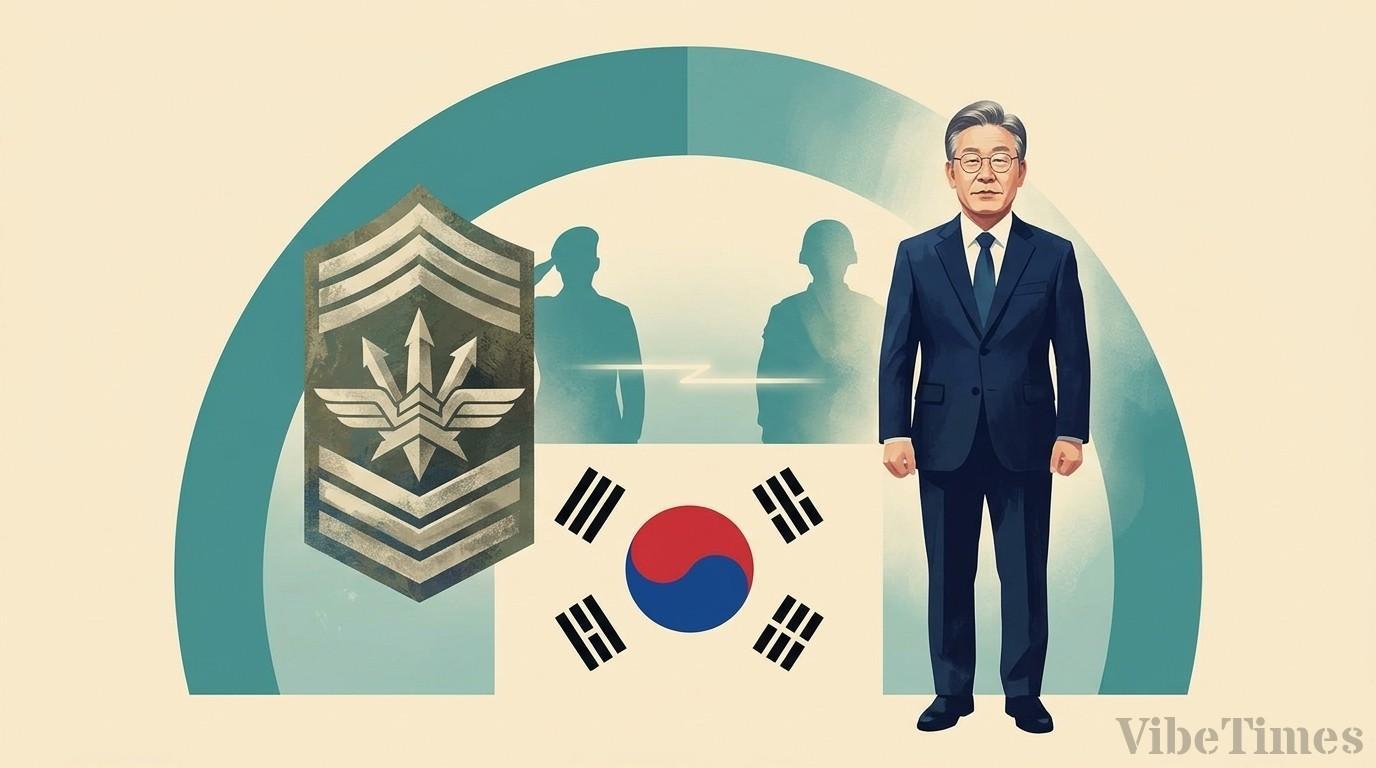
President Lee Jae-myung has made the return of wartime operational control (OPCON) a fixed mandate, ordering it be "completed as soon as possible."
The president emphasized achieving self-reliant national defense through the OPCON transfer while attending the 78th Armed Forces Day ceremony at Gyeryongdae in South Chungcheong Province on the 1st. Wartime operational control refers to the authority to command military operations in the event of war, currently exercised by the ROK-U.S. Combined Forces Command. He also stressed the military's political neutrality during the ceremony. His remarks carry added weight, coming amid ongoing controversy over political bias within the security apparatus following the recent DMZ landmine explosion.
The Backdrop of the Self-Reliant Defense Declaration and Security Issues
What stood out in the commemorative address was the president's approach to pressing security issues. Describing the DMZ landmine explosion as an "unfortunate accident," Lee made no direct mention of North Korea's responsibility. Instead, he has maintained a基调 of restoring dialogue and easing military tensions, consistent with his opposition to "deploying combat forces in a form that would engage in or intervene in the war," as stated at his press conference on the 18th of last month, and his remark on the 2nd that he would "steadily untie the knot in inter-Korean relations." His call for Pyongyang to continue restoring dialogue and easing military tensions is in the same vein.
At the same time, he urged accelerating the construction of nuclear-powered submarines and the modernization of missile technology, including hypersonic missiles. This is what is known as a dual-track strategy, pursuing both tension reduction and military strengthening. Raising the OPCON transfer and nuclear submarines together on the symbolic stage of the Armed Forces Day ceremony is seen as an attempt to directly imprint his commitment to self-reliant defense on the military leadership and the public.
Political Shockwaves and Cross-Party Sparring
The early OPCON transfer is a sensitive topic in political circles as well. The People Power Party has continued its security offensive, with party leader Jang Dong-hyuk claiming the DMZ landmine disaster was "a joint product of the Moon Jae-in and Lee Jae-myung administrations." President Lee's post-accident call for a "swift and transparent investigation" into the facts, while warning against baseless conspiracy theories, also carries the character of a response to this opposition offensive.
The OPCON transfer is also a coordination matter for the ROK-U.S. alliance. Since the timing and conditions of the transfer depend on an assessment of South Korea's ability to conduct independent operations, whether this remark translates into actual implementation speed remains to be seen. Intertwined with the president's approach to the United States—as seen in his chairing of a State Council meeting immediately after returning from his tour of the U.S. and Mexico—developments in the OPCON negotiations are expected to become a test of the ROK-U.S. relationship going forward.
The Security Card amid Falling Approval Ratings
It is also worth noting the domestic political significance of emphasizing security autonomy at this juncture. According to an NBS survey, the president's approval rating for his handling of state affairs fell to 43%, his lowest since taking office, while disapproval exceeded 50%. Some polls put his approval as low as 36.5%. With analyses suggesting that his press conference and overseas trips produced minimal approval rebounds, security—along with the three major social policy areas of housing, jobs, and consumer finance—remains a potential area where the government can deliver results.
Major military undertakings such as the OPCON transfer and nuclear-powered submarines require meeting three conditions—budget, technology, and allied cooperation—making short-term achievements difficult. Nevertheless, the self-reliant defense narrative could provide a shield against opposition security criticism and help secure the trust of some conservative voters, and attention is focused on whether the president's security message will become a driving force for recovering his approval ratings.
With inter-Korean relations frozen and the fallout from the landmine accident continuing, the president's order to reclaim OPCON will hinge on whether the self-reliant defense roadmap is concretized. Judicial branch conflicts exposed by Chief Justice Cho Hee-de's refusal to renominate Supreme Court justices, and tensions within the Democratic camp over the appointment of senior corruption investigations chief nominee Kim Ji-yong, have left the political calendar crowded—leading some to assess that military reform is an area relatively easier to build national consensus on. The direction of this administration's security policy is expected to be determined by the pace of military restructuring to meet OPCON transfer conditions and the speed of ROK-U.S. consultations.