Lee Jae-myung Tops Buzz Rankings as Lee Jun-sek Settles into Second

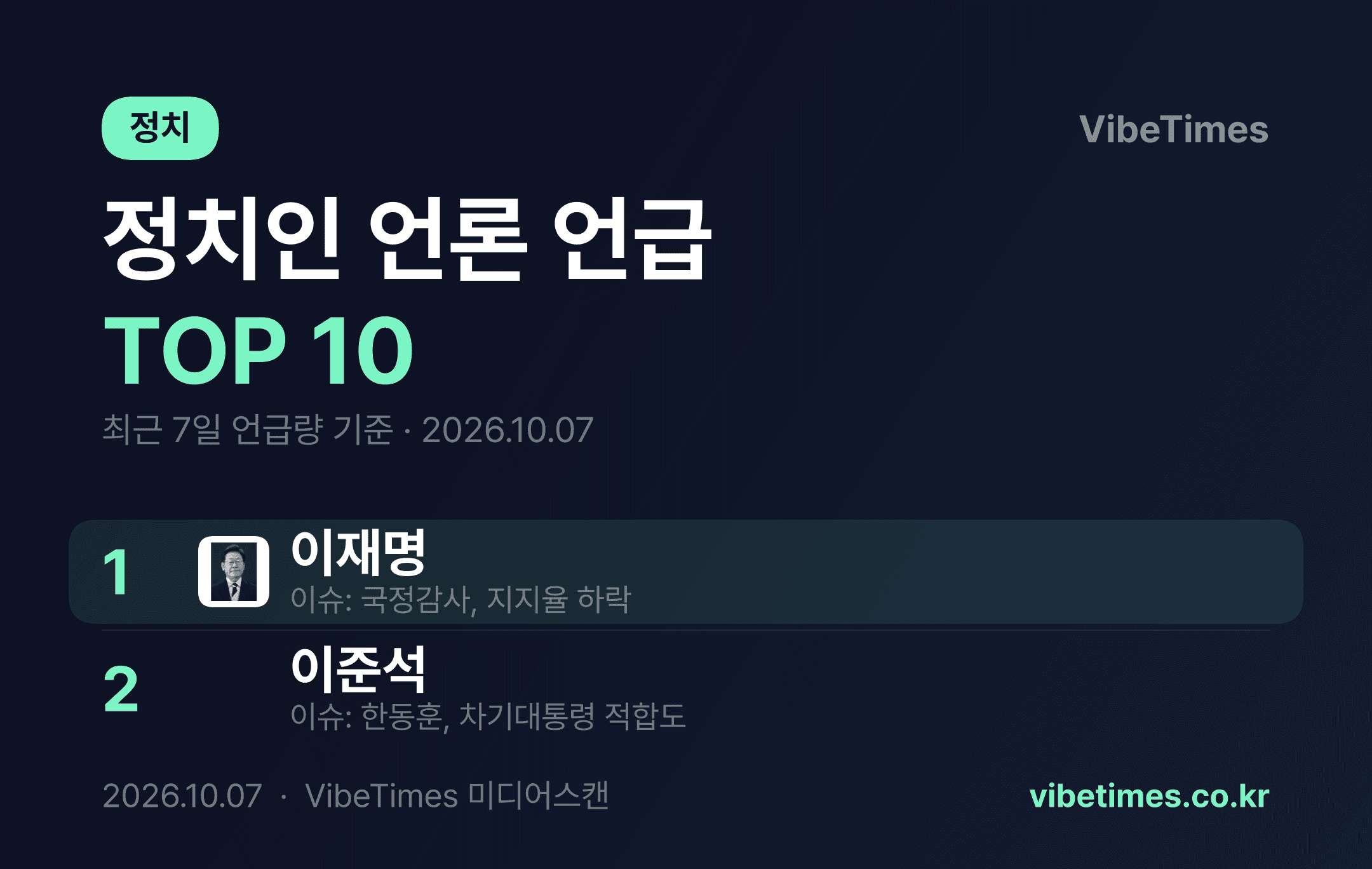
Lee Jae-myung ranked first in politicians' media buzz as of October 7, 2026, with Lee Jun-sek close behind in second place.
No. 1 Lee Jae-myung: Audit Season and Falling Approval Ratings Mentioned in Tandem
In the politician buzz rankings compiled on this day, President Lee Jae-myung came out on top. Buzz is an indicator that combines the volume of media coverage with search and social media reactions, and rankings rise regardless of whether the context in which a name is mentioned is positive or negative. For Lee, the National Assembly audit season was the spark. With the president's performance and policy issues repeatedly called into question during the ruling and opposition parties' audit clashes, the sheer volume of coverage surged.
What is notable is that falling approval ratings were tallied as a major issue alongside it. The fact that both a political event—the audits—and an evaluative metric—weak approval ratings—drove his buzz simultaneously means that a first-place ranking does not necessarily signal good news. Rather, it shows that public attention is shifting toward a midterm assessment of the administration's performance. When coverage volume grows while approval ratings are trending downward, exposure in negative contexts can expand, so leading the rankings may prove a burden for the ruling camp.
No. 2 Lee Jun-sek: The Next Presidential Race Drives the Conversation
Rep. Lee Jun-sek settled into second place. The axis of the buzz around him is clear: his positioning relative to former Justice Minister Han Dong-hoon, and polls on suitability as the next president. In the run-up to a presidential election, surveys measuring fitness as the next leader become a staple of media coverage, and Lee has been raising his name into the upper ranks of these polls, increasing his coverage frequency.
The frequent pairing of Lee Jun-sek and Han Dong-hoon shows that the contest for leadership within the conservative camp remains very much alive. Every time the two are mentioned together, speculation about shifts in support bases and the possibility of candidate consolidation follows, which in turn amplifies their buzz in a virtuous cycle. His second-place ranking should be read not simply as a popularity metric, but as evidence that Lee Jun-sek is already being classified among the leading contenders in the next presidential race.
What the Rankings Say About the Political Landscape
The structural feature of this ranking is that the top politicians from the ruling and opposition camps occupied the top two spots side by side. A sitting president and a next-presidential-race hopeful facing off in buzz rankings directly reflects a transitional landscape in which the political agenda is moving from the audit season toward the presidential cycle. For the ruling party, with audit and approval-rating issues weighing on it, policy achievements are needed to shift the agenda toward results; for the opposition, the task remains to convert public sentiment about the next leadership into presidential-race momentum.
Future movements in the rankings are expected to diverge along two lines. Once the audits wrap up, Lee Jae-myung's coverage volume will likely move according to policy announcements and whether conflicts with his party emerge. Lee Jun-sek's buzz is highly likely to fluctuate in step with the cycle of public opinion poll releases. Approval ratings are numbers that read differently depending on the angle from which they are viewed—like clouds—and that is the core message of this tally: leading the rankings does not mean holding the high ground.