October 24 Investment Report: AI Value Investing Portfolio +38.5%


[Daily Market Insight] Soaring Oil Prices and US Rates Near 5%: The AI Value Investing Portfolio's Choice in a Turbulent Market
Wall Street lurched sharply in a single day. The Dow plunged 1.23% and the S&P 500 slipped modestly, while WTI crude oil surged nearly 4%, stoking inflation fears, and the US 10-year Treasury yield edged right up to the 5% mark. Seoul told a different story, however. The KOSPI closed up 0.30%, holding the 5,550 level with help from large-cap semiconductor stocks, and the Korean won extended its gains. Amid this landscape, the 'AI Value Investing Portfolio' posted a cumulative return of +38.53% with total assets of $13,853, delivering performance that makes the market's turbulence look almost irrelevant.
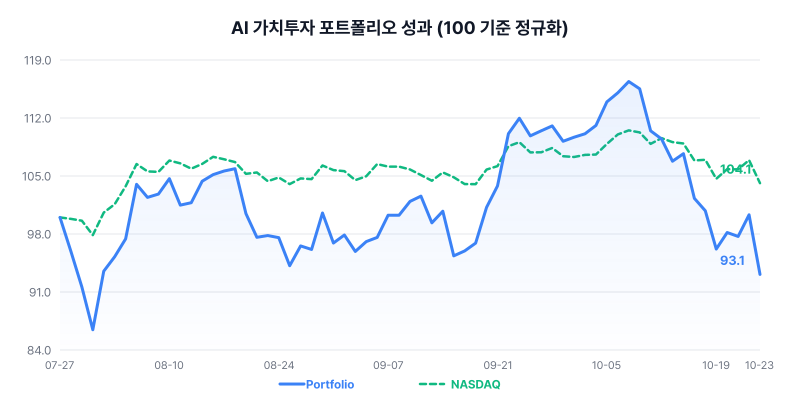
The Flow of Returns: How Heavy Is the Current Pullback?
Still, the past five days of asset movement reveal things are not entirely comfortable. Total assets, which had climbed to $14,923 on the 22nd, shed more than $1,000 in a single day on the 23rd. The main culprit was the sharp slide in individual semiconductor stocks. Viewed dispassionately, however, this correction is less a collapse of the index than a shedding of excess weight by memory and AI value-chain names that had been soaring almost vertically. The volatility index (VIX) at 19.45 remains within its year-to-date safe zone, and Nasdaq 100 futures are actually slightly up—suggesting fear has not spread into a structural crisis.
Holdings Check: Between Cheap Growth and Expensive Expectations
The backbone of this portfolio remains semiconductors. Micron, though underwater from its peak relative to purchase price, trades at an 11x P/E and a PEG of 0.16—evidence that its price is extremely low relative to its growth rate. Nvidia, at a PEG of 0.27, defies the conventional wisdom that it is 'expensive'; its earnings growth has consistently outpaced its share-price gains. AMD, by contrast, shows how fully expectations have been priced in, with a P/E approaching 130x, while Intel—still loss-making and valued on PEG alone—remains on the test bench. Amazon and Meta, proxies for the broader AI consumption cycle, serve as stabilizers at unremarkable levels of 20x and 22x, respectively.
| Ticker | Shares | Purchase Price | Current Price | P/E |
|---|---|---|---|---|
| Broadcom | 5.67 shares | $326.03 | $323.24 | 43.2 |
| Amazon | 1.95 shares | $208.39 | $250.38 | 20.1 |
| Intel | 2.80 shares | $104.56 | $85.49 | - |
| Meta | 0.55 shares | $653.56 | $648.85 | 22.1 |
| SOXL | 13.92 shares | $71.22 | $82.11 | 18.6 |
| TQQQ | 1.13 shares | $76.34 | $66.42 | 27.0 |
| AMD | 6.82 shares | $198.62 | $507.93 | 129.6 |
| Nvidia | 24.00 shares | $184.21 | $212.21 | 26.8 |
| Micron | 1.30 shares | $930.96 | $856.49 | 11.5 |
Trade Review: Discipline That Breaks Concentration
The essence of recent trades boils down to one sentence: 'Move from stocks that have run up to beaten-down cheap ones.' Realizing part of the gains in Nvidia and AMD eased single-stock concentration, which had reached 38%, and the proceeds were used to buy the correcting Micron in three tranches. This is classic rebalancing—maintaining conviction in growth stocks amid expanding AI and memory demand while reducing single-name concentration risk. Trimming the leveraged SOXL and TQQQ positions likewise counts as a proactive move to damp volatility in a fast-shifting market.
| Date | Type | Ticker | Shares | Price |
|---|---|---|---|---|
| 2026-10-23 | Buy | Micron | 0.47 shares | $856.49 |
| 2026-10-23 | Sell | Nvidia | 1.26 shares | $212.21 |
| 2026-10-23 | Sell | AMD | 0.36 shares | $507.93 |
| 2026-10-16 | Buy | Micron | 0.31 shares | $931.24 |
| 2026-10-16 | Sell | Nvidia | 1.33 shares | $217.23 |
| 2026-10-09 | Buy | Micron | 0.11 shares | $1035.84 |
| 2026-10-09 | Sell | TQQQ | 0.06 shares | $80.23 |
| 2026-10-09 | Sell | SOXL | 0.73 shares | $142.52 |
Outlook: The Question Posed by 5% Rates
The variables are clear. If the US 10-year yield breaks above 5%, valuation pressure on long-duration growth stocks will inevitably build, and if soaring oil erodes corporate margins, AI investment demand could suffer as well. Conversely, the Philadelphia Semiconductor Index's 0.44% gain even in a down market shows this correction is not a sector fundamentals problem. With the won strengthening, the portfolio's beneficiary structure could persist as well. How safely it crosses the threshold into a 5%-rate era is the key to carrying the +38.53% achieved so far toward its ultimate goal.
※ This report analyzes the simulated operation of the AI Value Investing Portfolio and does not constitute investment advice. Actual investment decisions should be made at your own discretion and responsibility.
Curious about the portfolio's full details?
Subscribe to the newsletter below to receive a detailed investment report every day.