Foreign Investors' 15 Trillion Won Net Selling Impacts SK Hynix Stock Price

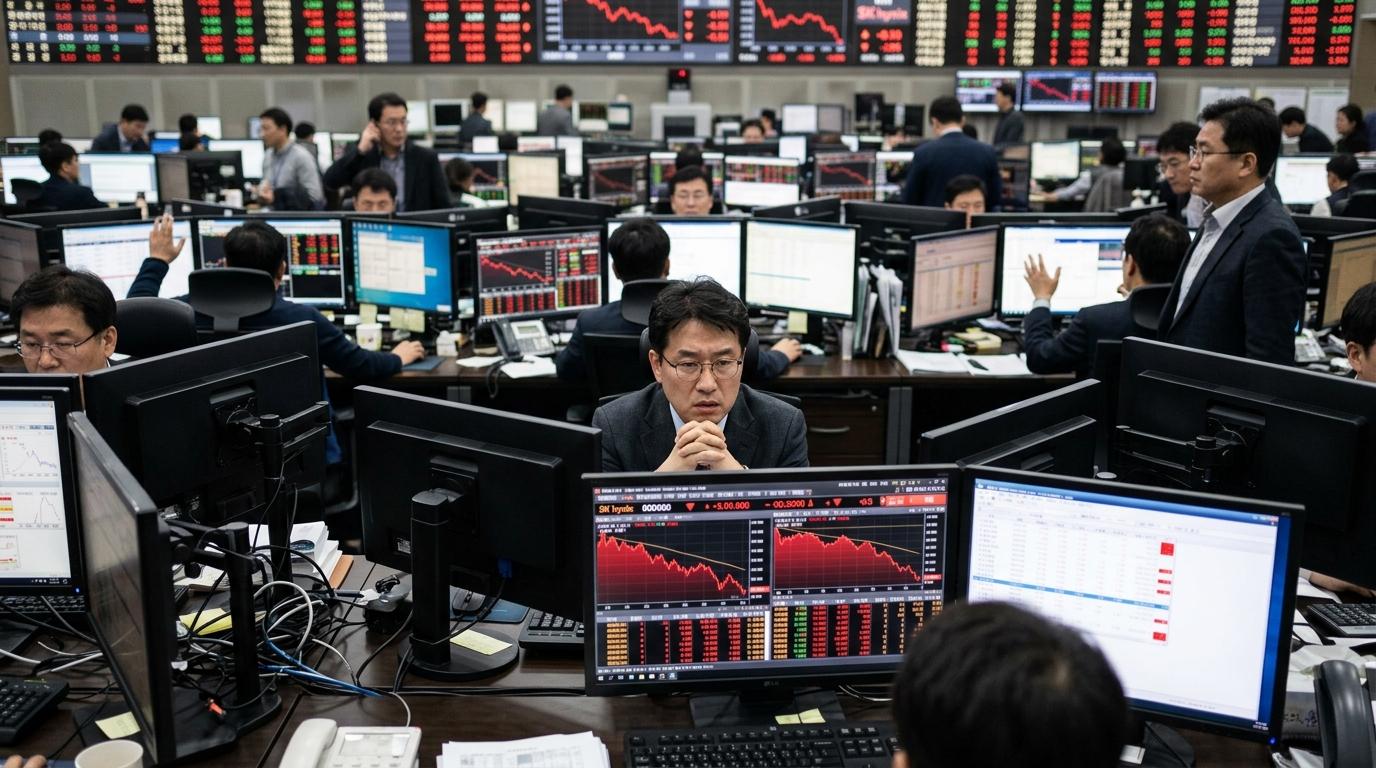
Market attention is sharply focused on recent foreign investor net selling activity in the South Korean stock market, amounting to approximately 15 trillion won. Investors are keenly interested in a deep analysis of the short-term stock price pressures SK Hynix, one of the top market cap stocks on the KOSPI, is facing amidst this macroeconomic trend, and the true extent of its impact.
Analysis of the Impact of 15 Trillion Won Foreign Net Selling on SK Hynix's Short-Term Stock Price
Examining the significance of the '15 trillion won' figure and the overall foreign investment sentiment in the market, the approximately 15 trillion won net selling recorded by foreign investors in the domestic stock market recently indicates the severity of foreign capital outflow across the Korean stock market during a specific period. This figure can be interpreted not just as individual stock movements, but as an indicator reflecting changes in foreign investment sentiment towards the Korean stock market as a whole and a slowdown in supply-demand conditions. It is analyzed as a result of complex factors such as changes in the global macroeconomic environment, uncertainty in interest rate policies, and geopolitical risks, rather than a mere temporary market correction. Such large-scale net selling suggests a temporary decline in foreign investors' perception of the Korean stock market's attractiveness.
SK Hynix is sensitive to changes in foreign capital flows as a leading stock on the Korean market because, along with Samsung Electronics, it forms the top tier of market capitalization among technology stocks on the Korean stock market, significantly influencing KOSPI index movements. Therefore, foreign investor trading patterns are highly likely to be directly linked to SK Hynix's stock price trajectory. If foreign investors' net selling is concentrated on SK Hynix alongside a deterioration in overall foreign investment sentiment towards the Korean stock market, it will act as considerable selling pressure on the stock. To understand SK Hynix's stock price movement amidst these macroeconomic foreign capital flow changes, it is necessary to closely examine both the overall market supply-demand trends and SK Hynix's individual foreign capital flow situation.
Understanding the pattern of net selling targeting SK Hynix through the timing and scale of selling pressure is crucial. Within the context of the 15 trillion won in foreign net selling across the Korean stock market, pinpointing whether SK Hynix was among the top stocks experiencing foreign net selling during that period is key. If the proportion of foreign net selling in SK Hynix was high, it signifies direct downward pressure on its stock price. When large volumes of sell orders are released into the market, they can temporarily overwhelm buying pressure, causing price adjustments and, in turn, leading to a contraction in investor sentiment that fuels further declines. Therefore, analyzing the timing, scale, and concentration of foreign net selling in SK Hynix provides critical clues for assessing its short-term stock price impact.
Deepening supply-demand imbalances are a factor in expanding short-term stock price volatility, and large-scale net selling by foreign investors intensifies short-term supply-demand imbalances by increasing the supply of SK Hynix shares while simultaneously reducing demand. Particularly in situations where market liquidity is scarce or investors are in a wait-and-see mode, sudden and large-scale selling can shake stock prices even more significantly. This is highly likely to lead to short-term stock price declines, with the extent varying depending on the speed and scale of the selling volume, as well as market participants' reactions. If short-term traders or program trading-driven profit-taking or stop-loss orders coincide, the downward range could further widen.
The possibility of a spreading 'sell-off' sentiment due to shrinking investor confidence also warrants attention. Foreign selling is not merely a supply-demand issue; it negatively impacts market participants' investment sentiment. Particularly, large-scale selling of leading large-cap technology stocks like SK Hynix can create a learned response of 'if foreigners sell, prices fall further,' stimulating selling sentiment among retail investors and some institutional investors. If this 'sell-off' sentiment spreads, it may be difficult to avoid short-term stock price declines, even with positive company fundamentals or news. This can limit opportunities for technical rebounds and make investors' decisions more cautious.
Semiconductor Industry Outlook and SK Hynix's Fundamentals Versus Future Stock Price Prospects at a Crossroads
Looking at signs of recovery in the global semiconductor industry and the fundamental strengths of SK Hynix, the company's stock outlook, despite macroeconomic supply-demand pressures, depends on its fundamental underpinnings and the improvement of the semiconductor industry cycle. Currently, the prevailing analysis suggests that the global semiconductor market is entering a phase of gradual recovery, driven by increased demand for artificial intelligence (AI) and rising memory prices. SK Hynix, in particular, possesses long-term growth potential based on its unique technological leadership in the High Bandwidth Memory (HBM) market and its solid position in the AI semiconductor sector. These fundamental strengths can serve as a powerful catalyst for stock price rebounds once foreign net selling subsides, becoming a key factor supporting stock prices when positive market sentiment resurfaces.
Predicting the timing of the stabilization of short-term selling pressure and stock price recovery scenarios, the short-term rebound timing for SK Hynix's stock price hinges on the stabilization of foreign net selling. If foreign selling momentum slows or turns into net buying, the stock price could rapidly recover as previously suppressed buying sentiment reawakens. Particularly, if overall supply-demand conditions in the Korean stock market improve or global macroeconomic uncertainty eases, foreign capital inflows could resume. If positive momentum in AI-related sectors continues and the visibility of SK Hynix's earnings improvements increases, it is not impossible for the stock to break through previous highs or set new records, overcoming short-term supply-demand headwinds. The simultaneous improvement of market fundamental expectations and foreign capital flows is a key variable.
Adopting a balanced investment strategy between short-term volatility and long-term growth, SK Hynix investors should ultimately assess the company's fundamentals and the structural growth of the semiconductor industry from a long-term perspective, rather than being swayed by short-term stock price fluctuations caused by foreign net selling. In the short term, a strategy of closely monitoring foreign capital flow trends and adjusting investment exposure may be necessary. However, SK Hynix's technological leadership and market dominance as a key beneficiary of the AI era will drive long-term value appreciation. Therefore, correction phases caused by short-term supply-demand headwinds, such as the current 15 trillion won net selling, could actually present opportunities for low-priced buying from a long-term perspective. SK Hynix's solid fundamentals are expected to overcome short-term market trends and support steady stock price growth.
