US Public Companies Ranked by All-Time Highest Revenue

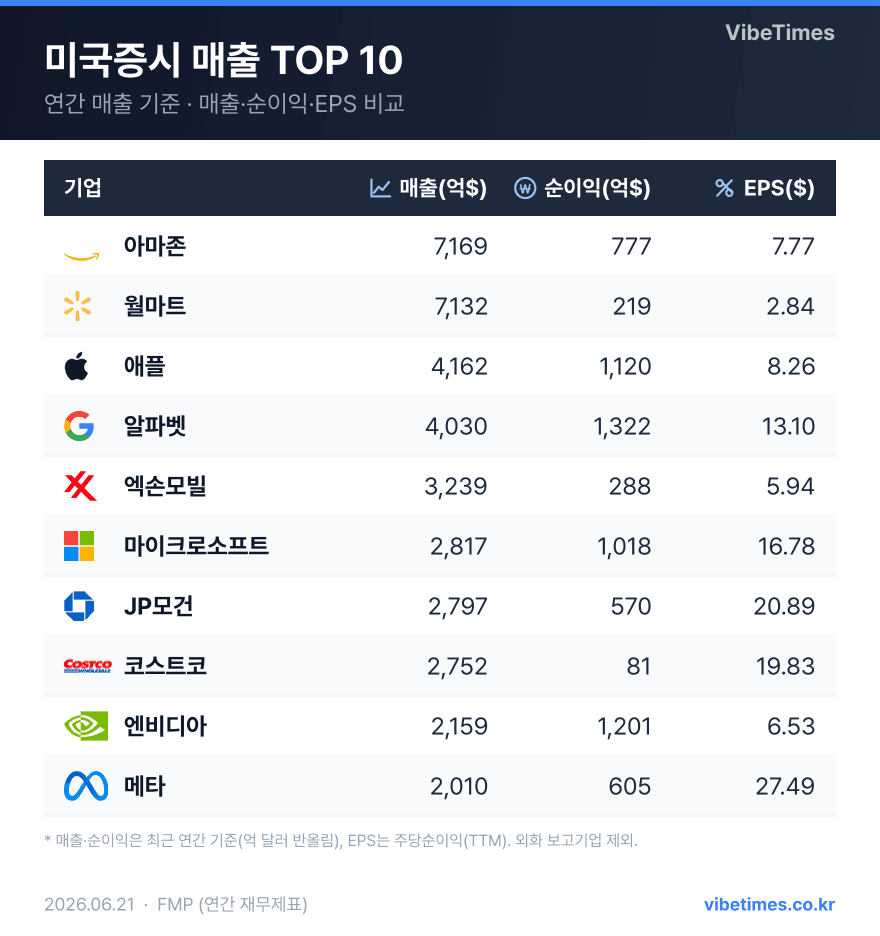
On June 21, 2026, the latest rankings of U.S. publicly traded companies by revenue were released. According to the announcement, Amazon and Walmart secured the first and second positions, respectively, boasting overwhelming revenue figures. Notably, Amazon set a new all-time record with a staggering $716.9 billion (approximately 990 trillion won) in revenue. Walmart followed closely with $713.2 billion (approximately 985 trillion won), demonstrating its strong performance and narrowing the gap with the top spot. The combined revenue of these two giants reached $1.4301 trillion, accounting for a significant portion of the total revenue of the top 10 companies.
Tech Giants' Immense Profitability and Market Dominance
Within the top ranks, the dominance of technology companies continued to solidify. Apple, at third place, achieved $416.2 billion in revenue and a net profit of $112 billion, showcasing its high profitability. In terms of net profit alone, Apple ranked second after Nvidia ($120.1 billion) and third after Alphabet ($132.2 billion), highlighting its exceptional ability to generate profit relative to its revenue scale. Alphabet, despite ranking fourth with $403 billion in revenue, posted a net profit of $132.2 billion, a testament to the superior profit margins characteristic of tech firms. Its earnings per share (EPS) also remained high at $13.10.
Microsoft, in sixth place, maintained strong competitiveness with $281.7 billion in revenue and $101.8 billion in net profit. Nvidia, while ranking ninth, recorded an impressive net profit of $120.1 billion on $215.9 billion in revenue, boasting industry-leading profit margins. This figure starkly illustrates Nvidia's unparalleled technological prowess and market dominance, positioning it at the center of the booming artificial intelligence (AI) industry in recent years. Meta, at tenth place, confirmed its robust revenue model in advertising and social media platforms with $201 billion in revenue and $60.5 billion in net profit. The substantial net profits of these tech companies are expected to fuel future growth through massive investments in research and development and innovation.
Resilience of Traditional Industries and Profitability in Finance & Retail
Traditional industry players also consistently featured among the top revenue generators. ExxonMobil, fifth, with $323.9 billion in revenue, reaffirmed the significance of the energy market. Its net profit of $28.8 billion suggests stable profitability despite oil price volatility. Costco, eighth, solidified its position as a retail powerhouse with $275.2 billion in revenue and $8.1 billion in net profit, driven by its low-price strategy and membership model.
In the financial sector, JPMorgan Chase ranked seventh with $279.7 billion in revenue and $57 billion in net profit, representing the influence of the U.S. financial industry. Particularly, JPMorgan's EPS of $20.89 is notably high, reflecting the stable operation of financial markets and efficient asset management capabilities. The net profits of these companies are underpinned by robust demand in their respective industries and effective business operational strategies, indicating a pursuit of steady growth despite macroeconomic conditions.
Market Impact and Investment Implications
This ranking clearly demonstrates the sustained influence of technology and consumer/energy industries, the two pillars of the U.S. economy. The revenue competition between Amazon and Walmart signals accelerating changes in consumer trends and the convergence of online and offline retail channels. Both companies are expanding into diverse business areas such as logistics, cloud, and advertising, creating synergies that are expected to further strengthen their market dominance.
The substantial net profits of tech companies signify ongoing investments in future growth sectors like AI, cloud computing, and digital advertising. Nvidia's high profit margins, in particular, attest to the explosive growth of the AI semiconductor market and are likely to spur investments across the entire related ecosystem. Apple, Microsoft, and Alphabet are expected to maintain their competitive edge and discover new revenue streams through the launch of innovative products and services. Their significant cash reserves could translate into enhanced shareholder value through mergers and acquisitions (M&A) or share buybacks.
Conversely, traditional companies like ExxonMobil and JPMorgan Chase are expected to generate stable returns amidst macroeconomic volatility, contributing to portfolio diversification. However, the energy industry's sensitivity to external environmental changes, such as geopolitical risks and green transition policies, should be noted. Costco, with its strong customer base and price competitiveness, has demonstrated its ability to maintain relatively stable demand even during economic downturns.
Overall, this ranking suggests that the U.S. economy will continue its growth trajectory, driven by the innovation of giant tech corporations and the resilience of traditional industries. Investors should make prudent decisions by comprehensively considering each company's core business competitiveness, capacity for new technology investment, and ability to respond to macroeconomic changes. Particularly, it is crucial to thoroughly assess a company's actual profit-generating capabilities and potential for increasing shareholder value through metrics like net profit scale and EPS growth rates.