National Assembly Data Analysis: Cho Kuk Innovation Party Far-Left on Economy, Centrist on Society… Hwang Un-ha Most Leftist, Lee Hae-min Moderate

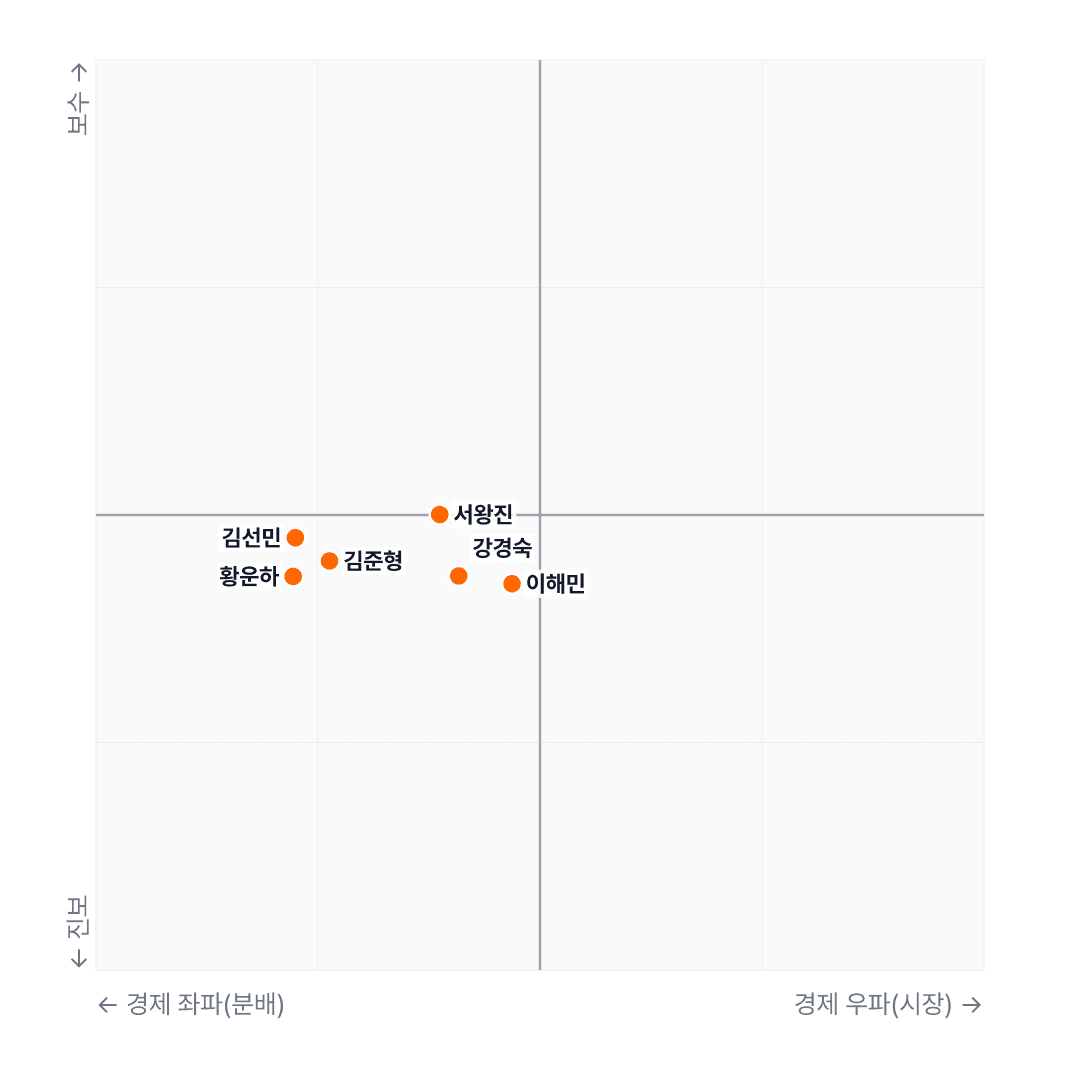
Strong Progressive Stance in Economic Issues… Moderate Centrist Stance on Social Agendas
A quantitative analysis of bill sponsorships and voting behavior by the 12 lawmakers of the Cho Kuk Innovation Party reveals distinct leftist characteristics in their ideological leanings. Notably, on economic agendas, they are positioned distinctly further to the left than the average Democratic Party member. Conversely, regarding social issues, they adopt a relatively moderate stance, refraining from leaning towards intra-party extremes, resulting in a marked disparity between the two fields. This deviation is interpreted as a strategic choice by the party to champion radical income redistribution and labor rights strengthening while avoiding the loss of public support amidst complex sociocultural conflicts. According to quantitative data that converts ideological coordinates into a scale of 1 to 100, the intensity of the party’s leftist leanings in the economic sector was measured to be more than three times stronger than in the social sector.
Both Ends of the Ideological Spectrum… From Hwang Un-ha to Lee Hae-min
Examining the distribution of individual lawmakers clarifies the heterogeneous spectrum within the party. The figure displaying the strongest progressive leanings was Rep. Hwang Un-ha, who recorded the most leftist coordinates within the party across both economic and social agendas. He was followed by Reps. Kim Sun-min, Kim Jun-hyung, and Jeong Chun-saeng, who actively participated in sponsoring bills calling for strong state-led market intervention and taxation of the wealthy. The average leftist index of this top quartet—four out of the total 12—exceeds the party average by approximately 1.5 times.
In contrast, Rep. Lee Hae-min, who showed the most right-leaning tendencies within the party, occupies a position close to the center across both economic and social spheres. Reps. Kang Geum-suk, Seo Wang-jin, and Baek Seon-hee also displayed relatively moderate voting patterns, nearing the average of the opposition bloc. This phenomenon, where cumulative bill voting patterns differ significantly among lawmakers sharing the same party affiliation, suggests that individual constituency conditions and personal political philosophies served as major variables in the bill passage process, rather than factional line differences.
A 0.6% Trajectory… Deviation from Party Lines and Data Limitations
Analyzing the phenomenon of lawmakers deviating from party lines amid the currents of major politics reveals another political context. According to disclosed voting data, Rep. Park Eun-jung most frequently failed to follow the party leadership’s voting guidelines, at a rate of 0.6%. She was followed by Reps. Kim Jun-hyung, Kim Jae-won, and Kim Sun-min, with deviation rates of 0.4% and 0.3%, respectively. Although the deviation rate is less than 1%, deviation votes cast toward the ruling party on key agenda items likely served to secure political leverage or reflect specific industry interests. Public records also confirm instances where lawmakers holding specific corporate shares or receiving high-value donations from relevant sectors participated in votes raising potential conflict of interest concerns while deliberating bills directly related to industrial oversight. While this cannot be definitively classified as illegal, it remains a point requiring continuous institutional critique and reform.
Ultimately, the quantitative ideological coordinates of the Cho Kuk Innovation Party demonstrate a strong aspiration for economic equality. However, this data is limited to statistics accumulated from the monthly voting buttons in the National Assembly plenary sessions, rather than grand political slogans or one-time events perceived by the public. Therefore, it must be noted that visual discrepancies may arise between a lawmaker’s public image and their written voting records. The future manner in which these 12 lawmakers propose amendments to the ruling party’s economic bills is expected to flexibly alter the party’s substantive ideological spectrum once again.
Lawmakers Mentioned in Article
| Lawmaker | Party | Ideological Leanings | Note |
|---|---|---|---|
| Hwang Un-ha | Cho Kuk Innovation Party | Economic Leftist · Social Progressive | Far-Left in Party |
| Kim Sun-min | Cho Kuk Innovation Party | Economic Leftist · Social Progressive | Far-Left in Party |
| Kim Jun-hyung | Cho Kuk Innovation Party | Economic Leftist · Social Progressive | Far-Left in Party |
| Seo Wang-jin | Cho Kuk Innovation Party | Economic Leftist · Social Conservative | Right-leaning in Party |
| Kang Geum-suk | Cho Kuk Innovation Party | Economic Leftist · Social Progressive | Right-leaning in Party |
| Lee Hae-min | Cho Kuk Innovation Party | Economic Leftist · Social Progressive | Right-leaning in Party |