President Lee Jae-myung Meets Jensen Huang, Sam Altman in San Francisco

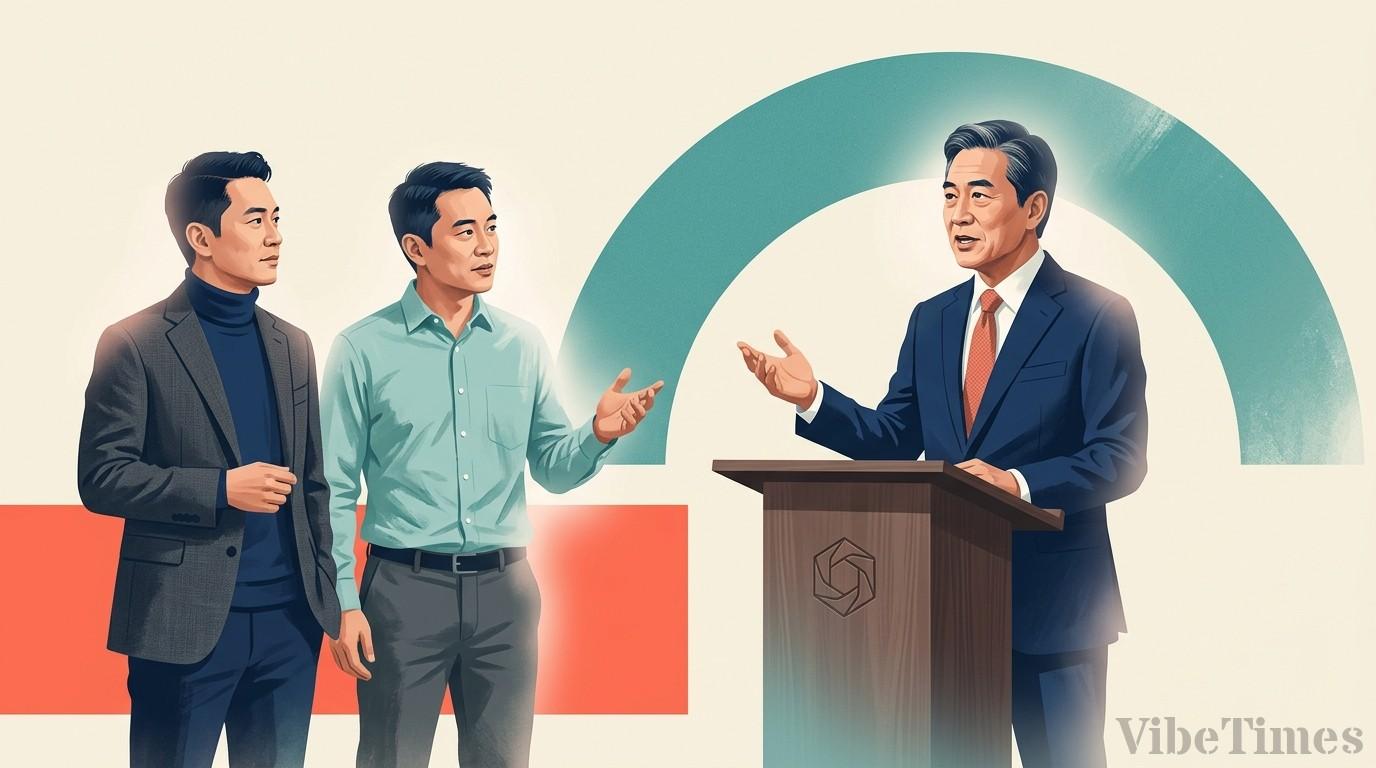
San Francisco Big Tech Meetings and Prospects for Attracting Large-scale Investment
President Lee Jae-myung has embarked on a tour of three South American countries, starting in San Francisco, U.S., for an extended itinerary of seven nights and 11 days. The core focus of this tour is securing dominance in artificial intelligence (AI) technology and attracting investment in cutting-edge industries. In particular, during the U.S. leg of the trip, he held successive meetings with global big tech leaders, including Nvidia CEO Jensen Huang and OpenAI CEO Sam Altman. The objective is to solidify technical cooperation for building a high-end semiconductor and AI ecosystem.
Presidential Policy Office Chief Kim Yong-beom presented clear standards for the economic achievements of this tour during a briefing with foreign media. He emphasized that long-term contracts for memory semiconductors would be signed with U.S. big tech companies and that the figures derived would be of a considerable magnitude. Additionally, the government revealed plans to create a massive "Future Response Fund" that could exceed 4,700 trillion won to prepare for Korea's future. This is interpreted as a strategic intention to leapfrog the national industrial structure beyond simple diplomatic protocol.
Rising Dual Issues: Expanding Labor Flexibility and Raising Property Taxes
To attract massive investment and form the fund, political and industrial circles cite securing labor market flexibility as an urgent task. Recently, a re-examination of the "Yellow Envelope Law" (the revised Labor Union Act Articles 2 and 3), which was implemented less than a year ago, has emerged at the forefront of policy debate. President Lee pointed out at a Cabinet meeting that the scope of labor disputes has been expanded too broadly. The rigidity of labor relations is seen as an unavoidable core obstacle blocking large-scale corporate investment. Consequently, the President quickly instructed for revisions to enforcement ordinances or strengthening of guidelines at the government level, moving to supplement the law. This is analyzed as a determination to prevent the contraction of corporate production activities and investment.
Institutional reform of the real estate market is also being treated as a key axis determining the stability of the macro economy. Despite a Gallup Korea poll showing his approval rating falling slightly for a third consecutive week to 51%, President Lee presided over a public debate on real estate policy and maintained a policy基调 of pushing forward. He defined the ultimate goal of real estate policy not as simple price control, but as price normalization. The plan is to seek pragmatic solutions, fearing the "Lost 30 Years" of long-term stagnation experienced by Japan. In particular, the formalization of property tax hikes by setting new tax standards based on single-homeowners will directly impact future tax revenue structures and housing market transactions. The policy intent is clear: to block capital inflow for speculative purposes and increase the tax burden on multi-homeowners to protect actual residents.
Pacing Prosecutorial Reform and Political Risks
Movements to minimize political issues in order to secure the driving force for economic policy are also being detected. Justice Minister Minister Sung-ho Jeong offered to resign over the controversy surrounding the abolition of supplementary investigations, but President Lee personally rejected the offer and urged him to stay. This appears to be a safeguard against the policy balance collapsing due to internal and external growing pains during the early stages of prosecutorial reform under the administration. Additionally, author Yu Si-min harshly criticized the President's direction on prosecutorial reform, saying "it smells fishy," exposing political disagreements. Democratic Party senior Yu In-tae also issued warnings of division, mentioning figures showing signs of leaving while stating that "the eyes of the political circle are strange." Consequently, claims have been raised that the President requested a meeting with author Yu twice but was refused, putting the internal unity of the Democratic Party on emergency alert.
Political stability and corporate investment capacity are essential to generate economic results. The biggest variable for the market is whether the specific investment contracts and long-term agreements with big tech promised in San Francisco will actually be fulfilled after President Lee returns from the South American tour. As seen in the instructions given at the Cabinet meeting for the swift implementation of supplementary measures regarding single-stock leveraged products and the move to advance the timing of deposit increases to the 31st, administrative power to control overheating in the financial market is operating very quickly. How the funding method for the ambitiously proposed Future Response Fund, labor law revisions, and property tax hikes dampen or stimulate investment sentiment is expected to serve as a key indicator determining the national economy moving forward.