Temperature and Timing for Crispy Air-Fried Eggplant

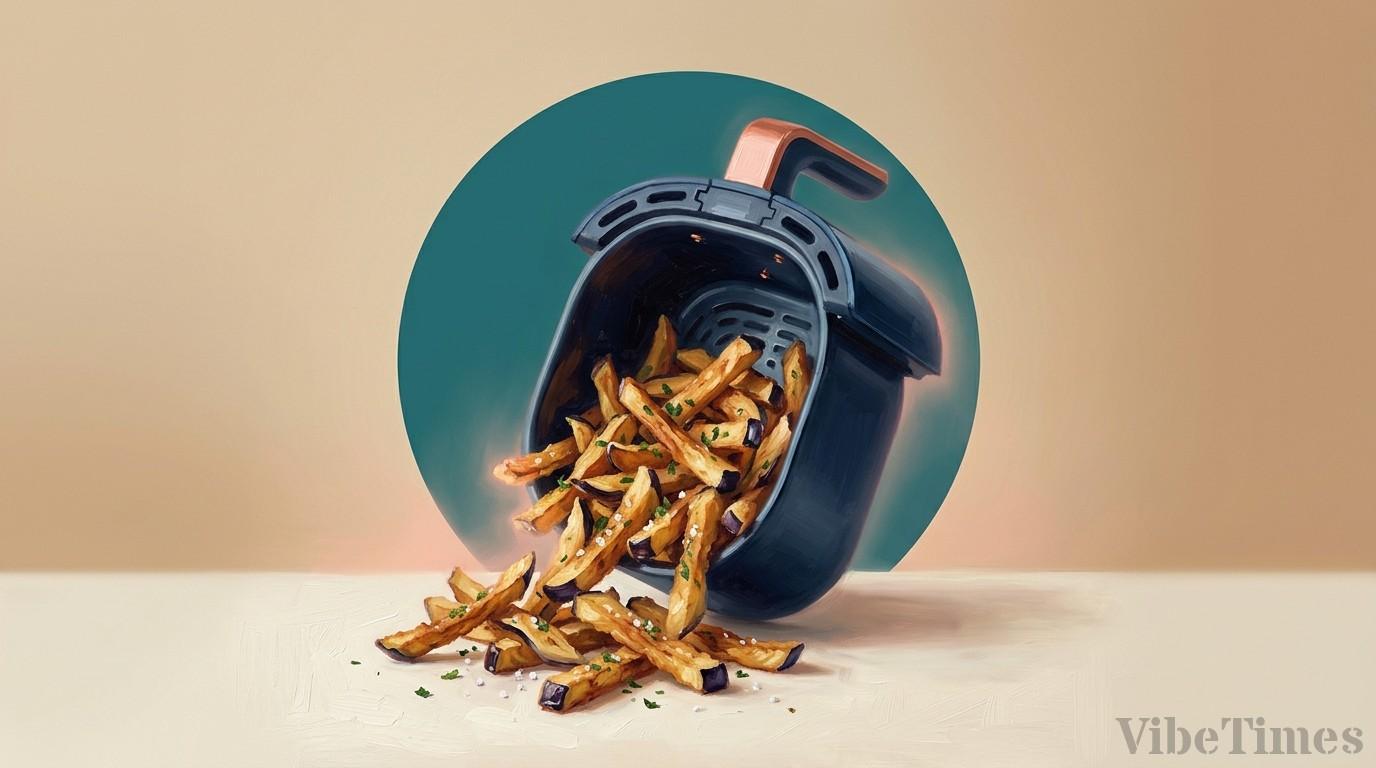
Analyzing the Causes of Failure: Why Air-Fried Eggplant Gets Soggy
The Paradox of 92% Moisture and the Steaming Effect
The most common type of failure when cooking eggplant in an air fryer is the phenomenon where the outside burns yellow while the inside remains soggy. Conversely, it is also frequent for the surface to be hard and dough-like while the inside is completely uncooked. The fundamental cause of these phenomena lies in the physical characteristics of the eggplant itself. Eggplant has an extremely high water content, with water accounting for about 92% of its total composition. It is like a sponge holding a massive amount of water inside.
An air fryer is a cooking appliance that cooks food by circulating hot air intensely inside to evaporate moisture from the ingredients. However, if the batter completely wraps the eggplant, the path for internal moisture to escape disappears. Consequently, the device fills only with steam, resulting in a so-called 'steaming' effect where heat is not transmitted inside the batter. This leads to fatal failures, such as the batter remaining in a doughy state or becoming sticky.
Limitations of Thermal Conductivity and Structural Differences in Appliances
The biggest difference between regular deep-frying in oil and air frying is the speed at which heat penetrates the ingredients. When ingredients are placed in hot oil, the surface of the batter hardens instantly due to high thermal conductivity, trapping internal moisture and frying it off. In contrast, since air fryers transfer heat via air, it takes a considerable amount of time for the temperature to penetrate to the inside of the ingredient. Because of this time difference, applying the same cooking time and temperature used for oil frying directly to an air fryer inevitably results in a soggy product.
To overcome the limitations of an appliance with slow heat penetration, preliminary work to definitively reduce the ingredient's own moisture before cooking must be prioritized. Since increasing cooking time does not naturally evaporate moisture, strategic temperature settings and time allocation are required.
Core Solution: Temperature and Timing for Perfect Crispiness
Strong Heat at 180°C to 190°C
Combining cooking data from culinary experts with various recipes, the ideal temperature for achieving crispy eggplant fries in an air fryer is between 180°C and 190°C. This temperature range slowly dries the moisture remaining inside the eggplant while having the effect of instantly grilling the batter coating the surface with strong heat. This can be considered the optimal hot air condition to achieve both goals simultaneously.
When setting the temperature, care must be taken to avoid excessively low or high temperatures. If set below 170°C, the batter does not harden sufficiently, making it difficult to expect a crispy texture. Conversely, exceeding 200°C results in a disaster where only the outside burns while the inside remains raw. Therefore, precise temperature control is cited as an essential condition for crispiness.
Segmented Time Management and Essential Flipping
Just as important as temperature is time allocation. The total cooking time for successful crispy eggplant is around 15 to 20 minutes. However, you should not simply set this time, turn on the device, and leave it unattended. Wisdom is required to subdivide the cooking process and adjust the temperature at each stage.
For the first 10 minutes, set it to 180°C to evaporate internal moisture and cook the surface slowly at a low temperature. At the 10-minute mark, you must stop the device and flip the fritters once. The bottom surface touching the basket is prone to becoming soggy as moisture rises. Immediately after flipping, it is good to spray oil evenly once more to prevent the surface from drying out. Afterwards, slightly raising the temperature to 190°C and cooking for the remaining 5 to 10 minutes completes perfect golden brown crispy fritters.
Practical Application: Pre-treatment Tips for Crispy Frying
Definitive Moisture Removal Using Salt
It is nearly impossible to completely remove the eggplant's excessive moisture using only the air fryer's heat source. Therefore, the process of definitively extracting moisture through pre-work before frying is vital. After slicing the eggplant into bite-sized pieces, sprinkle salt evenly and let it sit for 15 to 20 minutes; this is called 'Odoshi,' or the process of drawing out water. Afterwards, using kitchen towels to tightly squeeze out the discharged moisture can dramatically shorten cooking time.
Salt curing does not merely remove moisture. It performs a scientific role by breaking down the eggplant's cell tissue to make the texture porous, helping the batter adhere much better to the surface. If this moisture removal process is skipped, the eggplant will shrink inside the batter, resulting in a hard and tough texture.
Applying a Thin Batter and Choosing Materials
The key principle for air fryer batter is to apply it thinner than for deep-frying. If the batter is too thick, heat will not reach the inside, and it will not cook. First, coat with frying powder, lightly dust off excess powder, then apply a thin coat of batter made by mixing a small amount of cold water or carbonated water. To maximize crispiness, a 2-step coating technique, applying a thin layer of finely ground bread crumbs or panko again, is effective.
There are also points to note when applying oil. If you apply oil directly with a brush, the unfortunate accident of the batter peeling off can occur. You must use a spray-type oil and spray it evenly like dusting to ensure the surface crisps uniformly. It is advisable to use avocado oil or grapeseed oil, which are favorable for high-temperature cooking. Additionally, boldly remove perforated foil that obstructs air circulation and lay a perforated mat to prevent the phenomenon of bottom moisture being re-absorbed into the fritters.
Texture Trend Comparison and Safety Rules
Technical Differences Between Soft and Chewy vs. Crispy
The traditional soft and chewy eggplant, loved for a long time, is completed by slicing the ingredient thick (over 1.5 cm), applying only a single layer of batter, and cooking at a low temperature around 160°C for a long time. This method focuses on keeping the inside moist. In contrast, the recent trendy crispy style is characterized by slicing the eggplant thin (under 1 cm) to thoroughly remove moisture, applying a 2-step batter, and cooking at a high temperature of 190°C for a short time.
While a soft texture can be obtained relatively easily by utilizing the air fryer's unique steaming effect, achieving a crispy texture is only possible through the intricate combination of complex techniques such as pre-moisture removal, temperature zone settings, and mid-cooking oil spraying.
Essential Rules for Safe Consumption
Even if the crispy fritters are perfected, safety rules unique to the ingredients must be observed. If eggplant is left at room temperature for a long time after cooking, there is a risk it may easily spoil. Therefore, it is recommended to consume it within 2 hours of completion. If storage is unavoidable, it must be refrigerated, and then thoroughly reheated immediately before consumption. In particular, repeating thawing and refrigerating causes moisture loss, completely ruining the taste and texture, so it is most desirable to consume the cooked amount immediately.