Rep. Han Gi-ho Breaks Party Line 3.4% of the Time, Tops 'Conscience Voting' List
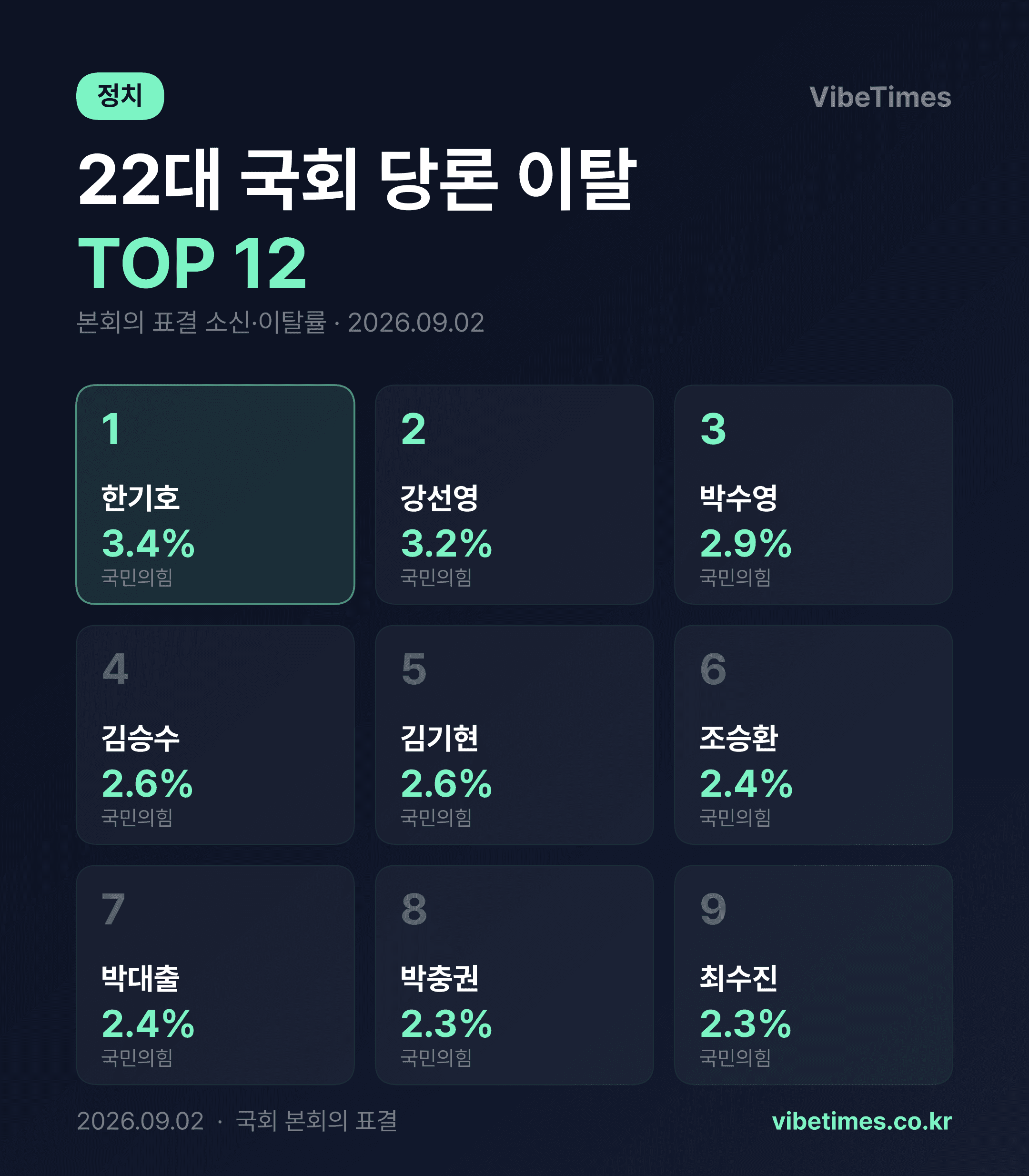
Rep. Han Gi-ho of the People Power Party stands at the top of the National Assembly's conscience voting rankings.
According to plenary voting tallies as of September 2, 2026, Rep. Han’s deviation rate from the party line was recorded at 3.4%. The deviation rate refers to the percentage of votes cast against the majority position of one’s affiliated party, serving as a yardstick to measure the scale of so-called "conscience voting," where individuals vote based on their own judgment rather than the party’s established line. Rep. Kang Seon-young ranked second with 3.2%, and Rep. Park Su-young ranked third with 2.9%, with all 12 ranked members, down to Rep. Shin Dong-wook in 12th place, belonging to the People Power Party. Although the figures are low, the starting point of this tally is that the relative rankings themselves serve as significant data, given the exceptionally strong party discipline in Korean politics.
A 1.3 Percentage Point Gap: A Tight Statistical Squeeze
The figures in the top ranks are clustered between 2.1% and 3.4%. The gap between 1st and 12th place remains at just 1.3 percentage points. Based on one hundred votes, this amounts to a difference of only three or four votes versus one or two. Since most plenary votes are filled with bills of little political weight, voting within party discipline is the default, and deviation is recorded as an exception. Considering how rarely these exceptions accumulate, a choice made once or twice on key bills can overturn the entire list—this high-resolution reality serves as a prerequisite for reading this indicator.
The clustering at the bottom is interpreted in the same context. Reps. Jo Seoung-en and Park Dae-chul are tied at 2.4%, Reps. Park Chung-kwon, Choi Su-jin, and Ju Ho-young are grouped together at 2.3%, and Rep. Kim Jae-seob forms another pair at the 2.1% line. It is a competition occurring in units of 0.1 percentage points. In this segment, the very existence of a tendency to deviate tells us more than individual rankings.
One-Party Skew: Two Interpretations
Korean political parties have maintained a strong disciplinary system that can impose disadvantages, such as in nomination or legislative activities, on members who violate the party line. The party line is determined by the party leadership, including the floor leader, and it is the default for the plenary session to operate within this framework; the fact that overall deviation rates remain in the low single digits is a result of this structure. The fact that the People Power Party dominated the top twelve spots on this board leaves room for two interpretations. If there were many contentious bills, it could be read as a sign of internal disagreements surfacing. If differences in voting denominators or bill composition played a role, it could be seen as a statistical byproduct. Either way, a level around 3% does not overturn the prevailing dominance of discipline.
Legislative Predictability: A Point for Markets to Watch
Party line discipline is directly linked to the predictability of legislation. If deviation rates remain low, the outcome of bill processing can be gauged according to the party leadership's blueprint, reducing policy uncertainty. Conversely, if this indicator moves upward, it is interpreted as a signal that major bills, such as budget proposals or tax reforms, could face unexpected variables during voting. The current 2-3% range falls within the zone of dominant discipline. For bills involving taxes, regulations, and industry support, voting results are immediately reflected in the outlook for related sectors, and for bills nearing the passage threshold, a single vote or two can decide life or death. Therefore, the behavior of these ranked lawmakers becomes a monitoring point for investors during situations involving key votes.
Variables for Ranking Reshuffling
Conscience voting typically emerges intensively in bills where interests conflict. Accordingly, rankings can easily be reshuffled as the session deepens. During periods when voting is concentrated, such as the year-end budget phase, there is a high possibility that the volatility of this indicator will increase. Whether top-tier members like Reps. Han Gi-ho and Kang Seon-young will widen their deviation gap or converge with the lower ranks due to a return to discipline is a key point to watch. However, the structure itself that keeps the overall deviation rate low is expected to remain difficult to change as long as the party leadership’s control is maintained.
Do not go gentle into that good night — Dylan Thomas
If we paste the poet's lines onto the voting chamber, it becomes a portrait of these lawmakers. The minority that did not meekly follow the majority into the night, their weight is loaded onto the small number of 3.4%.