10-Year Government Bond Yield Surges from 3.92% to 4.26% in Four Months

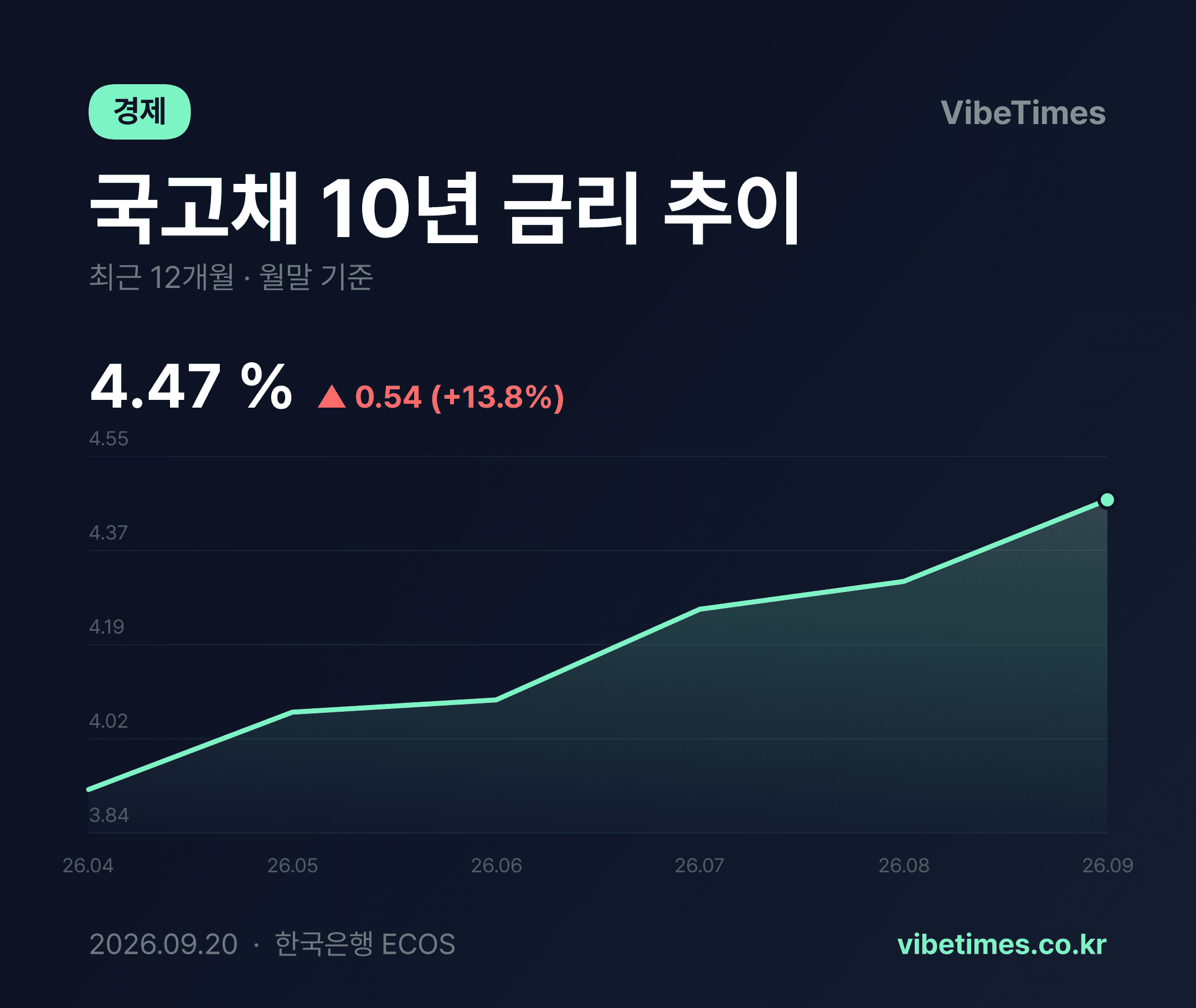
The yield on 10-year government bonds has risen 0.55 percentage points in five months.
Looking at end-of-month figures, the 10-year yield started at 3.92% in April, then moved through 4.07% in May, 4.09% in June, 4.26% in July, and 4.31% in August before climbing to 4.47% in September. The yield has now entered the mid-4% range. The change over six months amounts to +0.54 percentage points — a steep pace when annualized. Notably, the yield jumped 0.17 percentage points in July alone, accounting for roughly half of the total rise, which is the defining feature of this trend.
Why Yields Keep Rising
Government bond yields represent the interest rate the government pays when borrowing money. A rising yield means the market is less willing to buy bonds, or demanding higher compensation. The fact that yields have climbed for five consecutive months from April through September suggests this is not a temporary fluctuation but a structural trend.
The pattern of increases is also worth examining. There were two sharp jumps — 0.15 percentage points between April and May, and 0.17 percentage points between June and July. In contrast, the rise between May and June was only 0.02 percentage points. In other words, the yield has climbed in a stair-step fashion, alternating between gradual gains and sudden surges. This suggests that shocks tied to specific moments — such as inflation data or monetary policy decisions — may have been repeatedly priced into the market.
Impact on Markets
The direct effects of rising long-term yields are higher loan rates and increased corporate financing costs. The 10-year government bond yield serves as a benchmark for mortgage rates and corporate bond issuance. The rise from 3.92% to 4.47% means a heavier interest burden for households and businesses.
Bond prices move inversely to yields. While yields rose 0.54 percentage points, investors holding previously purchased government bonds likely suffered paper losses. Bond funds and banks' securities portfolios would also have faced valuation pressures. On the other hand, for fresh money entering the bond market, yields in the mid-4% range may offer a relatively attractive return.
The September figure of 4.47% is itself a message. The fact that the pace of increase has actually accelerated over the past six months — with the September rise reaching 0.16 percentage points from August — indicates that upward pressure on yields has not yet subsided. If this pace continues, the yield could exceed 4.5% before the end of the year.
That said, yields always reflect expectations. It can also be argued that after five straight months of increases, much of the market's negative outlook is already priced in. For investors, the sharply elevated yield level should not be viewed solely as a risk factor; this is also a moment to consider whether to seize the opportunity to enter at high yields. The yardstick for judging whether the uptrend continues will be upcoming inflation data and the direction of monetary policy.