Nvidia Reclaims Top Spot With $5.49 Trillion Market Cap

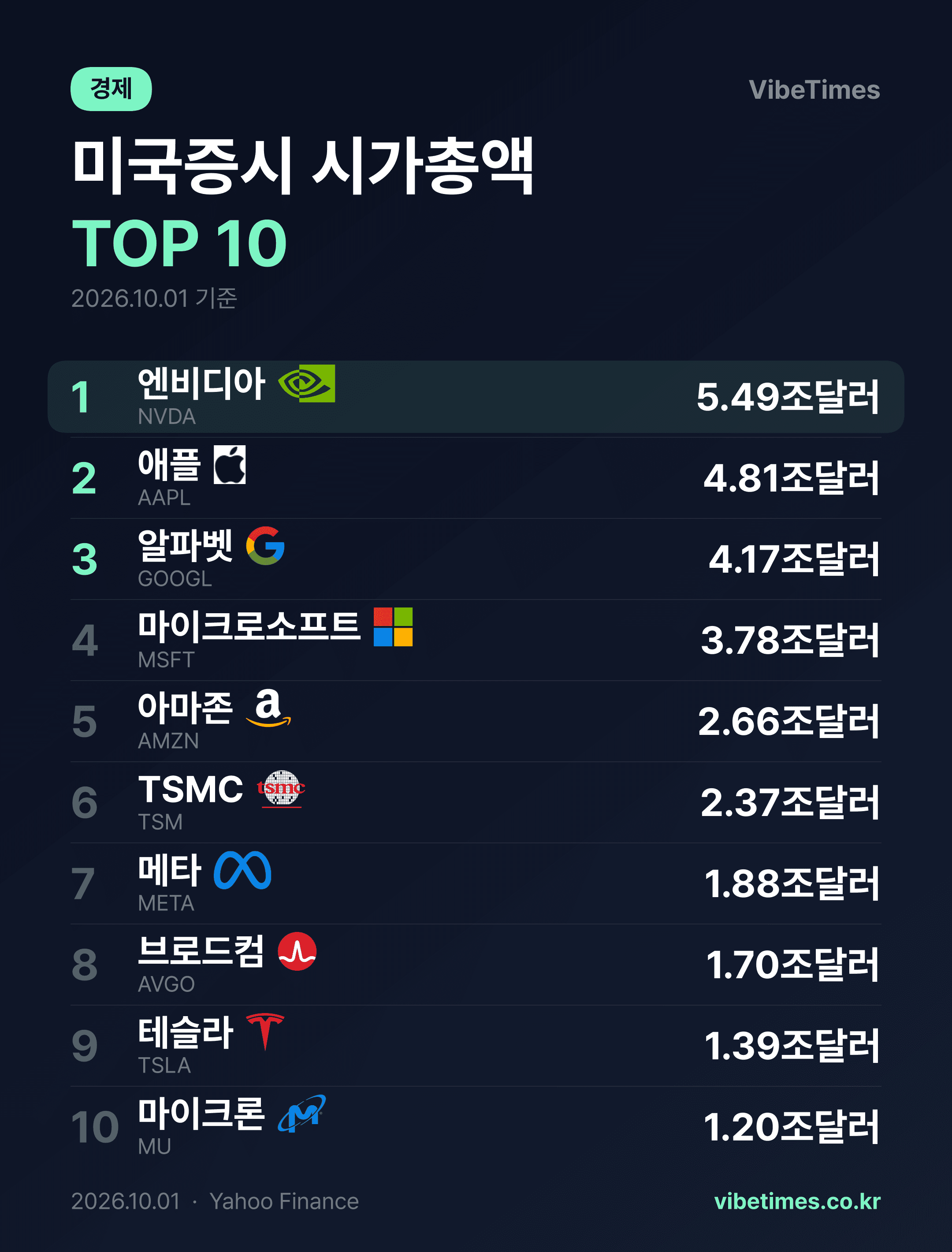
Nvidia has reclaimed its position as the world's most valuable company, with a market capitalization of $5.4936 trillion.
In a tally of the top 10 US-listed companies by market cap as of October 1, 2026, Nvidia topped the list with a share price of $227.21 and a market cap of $5.49 trillion, roughly $680 billion ahead of second-place Apple. Apple followed at $4.81 trillion, Alphabet at $4.17 trillion, and Microsoft at $3.78 trillion. The combined market cap of the top four companies alone exceeds $18 trillion — a testament to the fact that each rung of the market cap rankings is, in effect, a map of global capital flows.
The Big Tech Big Four, Shaken by Semiconductors
The key takeaway from this ranking is its composition. Semiconductor companies have markedly elevated their standing in the upper ranks, long dominated by platform and software firms. TSMC, at No. 6 with a market cap of $2.37 trillion and a share price of $456.94, has reached an unusual level for a contract chipmaker. Including Broadcom at No. 8 ($1.70 trillion) and Micron at No. 10 ($1.20 trillion), four of the top 10 are semiconductor-related companies. The most striking feature of this tally is that companies spanning chip design, manufacturing, and memory now stand shoulder to shoulder with platform giants.
Micron's emergence is particularly significant. With a share price of $1,065.08, it is the only company in the top 10 trading in the four-digit range. A memory chipmaker surpassing $1 trillion in market cap is read as evidence that demand for high-value memory has expanded structurally. With a P/E ratio of 24.1 — relatively low among the upper ranks — some interpret this to mean the market has not yet fully priced in Micron's earnings growth.
Static Prices, Widely Diverging Valuations
By percentage change, all 10 companies moved within a range of -0.01% to 0.03% — a fluctuation so slight it borders on a trading halt. But even when prices are frozen at a given moment, valuations differ sharply from company to company.
Placing P/E ratios side by side reveals an intriguing contrast. Alphabet has the lowest P/E in the upper tier at 17.1, meaning its earnings are large enough to justify a $4.17 trillion market cap. Tesla, by contrast, trades at an overwhelming high of 332.9. Though both belong to the trillion-dollar club, the market values Alphabet on current earnings and Tesla on expectations of future growth. Broadcom's P/E of 45.8 is likewise seen as reflecting high expectations for AI-related chip demand.
Nvidia's P/E of 28.7 is managed without excessive premium — befitting the market cap leader. Even at $227.21 per share, this shows earnings growth is keeping pace. Mark Twain advised spending truth sparingly because it is the most precious thing, but the stock market does the opposite: it pays in advance for future truths. How differently each company pays is the quick portrait painted by this ranking.
Expanding Trillion-Dollar Club and a Shifting Market Structure
All 10 companies in the top tier now exceed $1 trillion in market cap — the result of global liquidity and the concentration in tech stocks operating simultaneously. Notably, the gap between Tesla at No. 9 ($1.39 trillion) and Micron at No. 10 ($1.20 trillion) is only around $200 billion, suggesting the race for ranking could intensify. The difference between Meta ($1.88 trillion) and Broadcom ($1.70 trillion) is also narrow, at roughly $180 billion.
From an investor's perspective, two points warrant attention. First, with four semiconductor companies in the top 10, future rank shifts are likely to move in close sync with the AI infrastructure investment cycle. Second, the very fact that Alphabet with a P/E of 17 and Tesla with a P/E of 333 appear on the same list shows the market's heterogeneity — inclusion in the upper ranks alone is no substitute for sound investment judgment.
Whether Nvidia's reclamation of the top spot proves temporary or structural will likely become clear in upcoming earnings reports from chipmakers. Still, with three of the top four companies directly or indirectly tied to the AI value chain, the market cap rankings already serve as a thermometer of the AI economy.