Micron Tops US Stock Market With Five-Year Return of 1,351%

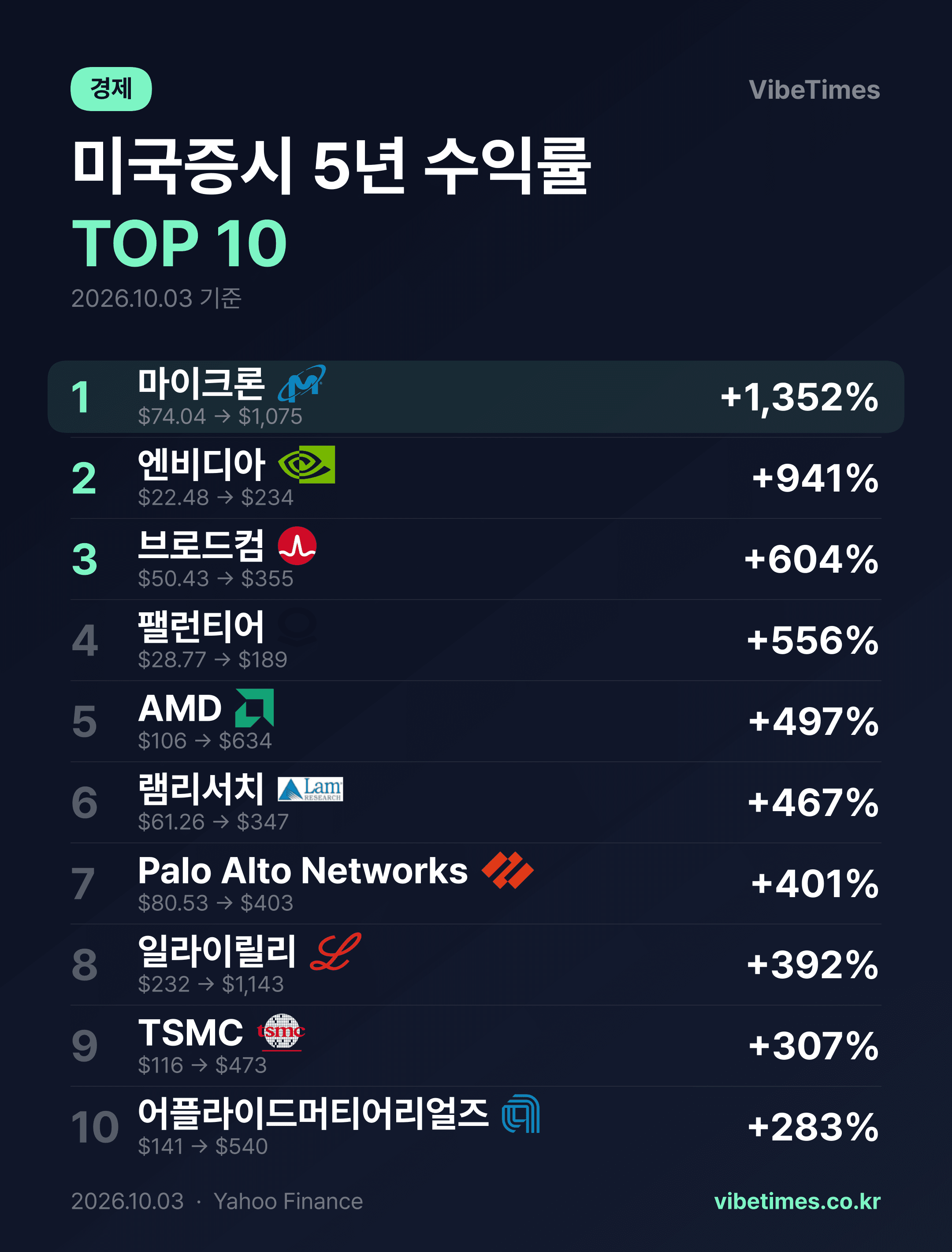
The biggest five-year gainer in the US stock market was not Nvidia, but Micron.
Semiconductors Ruled Wall Street's Past Five Years
Over the past five years, Micron's share price has surged from $74.04 to $1,075, delivering a 1,351.8% return. Over the same period, Nvidia rose from $22.48 to $234, for a gain of 940.6% — a performance that, in return terms, overwhelmed the company long seen as the symbol of the artificial intelligence (AI) boom. Add Broadcom in third place (604.2%), AMD in fifth (497.2%), Lam Research in sixth (467.3%), and Applied Materials in tenth (282.7%), and seven of the top ten stocks are semiconductor-related companies.
This trend reflects not merely the success of individual firms but a structural shift across the entire industry. Demand for memory and computing power needed to train and run AI has exploded, lifting the entire semiconductor value chain — from design to manufacturing to production equipment — at the same time.
The Meaning of Micron's No. 1 Spot and the Nvidia Paradox
Micron's rise to the top marks a change in the standing of memory chips. With high-bandwidth memory (HBM) becoming an essential component of AI semiconductors, the valuation of memory makers — long viewed as cyclical businesses — has been rewritten. Micron's market capitalization now stands at $1.24 trillion, earning it a place in the trillion-dollar club.
Nvidia's 940.6% return ranks second in absolute terms. Yet its $5.57 trillion market cap is the overwhelming leader among the ten stocks, 4.5 times Micron's. The rankings make one thing clear: percentage returns favor stocks that started from a low base, but from the standpoint of scale, Nvidia's growth still drove the market.
Looking at market cap, six of the ten companies exceed $1 trillion. TSMC, despite a relatively modest 306.9% return, maintains the third-largest market capitalization at $2.38 trillion — evidence that the tech rally was a broad-based rise across the industry, not confined to a single company.
What the Non-Semiconductor Stocks Tell Us
Only three stocks in the rankings are not semiconductor companies. Fourth-place Palantir posted the best software return at 556.1%, seen as a result of corporate investment flowing into data analytics software that applies AI to real business operations. Palo Alto Networks (400.8%) in seventh represents cybersecurity, while Eli Lilly (392.2%) in eighth represents pharmaceuticals, notably obesity treatments.
What these three have in common is that they show the AI boom spreading beyond semiconductor hardware into software and the broader economy. In particular, Palantir's market cap of $456.7 billion now exceeding Applied Materials' ($420.1 billion) is read as a symbolic signal that software companies have overtaken equipment manufacturers in stature.
The Task Ahead for the Market
The future of the top five-year performers ultimately hinges on whether AI investment continues. With the top three stocks having already delivered returns of roughly 1,000% or more, expecting the same pace going forward is difficult. It can also be argued that behind the high returns lies a growing valuation burden.
Still, because semiconductor value chain demand is tied to AI data center investment, the earnings trajectory of the top stocks is expected to serve as a thermometer for the AI industry as a whole. The pace at which Micron and other memory makers expand HBM supply, along with Nvidia's next-generation chip launch schedule, are cited as the key variables that will reshape the rankings.