Democratic Party Ranks First with 99.9% Voting Cohesion
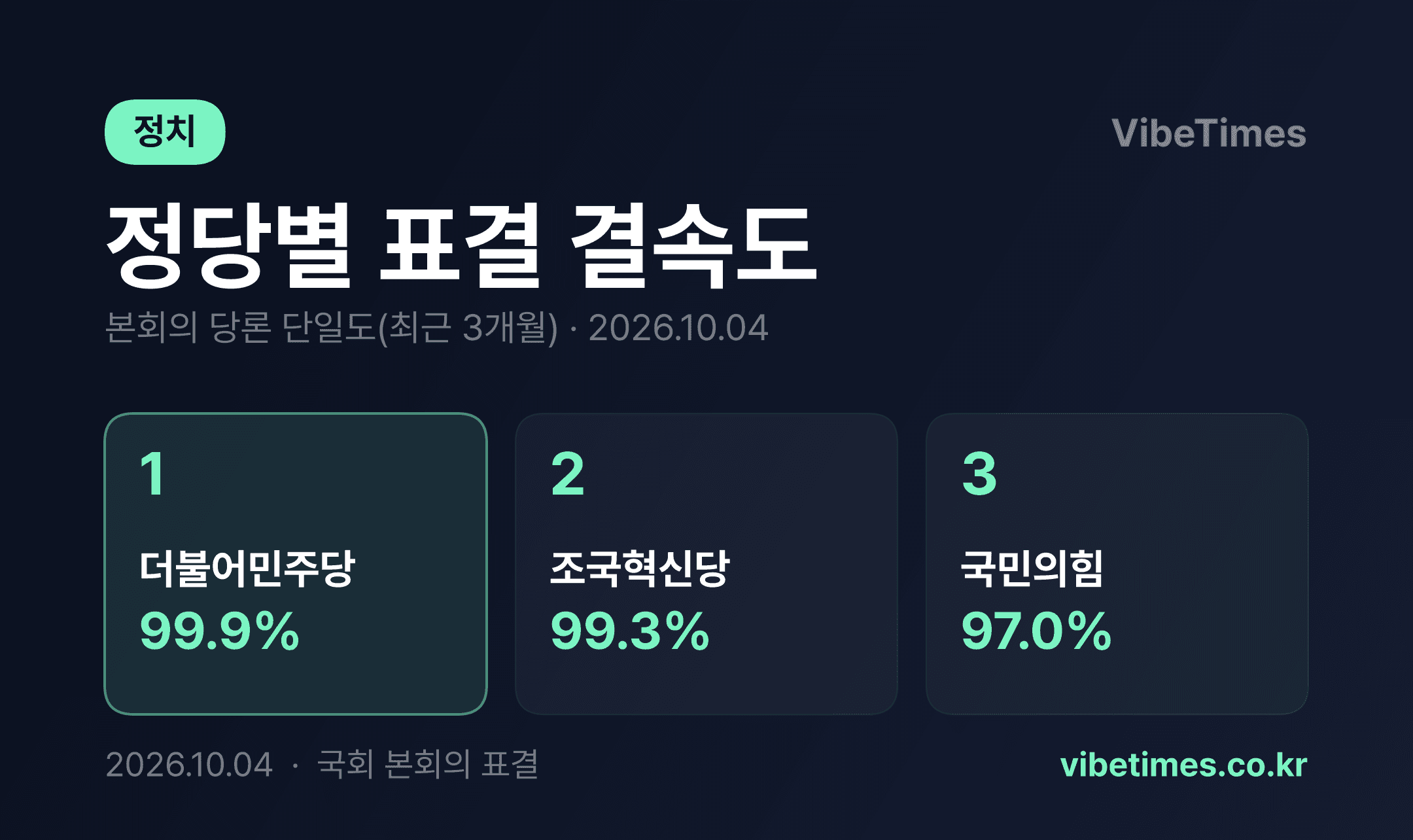
The Democratic Party posted a plenary-session voting cohesion rate of 99.9%, the highest among parties represented in the National Assembly, effectively a perfectly unified bloc.
According to voting cohesion statistics compiled as of October 4, 2026, the Democratic Party was followed by the Rebuilding Korea Party at 99.3% and the People Power Party at 97.0%. Voting cohesion is an indicator that measures, as a percentage, the degree to which a party's members vote in a unified direction in plenary sessions. The closer the figure is to 100%, the more successfully party lines were enforced without defection votes. Conversely, a lower figure is read as a signal of internal dissent or defection ballots.
What a 0.1-Point Gap Says
At 99.9%, the Democratic Party is essentially at complete unity. For the largest party in the Assembly to show virtually no defection votes demonstrates that its leadership's ability to reconcile differing views is working remarkably well. Larger parties typically see more diverse interests among individual members, yet the Democratic Party recorded only a negligible shortfall of 0.1 percentage points.
The Rebuilding Korea Party's 99.3% also deserves attention. Small parties are structurally vulnerable, as their small membership means one or two defections can sharply shake the overall cohesion rate. Maintaining a figure in the 99% range despite this vulnerability suggests that a strong sense of party identity and well-drilled voting discipline have taken root in a short time since the party's founding.
The Meaning of the People Power Party's 97.0%
The 97.0% figure, the lowest among the three parties, is by no means a failing grade. However, the gaps of roughly 2.9 percentage points with the Democratic Party and 2.3 points with the Rebuilding Korea Party are worth analyzing. This divergence suggests comparatively frequent votes against, abstentions, or absences. It is hard to rule out the possibility that repeated clashes between party lines and individual convictions occurred on bills pitting the ruling and opposition camps against each other.
This is precisely where the utility of the cohesion metric lies: it can capture, in numerical form, internal rifts or signs of defection that raw seat counts cannot reveal. The 97% figure itself is not a crisis signal, but if the downward trend continues, it could be interpreted as a red flag for party unity.
What Cohesion Means for the Political Landscape
High voting cohesion translates directly into the speed of legislation. With the ruling party's cohesion at 99.9%, the time and cost spent on internal persuasion when processing contentious bills are minimized. Conversely, if the opposition's cohesion is relatively lower, defection votes can become the deciding variable at voting moments. The difference between 97.0% and 99.9% could carry decisive weight precisely when the seat gap is narrow.
The key point to watch going forward is the direction of these figures. If the Democratic Party and the Rebuilding Korea Party sustain their 99%-range cohesion, the two parties' voting alliance is expected to solidify into an extremely stable one. Whether the People Power Party can defend its 97% level or faces downward pressure will likely be revealed in upcoming votes on contentious bills. Since cohesion statistics are a living indicator updated with every vote, an accurate diagnosis requires reading the flow rather than treating a single snapshot as definitive.
Like a stubborn boulder rolling forward, a united party pushes through. But just how long that push can hold will be judged at the next vote.