The Democratic Party ranks first with 11,540 bills sponsored

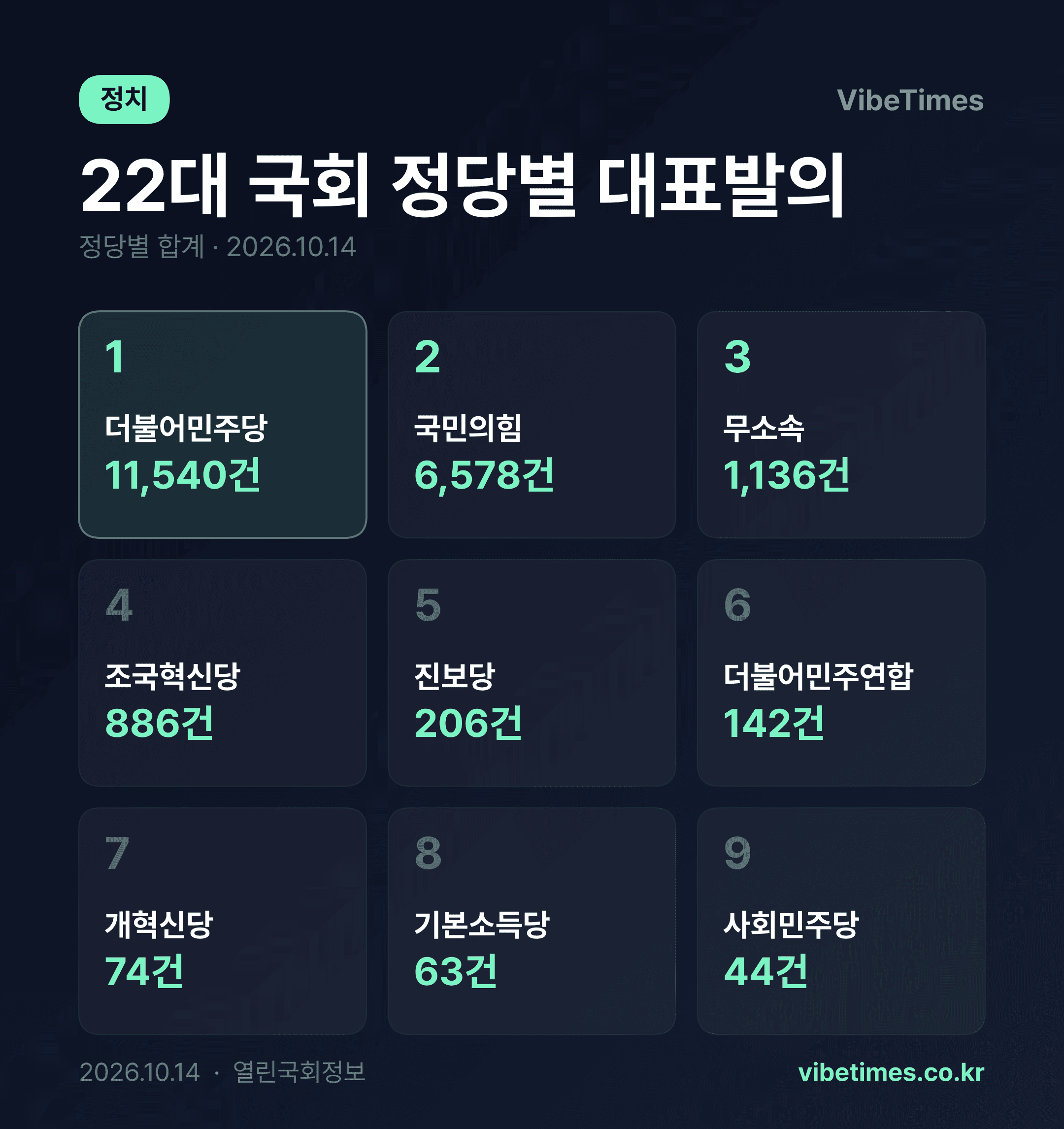
The Democratic Party of Korea recorded an overwhelming first place among parties in the number of bills sponsored, with 11,540.
The figure comes from National Assembly statistics on bills sponsored by party, compiled as of October 14, 2026. The People Power Party, in second place, managed only 6,578 bills, barely more than half of the Democratic Party's total. The gap between the two parties reaches 4,962 bills. Even the remaining eight parties and independents combined — excluding the two major parties — totaled just about 2,571 bills, failing to exceed a quarter of the Democratic Party's figure alone.
What the Front-Runner's Numbers Reveal
Sponsoring a bill means drafting legislation and submitting it to the National Assembly for the first time as its principal sponsor. It is the most direct indicator of a party's legislative output. The Democratic Party's 11,540 bills are roughly 1.75 times the People Power Party's 6,578. Of the total tally, the Democratic Party accounts for more than 55% of the roughly 20,989 bills across all ten parties.
This gap cannot be explained by the number of seats alone. The more seats a party holds, the higher the likelihood of bills passing, making it easier to put forward legislation, while minor parties tend to shy away from sponsoring bills when prospects of passage are slim. The Democratic Party's high volume of sponsorship numerically confirms that majority status translates directly into legislative momentum.
Independents in Third Place Reveal the Presence of Senior and Minor Lawmakers
The surprise in the rankings is third place. Independent lawmakers sponsored 1,136 bills, edging out the Rebuilding Korea Party's 886 to take third. Crossing the thousand mark without the backing of a party organization demonstrates individual legislators' legislative capability, or the power of legislative networks that persist even after leaving a party.
The Rebuilding Korea Party follows in fourth with 886 bills, and the Progressive Party in fifth with 206. But the gaps widen sharply further down: the Democratic Alliance at sixth with 142, the Reform Party at seventh with 74, the Basic Income Party at eighth with 63, the Social Democratic Party at ninth with 44, and People's Future at tenth with 20. The difference between fifth-place Progressive Party and tenth-place People's Future exceeds tenfold — meaning that even within minor parties, legislative capability varies widely.
The Meaning and Limits of Bill Counts
The number of bills sponsored does not equate to legislative achievement. Sponsorship is a metric separate from the bill passage rate, and only a portion of sponsored bills typically end up passing. Rather, a high volume of sponsorship can be read as a party's agenda-setting strategy of accumulating policy proposals in legislative form.
Even so, the significance of these statistics is clear. The power to propose legislation is effectively concentrated in the two major parties, and within that, the Democratic Party holds an absolute share. The People Power Party's relatively low sponsorship volume may be the result of prioritizing its role as minority and check — scrutiny and opposition — but it is clearly a disadvantageous indicator in the competition for legislative initiative.
The point to watch going forward is whether the sponsorship gap between the two major parties persists. If the ruling party continues to churn out more than half of all bills, the legislative landscape in the latter half of the 21st National Assembly is expected to deviate little from the current pattern. The numbers do not stay silent — the raw count of bills sponsored lays bare each party's legislative strategy.