Samsung Electronics Held Its No. 1 Market Cap of KRW 1,312 Trillion Without Any Comfort

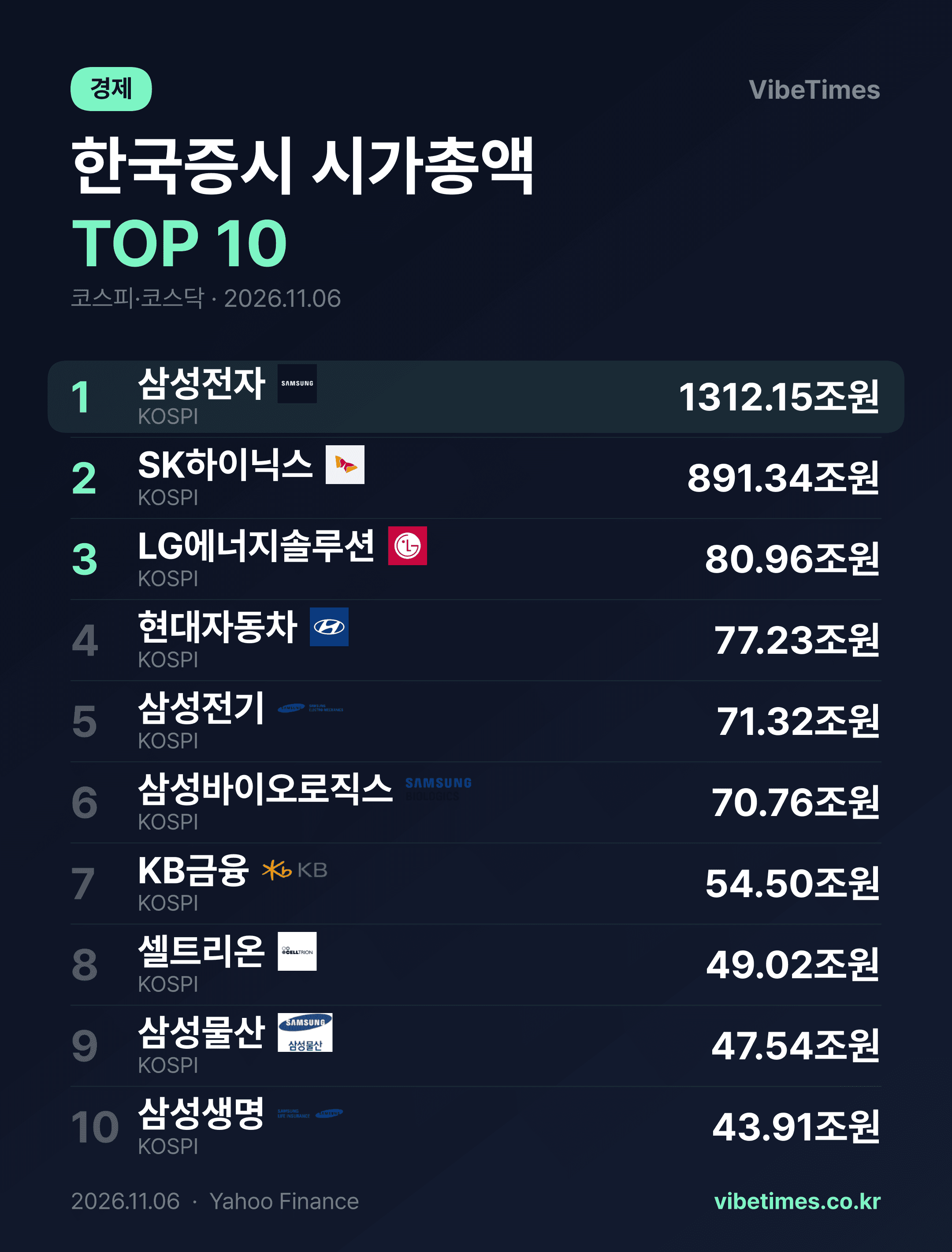
Samsung Electronics firmly held its position at the top of the Korean stock market with a market capitalization of KRW 1,312 trillion. According to data as of 4 p.m. on Nov. 6, 2026, the gap with second-place SK Hynix exceeded KRW 420 trillion. Even the combined market capitalizations of the eight stocks ranked third through tenth fall short of Samsung Electronics alone, making the meaning of this ranking unmistakably clear.
Top Two: The Overwhelming Dominance of the Semiconductor Twin Pillars
The two most valuable stocks on this day were both semiconductor companies. Samsung Electronics recorded a market capitalization of KRW 1,312.15 trillion despite a slight dip, closing at KRW 201,500, down 0.08 percent. SK Hynix likewise slipped 0.09 percent to KRW 1,264,000, maintaining KRW 891.34 trillion. Together, the two are worth roughly KRW 2,203 trillion, far surpassing the combined total of all stocks ranked third or lower.
Particularly noteworthy is that the two stocks' daily changes were nearly identical at minus 0.08 percent and minus 0.09 percent, respectively. This shows that similar flows of capital and valuations are at work across the semiconductor sector as a whole. In other words, sector-level movements, rather than stock-specific variables, are driving the market. The structure in which these two memory-centric companies effectively determine the movement of the entire Korean market will be difficult to change in the short term.
Rankings 3–10: A Balance of Batteries, Biotech, Finance, and Autos
From third place onward, the gaps between rankings narrow sharply. Third-place LG Energy Solution stands at KRW 80.96 trillion and fourth-place Hyundai Motor at KRW 77.23 trillion, a difference of only about KRW 3 trillion. The gap between fifth-place Samsung Electro-Mechanics (KRW 71.32 trillion) and sixth-place Samsung Biologics (KRW 70.76 trillion) is roughly KRW 560 billion — effectively within the margin of error. This means rankings in this tightly packed range could easily shift with a single day's moves.
Only four of the top ten stocks rose on the day. Eighth-place Celltrion posted the largest gain at plus 0.07 percent, while fourth-place Hyundai Motor and seventh-place KB Financial each rose 0.04 percent and sixth-place Samsung Biologics added 0.02 percent. On the downside, fifth-place Samsung Electro-Mechanics saw the steepest drop at minus 0.15 percent — a sign that the correction in electronic components ran somewhat deeper than in other sectors.
There is also something notable about the sector mix. Among the top ten, Samsung affiliates occupy five spots spanning electronics, electrical equipment, biotech, trading, and insurance (Samsung Life). Adding biotech player Celltrion to the mix makes it easy to grasp how large a weight the Samsung ecosystem — spanning manufacturing and finance — carries in the overall market. The remaining spots are divided one each among batteries (LG Energy Solution), autos (Hyundai Motor), and finance (KB Financial).
Market Structure and Investment Implications
The key takeaway from this ranking is concentration. The combined market capitalization of the eight stocks ranked third through tenth is roughly KRW 494 trillion — only 38 percent of Samsung Electronics alone (KRW 1,312 trillion). The structural conclusion is clear: to gauge the overall direction of the market, one must first look at the earnings and valuations of the two semiconductor heavyweights.
The daily price moves of all ten stocks stayed within plus or minus 0.2 percent — an unusually narrow range. Rather than a day shaped by major good or bad news for any single stock, it read as a period of the market broadly reassessing its direction. On days like this, the closeness of the rankings offers more insight than the rankings themselves. With third through sixth places clustered around KRW 10 trillion of one another, a daily swing of just 1 to 2 percent in this range could easily reshuffle the order by the next trading session.
There are two things to watch going forward. The first is whether the direction of the two semiconductor leaders diverges. As long as they move in the same direction, the market's overall trajectory is likely to remain stable. The second is turnover in the tightly packed third-to-sixth range. If batteries, autos, electronic components, and biotech swap positions in response to sector-specific variables, it would be the earliest signal of a shift in sector preferences within the market.
