Nvidia's 114-Fold 10-Year Return Tops the US Stock Market

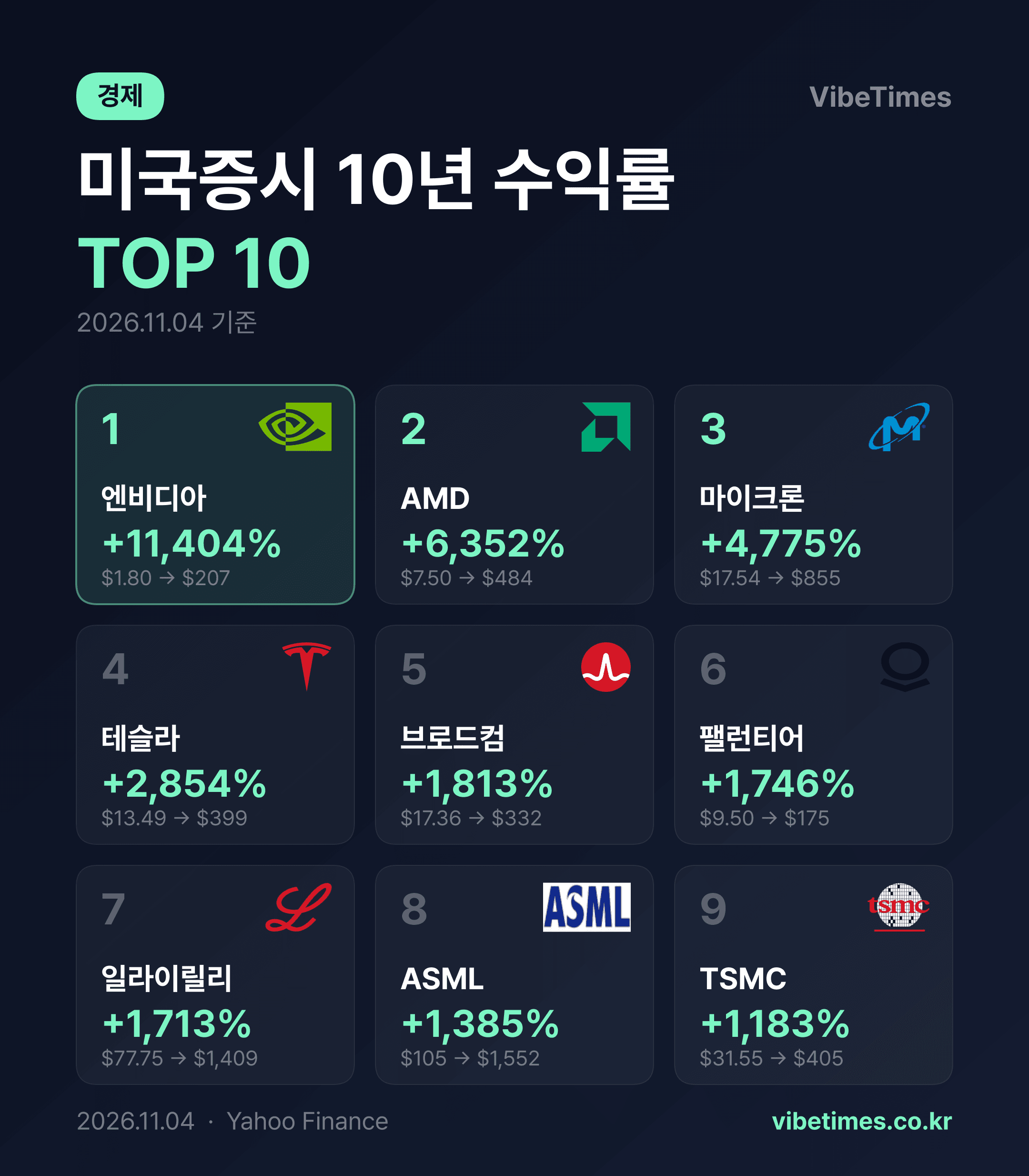
Nvidia has multiplied its stock price 114-fold over the past decade, claiming the top spot in US stock market returns. According to data as of November 4, 2026, Nvidia's share price rose from $1.80 in 2016 to $207, delivering a 10-year return of +11,403.5%. With a current market capitalization of $4.88 trillion, the company is now locked in a race for the world's largest market cap, trailing Apple's $4.94 trillion by a mere $60 billion.
Semiconductors Make Up More Than Half of the Top Ranks
A look at the top 10 stocks by 10-year returns reveals the defining character of this rally. Semiconductor-related companies account for six of the ten slots: Nvidia at No. 1, AMD at No. 2 (+6,352.0%), Micron at No. 3 (+4,775.1%), Broadcom at No. 5 (+1,812.6%), ASML at No. 8 (+1,384.7%), and TSMC at No. 9 (+1,183.0%). It underscores that demand for chips used in artificial intelligence (AI) training and inference has been the single biggest driver of the market over the past decade.
The individual stories are also worth noting. Micron's share price surged from $17.54 to $855, upending its former reputation as a memory chipmaker in a so-called commodity-like boom-and-bust industry, and earning it growth-stock status thanks to demand for AI high-bandwidth memory (HBM). AMD, once in Nvidia's shadow, climbed from $7.50 in 2016 to $484, cementing its position as the challenger. Its market cap of $762.1 billion remains only a sixth of Nvidia's, but it signals that a competitive landscape still exists in what had been a monopolized market.
Returns and Market Caps Tell Different Stories
Reordering the list by market capitalization changes the interpretation. Apple, which ranked only 10th by returns, boasts a market cap of $4.94 trillion — larger than No. 1 Nvidia — while TSMC (No. 9 in returns, $2.07 trillion) and Tesla (No. 4, $1.60 trillion) rank among the largest by market value. This reflects both a simple mathematical reality — companies that were already enormous a decade ago are inherently disadvantaged in return calculations — and a measure of just how abnormally large once-small companies have become.
A notable contrast is that of Palantir and Broadcom. Palantir rose from $9.50 to $175, a gain of +1,746.3%, showing that data analytics software can now generate returns on par with semiconductor hardware. Its $428.6 billion market cap remains smaller than the semiconductor heavyweights, but is an unusual size for a software company. Broadcom, by contrast, stands out as a case of having it both ways, pairing a +1,812.6% return with a $1.54 trillion market cap.
The Meaning of the Only Two Non-Chip Names
Only Tesla, Eli Lilly, Palantir, and Apple crack the top 10 without being semiconductor plays. Eli Lilly, at No. 7 with +1,712.7%, is the sole non-tech sector name in the upper ranks. Its climb from $77.75 to $1,409 is significant in that the structural growth of the pharmaceutical industry centered on obesity treatments produced returns rivaling the AI rally. Tesla's +2,854.2% rise from $13.49 to $399 also stands as a case study in sector diversification, having been driven by the single theme of electric vehicles.
What It Means Going Forward
The lesson for investors is simple: the winners of the past decade were those who maintained concentrated bets on a specific sector — above all, the AI semiconductor value chain. But the figure of 11,403.5% is an already realized past, and the same expectations cannot simply be projected onto the same stocks. Whether Nvidia overtakes Apple for the top market cap spot is set to become a symbolic gauge of whether semiconductor demand will endure.
Charles Darwin loved foolish experiments, they say, but the winners of the past decade in the stock market were not experimenters — they were those who staked their capital on the sure bet of AI. The question to watch is whether the next decade's leaderboard will again be filled with semiconductor names, or whether some new experiment now outside the rankings will claim the summit.