The Final Push of the Lee-Trump 30-Minute Summit Begins in the Real Game

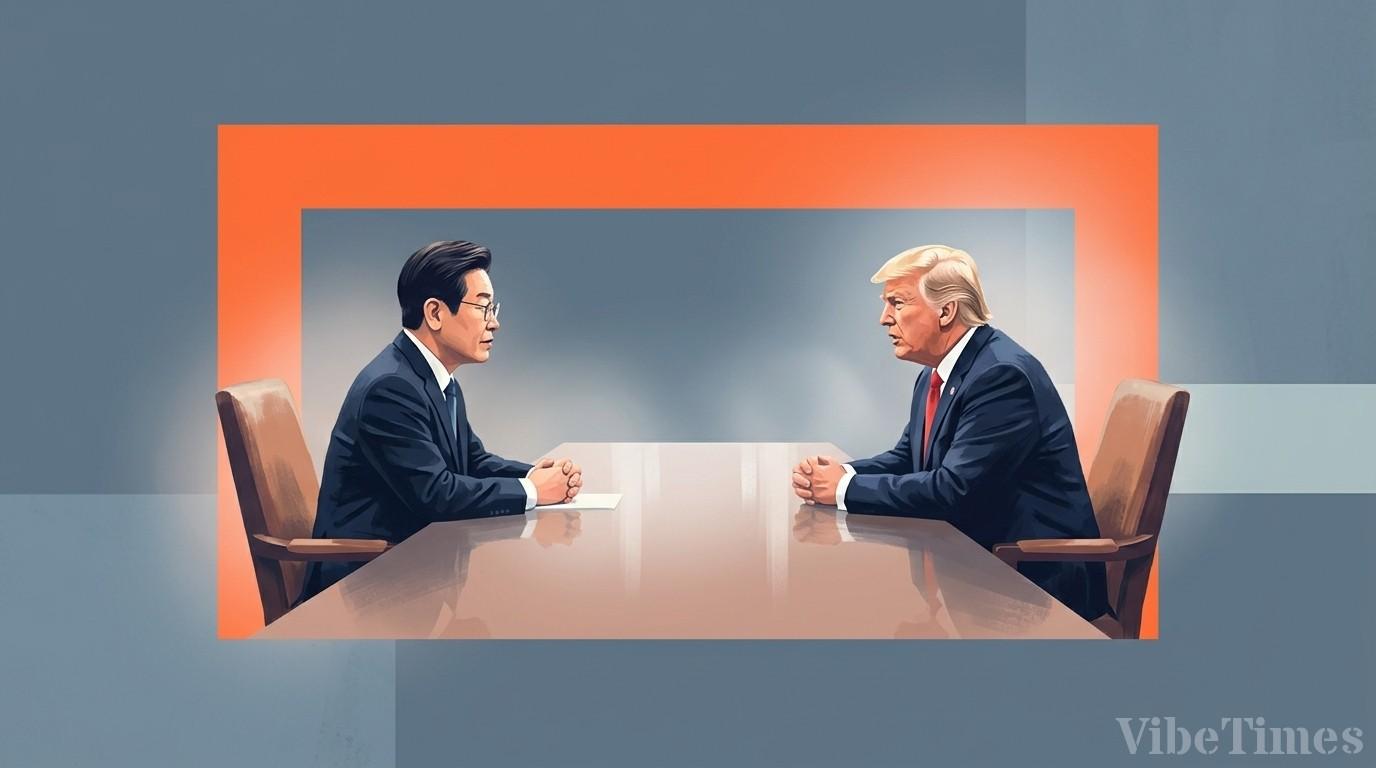
30-Minute New York Meeting: The Stage Moves to the Real Game
The South Korean and U.S. leaders placed the resumption of North Korea–U.S. dialogue and the transfer of wartime operational control on the summit agenda. President Lee Jae-myung and U.S. President Donald Trump held a 30-minute summit in New York on Monday (local time). While it drew attention that President Trump opened the meeting on a warm note by asking, "How is the First Lady doing?", the real weight fell on security matters. According to diplomatic authorities, the resumption of North Korea–U.S. talks, a Korean nuclear-powered submarine, and the transfer of wartime operational control all went on the summit table together.
The meeting was arranged around the schedule for the 81st session of the U.N. General Assembly. In his keynote address to the General Assembly, President Lee had earlier unveiled three major K-Initiative visions under the banner of "reconnecting a divided world," and outlined three directions for Korean Peninsula policy: inclusive peaceful coexistence, stable peaceful coexistence, and peaceful coexistence contributing to world peace. The summit is interpreted as a venue to translate that blueprint into concrete terms at the level of the Korea–U.S. alliance. Given that President Trump mentioned a golf meeting this November or December during the talks, this 30-minute session amounts to the opening act of a long negotiation.
The Restart Card and the Calculus of Pragmatic Diplomacy
The key is the "pragmatic approach" President Lee has consistently put forward recently. In an interview with The New York Times, he said that easing sanctions on North Korea would be worth trading for a halt to its additional development of nuclear weapons and intercontinental ballistic missiles (ICBMs). His metaphor of "stopping a moving car"—halting the further expansion of nuclear capabilities first and then building up conditions—reflects the same logic. This signals an intent to actively use sanctions as a negotiating card, and reads as a message that Seoul is willing to move flexibly even before complete denuclearization.
The risks, however, are far from trivial. Critics from South Korea's conservative camp and some diplomatic circles argue that a step-by-step approach could be seen as effectively recognizing North Korea as a nuclear state. The Trump administration, for its part, faces U.S. domestic legal procedures required to ease sanctions on North Korea, meaning a considerable gap remains between any agreement reached at the table and its actual implementation. The same goes for the OPCON transfer and the nuclear-powered submarine issue. Both are matters premised on Korea–U.S. trust and technical cooperation, so rather than being settled in a single summit, they are expected to advance at a pace set through working-level consultations.
An Alliance Economic Package as the Supporting Voice for Security Negotiations
What deserves attention is the economic card laid behind the security agenda. The Lee Jae-myung government is pursuing the construction of a power plant in Texas—meant to supply electricity to the U.S. AI and semiconductor industries—as the first candidate project for strategic investment in the United States. President Lee's emphasis that "we only do projects with commercial rationality" underlines that the investment is a structure of mutual benefit, not one-sided generosity. Given that President Trump has repeatedly raised tariffs and allied burden-sharing, tangible projects like energy investment are expected to serve as a buffer reducing trade friction, and as justification for persuading Washington to restart talks with Pyongyang.
There is also the variable of Middle East tensions. President Lee noted that a blockade of the Strait of Hormuz could deal a severe shock to the economy, and proposed a "coalition of constructive contributors." The more unstable energy supply chains become, the clearer the economic value of Korea–U.S. cooperation grows—which, in turn, is likely to strengthen Seoul's leverage at the security negotiating table.
The November Golf Meeting Becomes the Test
In the short term, two things are worth watching. First is whether the restart of North Korea–U.S. dialogue actually translates into concrete channels. If sanctions-relief discussions make it onto the formal agenda with the Trump administration's consent, the situation on the Korean Peninsula could see a breakthrough after its prolonged stalemate. Conversely, if Pyongyang remains unresponsive, President Lee's pragmatic approach could turn into a domestic political liability—not least because the ruling and opposition parties view it differently. The opposition People Power Party, including lawmaker Jeong Dae-sik, has criticized the President's re-nomination of Supreme Court justice candidates as "the President choosing the judges for his own trial," reflecting ongoing friction between the presidential office and the judiciary that forms part of the political backdrop. A key question is how much diplomatic achievement can absorb these domestic risks.
The second is the pace of consultations on OPCON transfer and the nuclear-powered submarine. How much the conditions are refined in working-level contacts before the November–December golf meeting mentioned by President Trump is expected to determine the fruits of the second summit. As Ehud Barak said, leaders can change their minds—or open their eyes. Stopping the moving car of North Korea–U.S. dialogue, too, will ultimately be achieved not through a single meeting but through leaders' repeated choices accumulating over time. The 30-minute New York summit has threaded the first button.