James Webb Telescope Opens New Horizons in Space Exploration

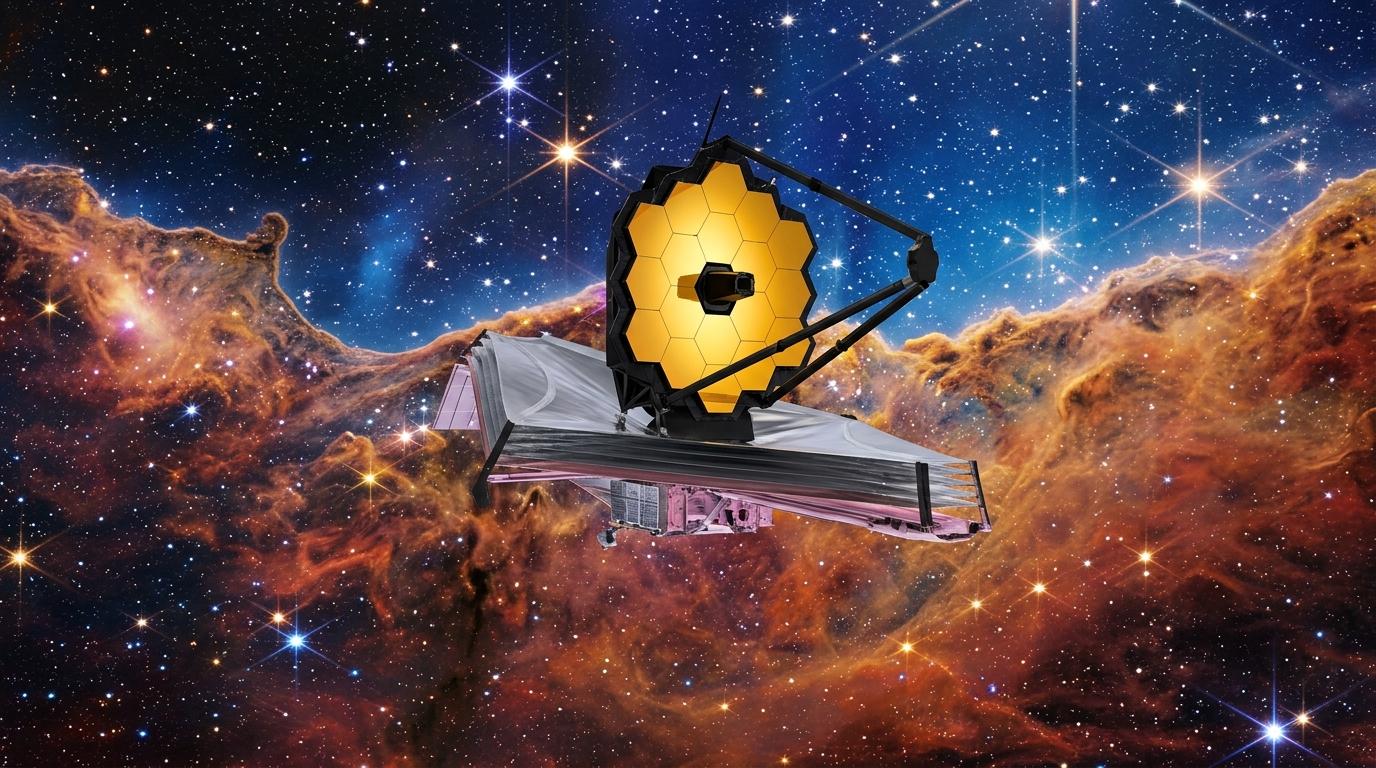
Launched in late 2021, the James Webb Space Telescope (JWST) has been transforming existing cosmological paradigms with its groundbreaking observational data, which is unravelling the secrets of the early universe just after the Big Bang, vividly capturing the formation processes of stars and planets, and revealing the atmospheric compositions of exoplanets. Inheriting the grand legacy of the Hubble Space Telescope, JWST, with its more powerful performance and new observational capabilities, is delving into the universe's most remote and darkest corners, delivering astonishing discoveries to the scientific world.
The Genesis of the James Webb Telescope: A New Way of Seeing the Universe
The James Webb Telescope possesses infrared observation capabilities that surpass Hubble's limitations. While the Hubble Space Telescope provided humanity with wondrous cosmic images in the visible and ultraviolet spectrums, JWST is specialized for the infrared spectrum. Due to the universe's expansion, light from distant, early galaxies is largely stretched to longer wavelengths, shifting into the infrared range. JWST is equipped with advanced technology specialized for this very spectrum, allowing it to peer into the universe's fundamental structures that Hubble could not capture. This provides it with essential capabilities to explore previously inaccessible areas, such as the birth of stars within complex nebulae or the nurseries of faint stars hidden by dust clouds.
Furthermore, based on sophisticated engineering designed to overcome extreme environments, JWST is positioned approximately 1.5 million kilometers (nearly a million miles) from Earth at the 'Lagrange point 2 (L2)'. This location utilizes Earth's shadow to shield the telescope from the Sun and maintain an ultra-low temperature. A massive, five-layer sunshield, the size of a tennis court, is used to meticulously block heat emitted by cosmic dust and starlight. Thanks to this intricate design, JWST can detect even the faintest infrared signals in an ultra-cold environment below -233 degrees Celsius (-387 degrees Fahrenheit), enabling highly sensitive observations. JWST's primary mirror, with a diameter of 6.5 meters, is about 2.7 times larger than Hubble's (2.4 meters). It consists of 18 hexagonal segments coated in gold-beryllium and can collect six times more light than Hubble, covering an area of approximately 25.4 square meters. This capability means it can observe light from distances exceeding 13 billion light-years, effectively looking back to about 200 million years after the Big Bang.
The Latest Cosmic Discoveries Revealed by JWST
From its early operational phase, JWST has been producing remarkable findings that challenge existing theories of galaxy formation, particularly confirming the existence of surprisingly mature galaxies in the very early universe. It has verified that galaxies from billions of years ago, mere hundreds of millions of years after the Big Bang, are significantly larger, brighter, and contain a greater number of stars than anticipated. For instance, it has captured images of galaxies at approximately 300 million years after the Big Bang (redshift z ~ 13 or higher), with discoveries like CEERS-93316 and GLASS-z13 representing extremely high redshifts. These findings are difficult to explain with current cosmological models and necessitate a fundamental re-evaluation of the speed and mechanisms of galaxy formation in the early universe. Such discoveries are sparking debate that could challenge the standard cosmological model (Lambda-CDM model).
Concurrently, JWST is making significant progress in the search for signs of life through the analysis of exoplanet atmospheres, demonstrating groundbreaking performance in analyzing the atmospheres of planets outside our solar system. Using transit spectroscopy, it analyzes the spectrum of light passing through an exoplanet's atmosphere as it transits its host star, clearly identifying the presence of various molecules such as water, methane, and carbon dioxide. Notably, the potential for detecting specific gases (e.g., dimethyl sulfide), which could be byproducts of biological activity, in the atmospheres of exoplanets with potentially Earth-like conditions, is opening a new chapter in the search for extraterrestrial life. This is advancing the quest for alien life from theoretical possibility to practical investigation.
Furthermore, to capture vivid moments of star and planet birth, JWST has photographed the interiors of nebulae – the dynamic environments where stars and planets form – with unprecedented resolution. It has provided detailed observations of faint, reddish infant stars glowing within mottled gas and dust clouds, as well as the structures of newly formed planetary system disks. This has greatly contributed to a deeper understanding of the early stages of planet formation and the development of companion planets. JWST is also conducting new observations of celestial bodies within our own solar system, enhancing our knowledge of the solar system's origins, the formation processes of terrestrial and Jovian planets, and the environments of moons and asteroids.
The impact of these JWST discoveries on the scientific community and future space exploration is profound, particularly in pressuring the redefinition of existing cosmological paradigms. The early galaxy findings from JWST have thrown down a gauntlet to the standard cosmological model that explains the universe's evolutionary process. If galaxies formed faster than expected, it necessitates revisions or expansions to existing hypotheses regarding the distribution of matter in the early universe, the role of dark matter, and the growth of black holes. Scientists will use JWST data to construct new theoretical models and conduct follow-up research to verify them. This holds the potential to elevate humanity's understanding of the universe's birth and evolution to a new level.
In terms of accelerating the exploration of life's potential existence, the ability to analyze exoplanet atmospheres offers the most powerful tool for humanity to search for the possibility of life in the universe. With JWST's continuous observations, more exoplanet atmospheric characteristics will be revealed, and research into detecting 'biosignatures' potentially linked to biological activity will accelerate. This is expected to play a crucial role in humanity confirming the universality of life and re-examining our own place in the cosmos.
Finally, JWST will serve as a foundation for the next phase of human space exploration, playing a vital role in planning and executing future space missions with its advanced technology and observational capabilities. In-depth understanding of the distant universe, along with new knowledge of celestial bodies within our solar system, will contribute to setting goals for future crewed and uncrewed missions, and advancing towards practical stages such as resource exploration and habitability assessments. Ultimately, this will expand the scope of human activities in space and serve as the driving force for continued challenges towards the cosmos.