New Space Technologies Go Commercial, Set to Transform Future Society

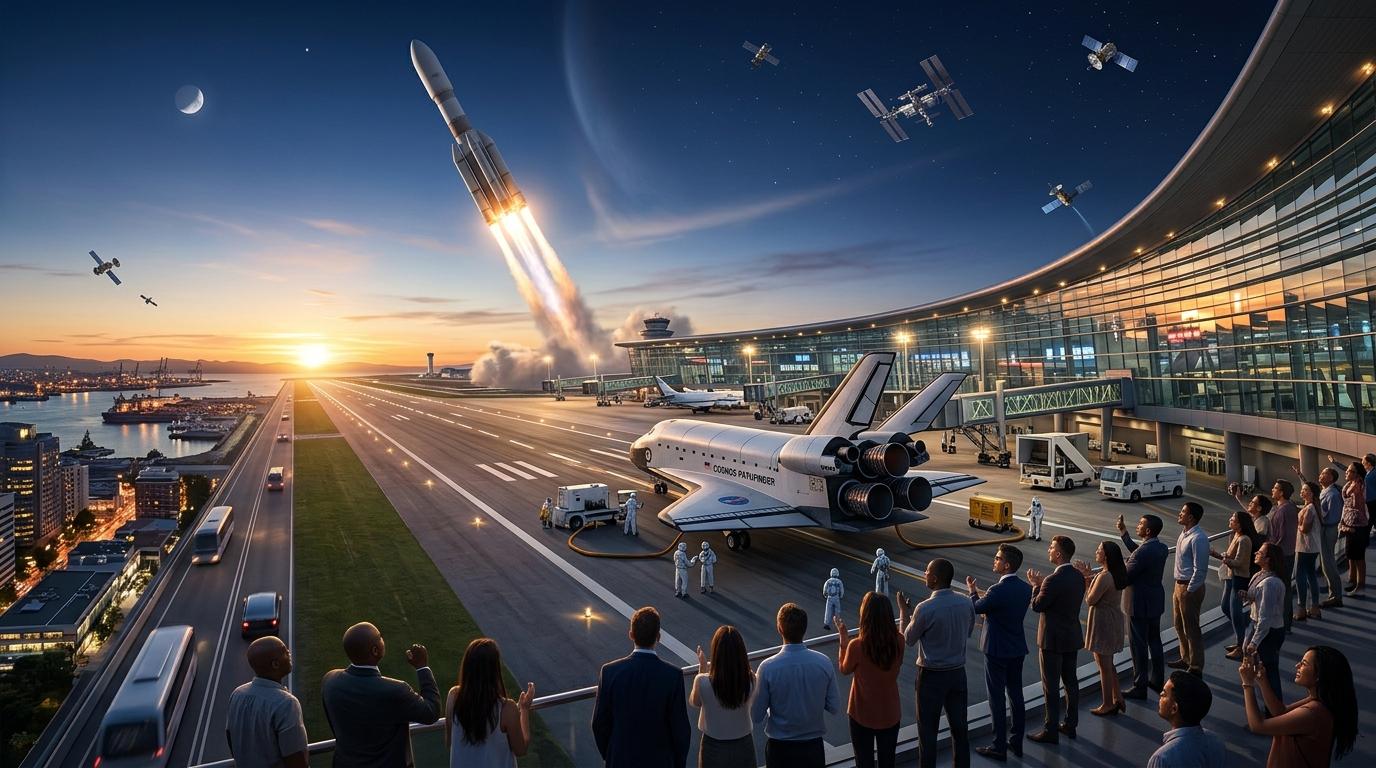
Space Tech Commercialization Poised to Reshape Future Society
Innovative space exploration technologies, including Artificial Intelligence (AI), advanced materials, and novel propulsion systems, are rapidly advancing towards commercialization amidst the private-sector-led 'New Space' era. These technological leaps are expanding humanity's reach beyond Earth's orbit to the Moon, Mars, and deeper into space, heralding unprecedented societal impacts through resource acquisition, expansion of industrial ecosystems, and transformation of human lifestyles. This article provides an in-depth analysis of the commercialization potential of key recent space exploration technologies and the societal ripple effects they are expected to bring.
1. Igniting the Private Space Era: The Convergence of Technological Innovation and Cost-Efficiency
The paradigm shift in space exploration has accelerated with the transition from government-led initiatives to a focus on private companies. Space, once a domain accessible only to a few nations due to immense costs and technological barriers, is now emerging as a new arena for economic activity, serving as a driving force behind the emergence and commercialization of various new technologies.
Reusable rocket technology has opened up revolutionary access to space. Traditional launch vehicles were discarded after a single use, incurring exorbitant costs. However, the advent of reusable rocket technology, pioneered by companies like SpaceX, has dramatically reduced launch costs and improved accessibility to space. As of 2023, SpaceX's Falcon 9 rocket has achieved over 200 successful reuses, estimated to have cut launch costs by more than 50% compared to conventional methods. This cost reduction is forming the foundation for lowering the entry barriers for private participation in satellite launches, cargo transportation, and even space tourism, thereby pioneering new space service markets. The development of fully reusable systems like Starship is expected to bring further innovation in large-scale satellite deployment and interplanetary transport.
Advancements in AI and robotics are maximizing exploration and operational efficiency. At the core of recently announced space exploration technologies are developments in Artificial Intelligence (AI) and robotics. AI enhances the efficiency of probes through autonomous navigation, data analysis, and mission optimization, while robotic arms and autonomous rovers amplify mission capabilities in extreme environments inaccessible to humans. These technologies are becoming indispensable for exploration activities on planets like the Moon and Mars, as well as for in-orbit maintenance and repair services for satellites. NASA's Perseverance rover, for instance, exemplifies the potential of AI technology to maximize scientific outcomes by autonomously executing complex missions.
Advanced materials and lightweighting technologies are simultaneously improving performance and reducing costs. Material is a key factor determining spacecraft performance. The development of ultra-lightweight, high-strength new materials, such as carbon composites, along with advancements in 3D printing technology, reduces the weight of space exploration equipment, saving propellant and enabling efficient fabrication of complex components. Innovations in these material and manufacturing technologies contribute to enhancing spacecraft durability and extending their lifespan, ultimately leading to overall cost reductions in space exploration and development. This enables the construction of more affordable and high-performance space systems, accelerating the pace of commercialization.
2. Technologies on the Cusp of Commercialization: The Dawn of a Tangible Space Economy
These technological advancements are moving beyond mere exploration to materialize new economic activities and services in space. Technologies that are either on the verge of commercialization or have concrete business models presented possess the potential to directly impact our lives.
The economic value of In-Situ Resource Utilization (ISRU) is a key sector poised to drive a tangible space economy. Technologies for mining and utilizing space resources such as ice, metals, and rare minerals from the Moon or asteroids hold the greatest commercialization potential. For example, the ability to decompose lunar water ice for rocket propellant (hydrogen and oxygen) or to produce construction materials from local Martian resources can drastically reduce the immense logistical costs required for long-duration space habitats and deep space missions. This could address resource depletion issues on Earth and transform space into a new frontier for economic opportunities. NASA's Artemis program, with its core objective of exploring and utilizing water ice at the Moon's South Pole, will serve as a strong foundation for future lunar base construction.
The widespread adoption of satellite internet and Earth observation services is also rapidly progressing. Low Earth Orbit (LEO) satellite constellation projects like SpaceX's Starlink aim to provide global internet services. As of 2024, Starlink has launched over 6,000 satellites and offers services in more than 70 countries, with plans to expand to 12,000 and eventually up to 42,000 satellites. This initiative can bridge the digital divide by providing high-speed internet to regions where traditional networks do not reach, benefiting education, healthcare, and disaster response across society. Furthermore, high-resolution Earth observation technologies will provide real-time data essential for climate change monitoring, agriculture, disaster prediction, and urban planning, playing a crucial role in policy-making and industrial development. The emergence of competitors like Amazon's Kuiper and OneWeb is expected to further expand the satellite internet market.
The advent of space tourism and in-orbit manufacturing/repair services is broadening the horizons of the space industry. Space tourism has already entered the realm of reality, with efforts underway to develop more affordable and safer travel packages. Additionally, technologies utilizing the microgravity environment for developing new materials (e.g., protein crystals, ultra-pure semiconductors) or for repairing components and recycling satellites in orbit will create new service industries by enabling extended lifespans and efficient management of space assets. This will transform space from a mere subject of exploration into a tangible arena for industrial activity.
3. Transformations in Future Society: The Ripple Effects of the Space Economy
The commercialization of new space technologies is expected to have broad impacts not only on technological advancement but also on the global economic structure, human lifestyles, and geopolitical dynamics.
New economic ecosystems and job creation will become visible. The expansion of space exploration and development will foster a vast economic ecosystem, not only within space-related industries but also across interconnected sectors. Demand for specialized personnel will surge in new fields such as satellite manufacturing, launch services, data analysis, space tourism, resource extraction, and in-orbit services, directly leading to the creation of new jobs. Roles for AI specialists, robotics engineers, advanced materials developers, and space law experts, among others, will become increasingly important. Furthermore, competition for space resource acquisition could potentially reshape the economic disparities between resource-rich and resource-poor nations.
It will contribute to solving Earth's problems and expanding the scope of human survival. Data acquired from space can make critical contributions to solving global environmental issues. Space technologies will serve as essential tools in addressing humanity's global challenges, including climate change monitoring, natural disaster prediction and response, and management of food and water resources. Moreover, the future prospect of establishing human habitats on celestial bodies like the Moon or Mars could serve as the ultimate insurance policy, expanding humanity's survival range in the event of terrestrial catastrophes or resource depletion.
Finally, ethical, legal, and security considerations, along with the necessity for international cooperation, are becoming increasingly critical. The expanded commercial use of space brings complex ethical, legal, and security challenges, including space debris, protection of celestial environments, ownership of space resources, and the potential for military applications. These issues cannot be resolved by any single nation or corporation; consensus must be reached through international discussions and cooperation involving all countries. The urgent task is to establish new international norms for responsible space development, which is an essential condition for the sustainable growth of the future space economy.