Democratic Party Leads 22nd National Assembly Bill Submissions with Over 10,000 Bills; Ranks of Other 5 Parties

Legislative Monopoly Evident in Two-Party System
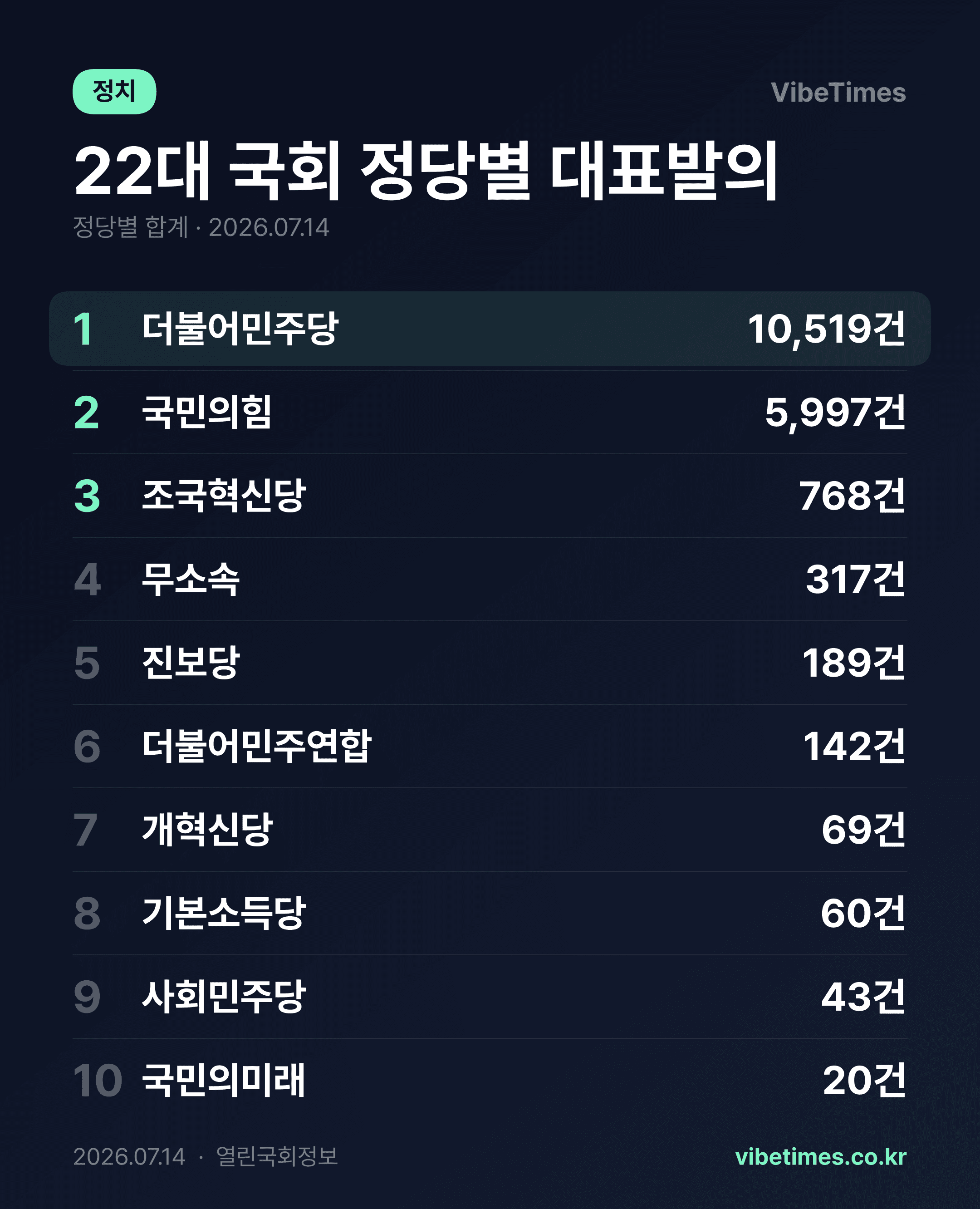
An analysis of the number of bills primarily sponsored by political parties in the 22nd National Assembly as of July 14, 2026, confirms the overwhelming legislative leadership of the two major parties. The Democratic Party of Korea (DPK) recorded the highest number of sponsored bills with a total of 10,519. The People Power Party (PPP) ranked second with 5,997 bills. Combined, the two parties sponsored a total of 16,516 bills. This figure accounts for over 90% of the total bills sponsored by the top 10 negotiating and non-negotiating blocs. Ultimately, the data clearly reveals a monopoly structure where the National Assembly's legislative activity is heavily skewed toward the two major parties.
Political Dynamics Revealed by Bill Submission Gaps
The gap between the first and second-place parties is approximately 4,522 bills. This means the DPK submitted about 75% more legislative bills than the PPP. This result is interpreted as a reflection of the strategy of the main opposition party to lead bill submissions and exercise policy influence and political strength within the political landscape of a governing minority versus an opposition majority. In contrast, the Rebuilding Korea Party ranked third with 768 bills, and independent lawmakers ranked fourth with 317 bills. The Progressive Party ranked fifth with 189 bills, followed by the Democratic United Party with 142. This suggests that parties not belonging to the negotiating blocs or minority parties face severe shortages in legislative infrastructure and personnel.
Polarization in Perception and Behavior Between Major and Minor Parties
Looking at the submission status of lower-ranked parties, there is a significant difference in legislative competitiveness even among parliamentary parties. The Reform Party recorded 69 bills, the Basic Income Party 60, and the Social Democratic Party 43. The People's Future Party recorded only 20 bills. Parties that stall in the single digits or low hundreds tend to focus on specific factions, regional interests, or particular issues. It is highly likely that they submit bills centered on symbolic legislation that highlights their party identity, rather than comprehensive state administration or all-encompassing policy legislation. This can be analyzed as a result of an inability to continuously produce a large volume of bills due to a lack of professional legislative personnel or limitations in gathering intra-party consensus.
Impact on Markets, Economy, and Investment Implications
Such statistical data offer important implications not only for the political sector's activity level but also for the macro economy and capital markets. The submission of over 10,000 bills by the major opposition DPK serves as a potential variable directly affecting corporate regulatory environments and tax reforms. This is because a significant portion of these bills likely relates to economic measures, such as corporate investment support, labor market flexibility, and reductions in wealth or corporate taxes. If the power struggle with the second-place PPP leads to a surge in delayed bills, the market will cite policy uncertainty and be forced to adopt a conservative investment approach. Legislative delays act as a factor that dampens investment sentiment in the real economy.
The over 16,000 bills submitted by the two parties are the core fuse determining the direction of regulatory policy and capital flows in the Korean economy. While bills from minority parties have impact limited to specific sectors, key bills from the two major parties induce capital reallocation across all industries.
From an investor's perspective, it is essential to screen key economic bills with high passage probabilities and scenarioize benefits and damages by industry. The compromise that will be found at the National Assembly plenary session regarding the DPK's active promotion of deregulation for large enterprises or support for specific high-tech industries, versus the PPP's emphasis on tax cuts, will serve as the standard dividing future macroeconomic growth trends. Moving forward, the gap in the number of bill submissions is expected to widen in proportion to the intensity of political confrontation.