Share of South Koreans Aged 65+ Reaches 19.2%; Fertility Rate Stands at 0.7 Range Amid Deepening Aging

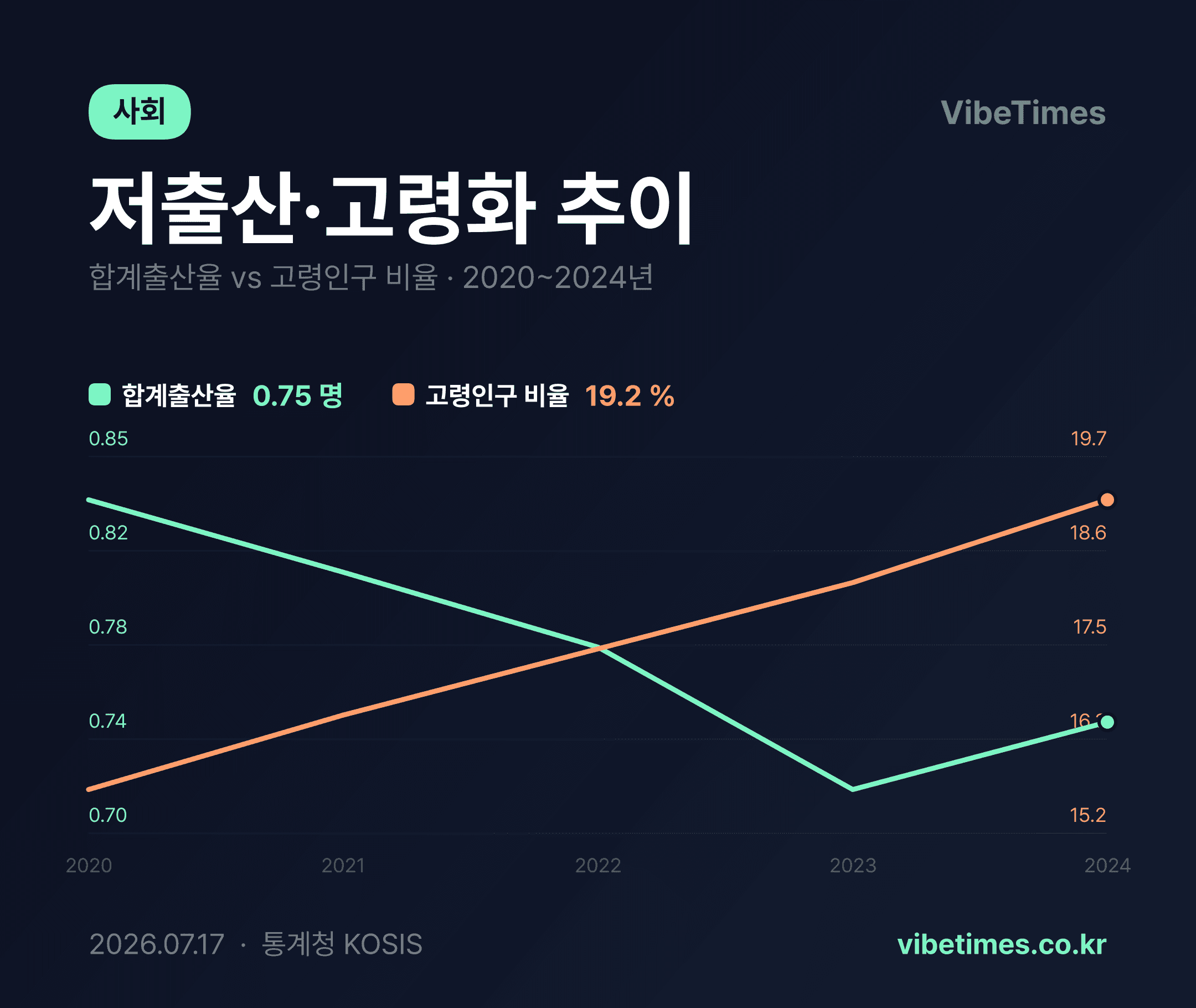
Fertility Rate Rebounds to 0.7 Range, Aging Population Surpasses 19%
As of 2025, South Korea's total population is recorded at 51,117,378. According to Statistics Korea's population trend survey, the total fertility rate fell to 0.721 in 2023 before rebounding slightly to 0.748 in 2024. This represents a minimal recovery occurring amidst a continuing trend of plummeting birth rates. During the same period, the proportion of the elderly population traced a sharply rising curve. The share of the population aged 65 and older, which was a mere 15.7% in 2020, increased steadily to reach 19.2% in 2024. The figures clearly demonstrate the reality that the demographic structure of society is undergoing extreme compression.
Income Polarization Accelerates Demographic Shift
Population decline and aging trends intertwine with macroeconomic indicators to reveal a complex landscape. According to statistics for the first quarter of 2026, the average monthly income of the top 20% of households (5th quintile) was 12,378,034 won. The trend of asset and labor income concentrating at the top is solidifying. Lower-income households struggle to secure funds for child-rearing and housing, leading them to forgo or delay marriage and childbirth. Conversely, the upper-income class has greater incentives to decide on childbirth and child-rearing due to stable financial status. The background to the 2024 fertility rate rising from 0.721 to 0.748—a rise of 0.027—is analyzed to be driven by structural factors, specifically an increase in births among the highest-income groups. Ultimately, this implies that the low birth rate issue has evolved beyond a simple demographic phenomenon into an economic imperative directly linked to household income gaps.
Declining Disposable Income and Severe Demand Shifts
The elderly population is growing at a rate far exceeding the decline of the working-age population. As the working-age population shrinks, the economy's overall capacity to generate value-added diminishes. The nation faces structural limitations as the tax base supporting public finances thins. Expenditures on public social security, such as the national pension and health insurance, are increasing exponentially. This fiscal pressure inevitably leads to higher insurance premium rates for the working generation, creating a vicious cycle that erodes household disposable income. The consumer market also follows the trajectory of demographic change. Demand for traditional growth industries, such as early childhood education and practical consumer goods for youth, is expected to continue contracting. Conversely, demand for elderly care services, including silver medical devices and silver towns, is predicted to surge. Investment capital is undergoing a rapid reallocation towards industries tailored for the elderly.
Investment Strategies Responding to Demographic Risk
The South Korean economy is expected to reach an inflection point in demographic shifts within the next five years. Corporate investment in automation facilities to compensate for the decline in the working population is expected to accelerate. Capital-intensive industries and companies possessing AI-based automation solutions are likely to emerge as market leaders. Government tax and immigration policies will also have to be overhauled to resolve labor shortages. This urgency stems from the immediate need for institutional deregulation to cultivate and attract skilled technical labor. Investors should not approach low fertility and aging merely as social issues. Business models that maximize capital efficiency rather than labor input must be re-evaluated from a long-term perspective. It is time to formulate asset allocation strategies by treating the shifting landscape of the consumer market—shaped by income polarization and compressed demographic growth—as a mega trend.