Net Salary by Income Bracket: A Comprehensive Guide to 4 Major Insurances and Taxes

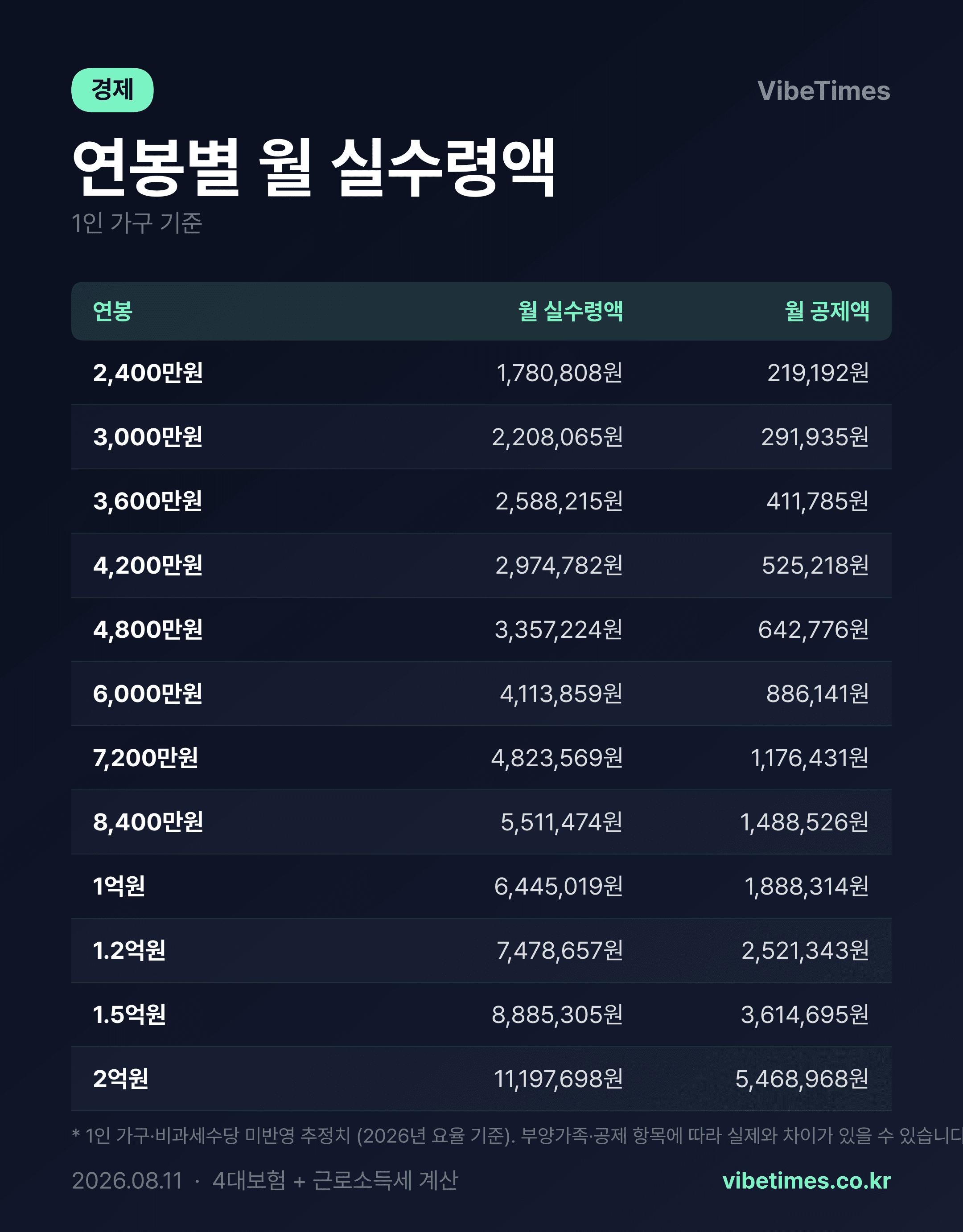
Steep Rise in Tax Burden by Income Level and Disconnect with Real Income
As of August 2026, a worker earning an annual salary of 100 million won takes home 6,445,019 won per month. This is a 22.6% reduction from the contracted annual salary divided by 12 months, which is 8.33 million won. The progressive tax rate structure, which sharply increases with rising income, is a key factor widening the gap between pre-tax and post-tax income for high earners. Compared to a monthly net income of 1,780,808 won for those earning 24 million won annually, income has increased approximately 4.1 times, but the actual take-home pay has only risen by 3.6 times.
This phenomenon stems from the sharp expansion of income tax. While an employee earning 24 million won annually pays only 31,111 won in combined income and local income tax, this figure jumps to 1,192,991 won for those earning 100 million won annually. As income quadrupled, the tax burden increased by about 38 times. In contrast, the 4 major insurance premiums rose from 188,082 won to 695,323 won over the same period, showing a relatively gentler upward trend. This is because, unlike social insurance premiums which are proportional to income but subject to certain caps, income tax rates themselves leap as the taxable income brackets increase.
An annual salary of 42 million won is analyzed as a symbolic threshold that fails to surpass the 3 million won monthly net income mark. The monthly net income for this salary is 2,974,782 won, with approximately 520,000 won deducted for 4 major insurance premiums and taxes (329,143 won and 196,075 won respectively). Only when the annual salary increases to 48 million won does one finally receive 3,357,224 won, entering the mid-3 million won range. In this bracket, classified as middle class, the proportion of 4 major insurance premiums remains higher than that of taxes.
Tax Burden Inversion in High-Income Brackets and Limitations on Wealth Accumulation
A qualitative change in the deduction structure is observed starting from the 72 million won annual salary bracket. Monthly taxes in this bracket are 612,187 won, surpassing the 4 major insurance premiums of 564,245 won for the first time. While social insurance premiums like health insurance and national pension feel relatively burdensome at lower incomes, income tax becomes the largest expenditure component as annual salaries rise. This inversion can limit household disposable income and shrink the real spending power of high earners.
The sense of increased income becomes even less pronounced in the bracket between 150 million won and 200 million won annually. A worker earning 150 million won annually receives 8,885,305 won per month, paying 2,715,036 won in taxes alone. When the annual salary jumps to 200 million won, the monthly net income becomes 11,197,698 won, but taxes surge to 4,364,972 won. Despite a 50 million won increase in annual salary, the monthly take-home pay only rose by approximately 2.31 million won. Consequently, about 45% of the additional income is deducted for taxes and insurance, interpreted as a critical point that could affect the work motivation of high-earning professionals and executives.
The total annual deductions for the 200 million won annual salary bracket reach approximately 65.6 million won, a figure higher than the pre-tax annual salary of an employee earning 60 million won.
Notably, among the 4 major insurance premiums, the National Pension has an income cap, limiting additional contributions for high earners above a certain level. However, health insurance and employment insurance premiums continue to rise proportionally to income, adding to the burden of high earners alongside taxes. The 1,103,996 won in 4 major insurance premiums paid by an employee earning 200 million won annually is nearly equivalent to the monthly minimum cost of living for an individual earning 24 million won annually. This data suggests that South Korea's income tax system heavily concentrates the tax burden on top earners.
Investment Strategies and Market Impact Based on Changes in Disposable Income
The difference in net income by income bracket directly impacts household asset management strategies. For those earning below 60 million won annually, the absolute amount of monthly net income is small, making savings and basic living expenses a high priority. The monthly income for workers in this bracket ranges from 1.78 million won to 4.11 million won, and considering inflation, the disposable funds available for the capital markets are likely to be limited. Conversely, from the bracket of 84 million won annually, with a net income exceeding 5.5 million won per month, there is a structure for surplus funds that allows for active asset investment.
The financial investment industry is planning customized products based on this net income data. For high earners with annual salaries of 100 million won or more, monthly deductions exceeding 1.8 million won make it essential to utilize pension savings or individual retirement accounts that offer income and tax credits. Even with a high pre-tax income, failure to maximize post-tax disposable income slows down wealth accumulation. In a situation where a worker earning 120 million won annually pays 1.74 million won in taxes monthly, tax-saving strategies are perceived not as an option, but as a matter of survival.
At the time of corporate wage negotiations, these actual take-home figures also serve as important negotiation points. Even a simple 5% annual salary increase may result in a lower perceived income growth for employees due to the progressive tax rate. Particularly in the bracket between 80 million won and 100 million won annually, income stagnation may occur due to shifts in income tax brackets, leading companies to diversify their compensation structures by enhancing non-taxable welfare benefits.
Outlook for Income Structure Linked to Future Inflation
Considering the continuous trend of inflation, current net incomes by income bracket are highly likely to fail to adequately reflect the real purchasing power of workers. Even if nominal wages rise, if the income tax brackets remain fixed, workers will experience a real income decrease, intensifying the 'bracket creep' phenomenon. The monthly net income of 2,588,215 won for those earning 36 million won annually is considered a tight amount for those living in major cities with high housing and education expenses.
While these figures may change depending on the direction of future tax law revisions by the government, the financial pressure on social insurance due to low birth rates and an aging population foreshadows a continuous rise in the 4 major insurance premiums. This means that deduction rates could increase from current levels across all income brackets. For social beginners earning below 30 million won annually, policies to ease the burden of 4 major insurance premiums are expected, while discussions on alleviating excessive progressive tax rates for high-income brackets are anticipated to continue.
In conclusion, employees must establish long-term financial plans based not only on their pre-tax annual salary but also on their actual disposable income, i.e., their post-tax take-home pay. The reality of paying 4.36 million won in taxes monthly even when earning 200 million won annually demonstrates the importance of qualitative management over quantitative income expansion. The gap between income brackets is expected to become more fluid with changes in tax policies and insurance rates, and individuals' asset management capabilities in response will emerge as a key variable in wealth disparity.