Comcast Ranks No. 1 Among Large-Cap Blue Chips With the Lowest P/E Ratios

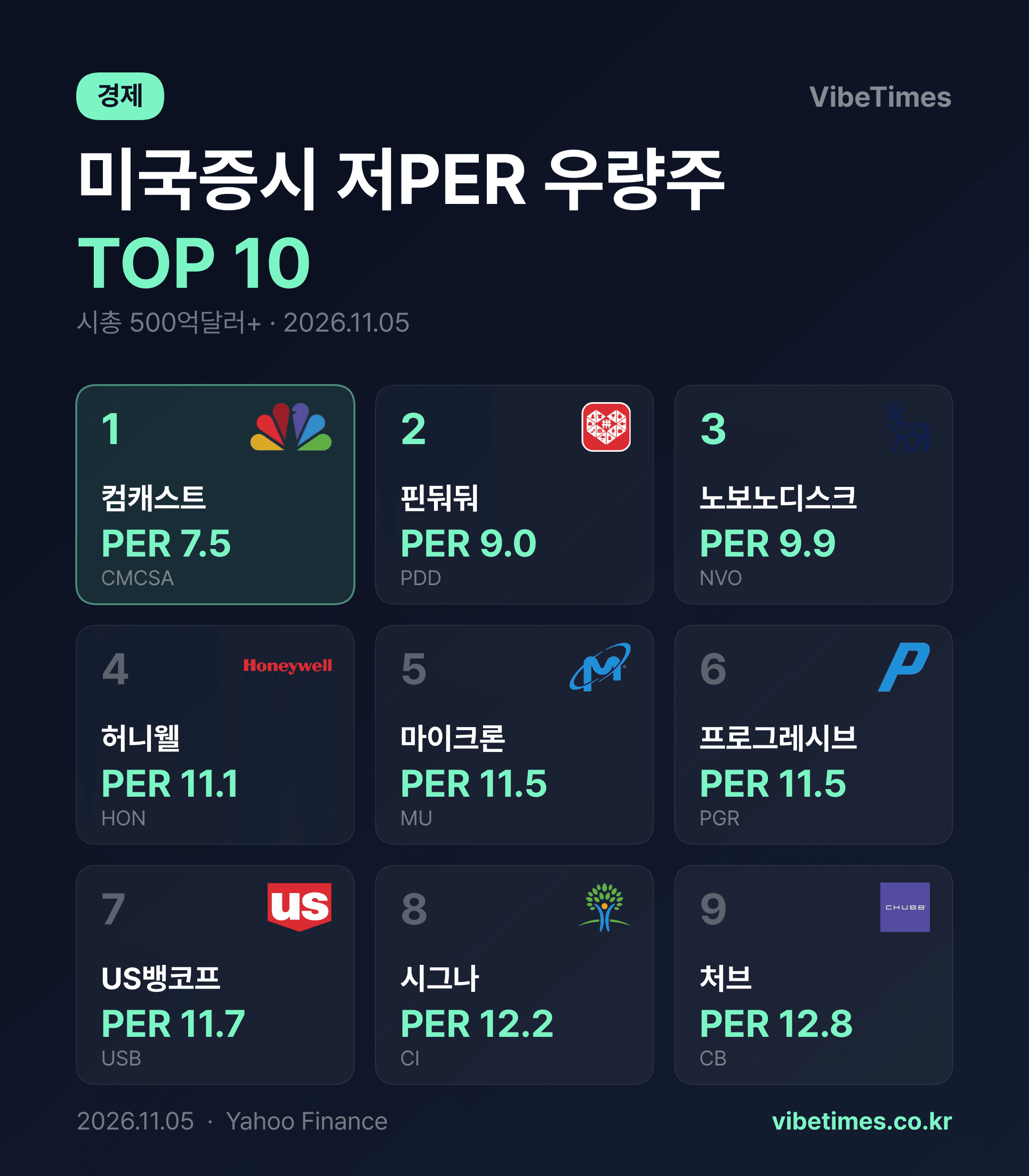
Comcast has topped the ranking of large-cap blue-chip stocks with the lowest price-to-earnings (P/E) ratios. As of November 5, 2026, Comcast posted the lowest P/E ratio among U.S. large-cap stocks at 7.5 times. Friedrich Nietzsche said there are no facts, only interpretations, but when it comes to low P/E rankings, the numbers speak clearly. These figures show how the market values these companies' share prices relative to their earnings.
What the Composition at the Top Tells Us
An unusual mix of companies sits at the top of the list. Comcast (P/E of 7.5, market cap of $84.1 billion) leads the pack, followed by PDD Holdings (9.0x, $114.1 billion) in second place and Novo Nordisk (9.9x, $177.2 billion) in third. Three distinct sectors — cable and telecom, Chinese e-commerce, and global pharmaceuticals — have all landed in the upper tier of the low-P/E ranking.
The lineup shares a common thread: all three companies have had the market price in slowing growth or structural risks. Comcast is weighed down by declining traditional cable TV subscribers, PDD Holdings by weakening Chinese consumption and intensifying competition, and Novo Nordisk by shifting competitive dynamics in the obesity drug market. A low P/E suggests the market is taking a conservative view of these companies' future earnings.
The Rise of Financial Stocks Stands Out
Further down the list, the financial and insurance sectors make a strong showing. After Honeywell (11.1x) in fourth place and Micron (11.5x) in fifth, financial stocks dominate. Progressive (11.5x), U.S. Bancorp (11.7x), Cigna (12.2x), and Chubb (12.8x), along with Goldman Sachs (12.9x) in tenth place, give financials five spots in the top 10.
This suggests financial stocks have been generating profits but that their share prices have failed to keep pace with earnings growth. Banks and insurers traditionally trade at lower P/E ratios than the overall market average, yet the fact that Goldman Sachs — the largest company in the top 10 by market cap at $258.5 billion — trades at just 12.9 times could still be read as a discounted valuation.
Micron's Position Is Notable
Micron stands out as a striking contrast. Semiconductors typically feature sharp earnings cycles and high share price volatility, yet Micron, with a market cap of $967.5 billion — by far the largest on the list — has a P/E of only 11.5 times. Its earnings scale has outpaced its share price, earning it a spot on the ranking. Analysts suggest such figures emerge when the market lacks confidence in how long the semiconductor boom's profits will last.
Daily price change data is also worth noting. The daily moves of all top 10 stocks clustered between -0.02% and 0.03%, indicating no notable price swings at the time of publication — evidence that low P/E valuations themselves are already a stable assessment fully reflected in the market.
Is a Low P/E an Opportunity or a Trap?
From an investment standpoint, this ranking is a double-edged sword. P/E ratios in the 7–13x range fall well below the market average, making them attractive entry points — provided earnings hold up. Indeed, Comcast and Novo Nordisk have long been regarded as companies with strong, stable cash flow generation.
However, a low P/E does not automatically mean a stock is undervalued. It may simply reflect the market pricing in stalled growth or risk factors in advance. The common challenge for these top-ranked stocks is to prove an earnings trajectory that exceeds the market's low expectations. If they succeed, this list will become a guide to finding undervalued stocks; if not, even these low P/E ratios risk turning out to be just another value trap.