Top 5 Low-PER Blue-Chip Stocks: Valuation Analysis

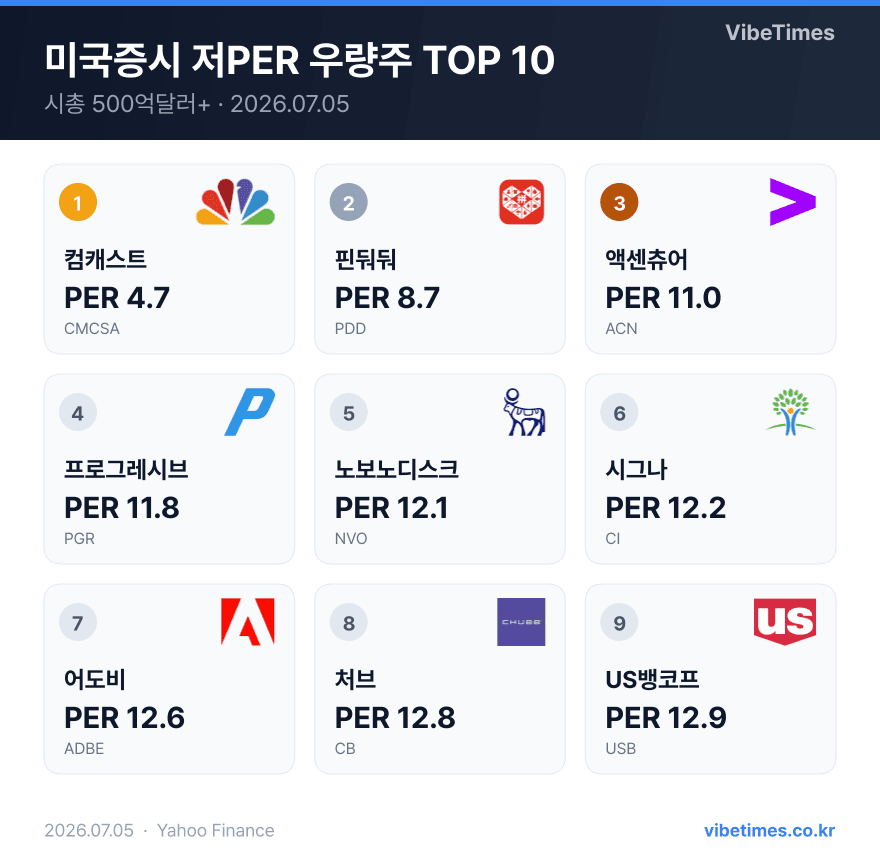
In-Depth Valuation Analysis of Top 10 US Companies with Low PER Ratios
As of July 5, 2026, an analysis of valuation metrics for the top 10 high-quality companies with low Price-to-Earnings (PER) ratios on the US stock market has been released. This analysis focused on identifying companies with undervalued market value and understanding their market position and potential. Comcast ranked first with a very low PER of 4.7x, followed by Pinduoduo at 8.7x and Accenture at 11.0x. The valuation levels of these top-tier companies suggest that their stock prices are relatively undervalued compared to their earnings generation capabilities. Market participants are expected to closely examine the earnings growth and future prospects of these low-PER companies to identify investment opportunities.
Valuation Status and Characteristics of Low-PER Companies
The 10 companies included in this ranking analysis have generally recorded low PER figures, attracting investor attention. Comcast, ranked first, reported a PER of 4.7x and a market capitalization of $85 billion, showing stable performance with a stock price fluctuation of 0.00%. Comcast, operating in the telecommunications and media industry, tends to maintain a low valuation based on consistent cash flow. Pinduoduo, a China-based e-commerce company, ranked second with a PER of 8.7x and a market capitalization of $117.3 billion, trading at a low valuation despite demonstrating significant growth potential. This can be interpreted as a result of a combination of factors, including the inherent volatility of emerging market companies and regulatory risks in China.
Accenture, ranked third, is a consulting and IT services firm with a PER of 11.0x and a market capitalization of $84.1 billion. Despite a slowdown in global economic growth, the company is evaluated as maintaining stable performance due to consistent demand for digital transformation from businesses. Progressive, a powerhouse in the insurance industry, ranked fourth with a PER of 11.8x and a substantial market capitalization of $135.2 billion. Novo Nordisk, a leader in the pharmaceutical and biotechnology sector, ranked fifth with a PER of 12.1x and a massive market capitalization of $223.2 billion. Novo Nordisk, in particular, has shown high growth based on innovative achievements in diabetes and obesity treatments. Signa, a provider of health insurance and related services, ranked sixth with a PER of 12.2x and a market capitalization of $76.1 billion. Adobe, a software company, showed a valuation of 12.6x PER and $87.3 billion market capitalization, ranking seventh. Chubb, a global leader in property and casualty insurance, ranked eighth with a PER of 12.8x and a market capitalization of $140.1 billion. US Bancorp, a mid-sized US bank, secured its position within the financial sector with a PER of 12.9x and a market capitalization of $96.2 billion, ranking ninth. Finally, Alibaba, China's largest e-commerce and cloud computing company, ranked tenth with a PER of 14.9x and a market capitalization of $230.7 billion. Like Pinduoduo, Alibaba possesses strong growth potential from the Chinese market and a vast customer base but is analyzed to be affected in its valuation by changes in the regulatory environment and intensified competition.
Overall, these companies, despite possessing stable earnings capabilities and substantial assets, are trading at low PERs relative to market averages, implying potential as 'undervalued blue-chip stocks.' They span various industries including telecommunications, e-commerce, insurance, and finance, indicating that undervalued opportunities are not limited to a specific sector. A low PER means investors can acquire shares at a lower cost relative to the company's net earnings, which can be interpreted as a signal of significant potential for future stock price appreciation.
Market and Industry Impact, and Investment Implications
The valuation analysis of top low-PER companies offers significant implications for overall stock market investment sentiment and capital allocation. These companies are typically in their mature stages or are undervalued due to short-term market concerns relative to their intrinsic value. However, backed by solid financial structures and stable profitability, they often hold long-term investment value.
The inclusion of Chinese companies like Pinduoduo (2nd) and Alibaba (10th) is particularly noteworthy in this ranking. While these companies have secured significant market share along with the growth of the Chinese economy, they face valuation pressures due to external factors such as intensified government regulation, geopolitical risks, and global supply chain realignments. Nevertheless, their market capitalizations of $117.3 billion and $230.7 billion respectively, demonstrate their substantial scale and attest to the potential of the Chinese domestic market and the unique platform influence these companies hold. Therefore, investing in these companies requires embracing high volatility, but significant investment returns can be expected if they successfully adapt to the regulatory environment and maintain market dominance.
Furthermore, the presence of companies from traditional industries, such as Comcast (1st), Progressive (4th), and Chubb (8th), among the top low-PER stocks is significant. These companies generally have business models less sensitive to economic fluctuations and often enhance shareholder value through consistent dividend payouts or share buybacks. Comcast, with a PER of 4.7x, serves as an example of undervaluation based on stable dominance in the telecommunications and media market, standing out for its strong cash flow generation ability. Such companies can be attractive options for investors seeking portfolio diversification and stability. Technology services and software companies like Accenture (3rd) and Adobe (7th) are also proving their competitiveness by maintaining relatively low PERs amidst economic slowdown concerns, supported by consistent demand. This indicates that the macro trend of accelerating digital transformation underpins the fundamentals of these companies.
From an investor's perspective, the existence of low-PER companies reaffirms the validity of the 'value investing' strategy. It is crucial to comprehensively evaluate a company's intrinsic value, growth potential, competitive advantages within its industry, and management capabilities, rather than solely relying on the PER figure. Especially as there is active searching for stocks that are 'safe yet potentially growing' in the current market, these low-PER blue-chip companies are well worth considering for inclusion in portfolios after further analysis and research. The market may sometimes overlook the value of quality companies due to macroeconomic uncertainties or short-term issues, and capturing these periods can be key to long-term investment success. These companies are expected to undergo a gradual re-rating process if they secure future growth drivers and improve performance based on their current low valuations.
Future Outlook and Investment Strategies
The valuation analysis of top low-PER companies in the US stock market provides important clues for future market investment trends and corporate strategic directions. Amidst persistent uncertainties, including the sustainability of a high-interest-rate environment and concerns about a global economic slowdown, investors are making investment decisions more cautiously. In this context, companies like Comcast, Pinduoduo, and Accenture, which generate stable profits while maintaining low valuations, are expected to increase their appeal as 'safe-haven assets' or 'value investment' targets.
The re-evaluation of valuations for companies like Pinduoduo and Alibaba is likely to be heavily influenced by China's policy direction and its economic recovery pace. If the Chinese economy enters a stable growth trajectory and regulations on technology companies are eased, these companies' stock prices have significant potential to rise above their current low PER levels. Conversely, if regulatory pressures persist or the Chinese economy falters, these companies may continue to trade at a discount. Therefore, investments in these companies require a cautious approach, closely monitoring changes in China's economic and policy environment.
Meanwhile, traditional industry companies such as Comcast, Progressive, and Chubb are expected to continue stable growth, supported by their robust market dominance and predictable cash flows. These companies may pursue strategies such as strengthening infrastructure through large-scale capital investments or expanding their business areas through mergers and acquisitions (M&A). Furthermore, consistent dividend payments contribute to stock price support, which could further enhance their investment appeal in a low-interest-rate or gradual interest-rate reduction environment. Software companies like Adobe are pursuing continuous growth through subscription-based revenue models and may discover new growth drivers through integration with AI technology.
Investors should deepen their fundamental analysis of individual low-PER companies and make investment decisions considering the long-term outlook and competitive landscape of the industries in which these companies operate. A low PER does not automatically guarantee undervaluation; the possibility of decelerated growth or underlying structural issues cannot be ruled out. Therefore, thorough verification is needed to determine whether the current low valuation represents a temporary market misunderstanding or an intrinsic problem with the company. By identifying high-quality companies with the potential for steady value appreciation over the long term through such analysis, stable investment performance can be achieved even in a volatile market environment.