South Korea's Low Birth Rate and Aging Population Intensify: Fertility Rate at 0.7 Range, Elderly Population at 19%

At the Crossroads of Rebound and Stagnation: Crisis Looms as Population Nears Collapse of 51 Million Mark
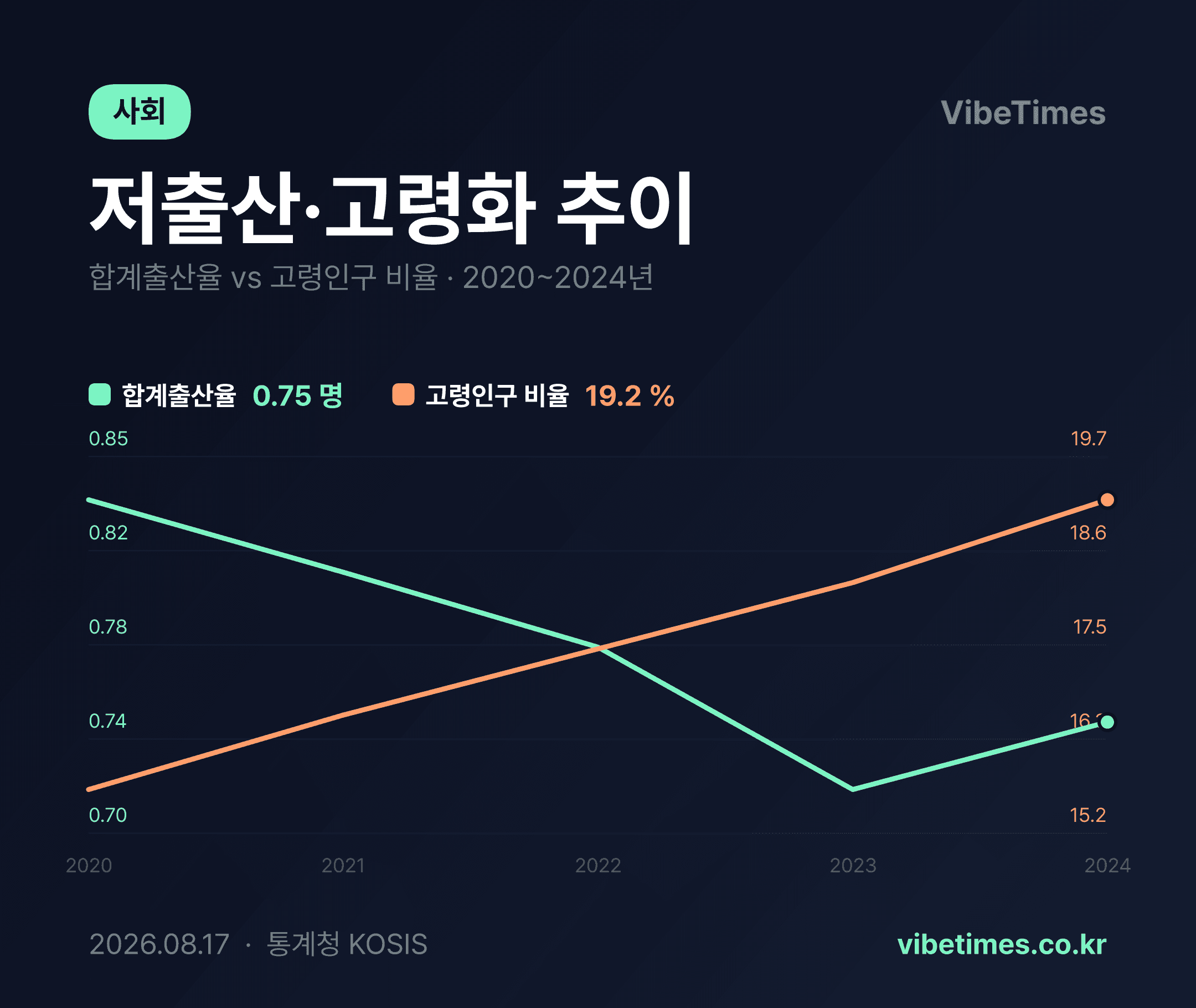
As of 2025, South Korea's total population is estimated at 51,117,378, having officially entered a phase of steep decline after passing its peak. An examination of indicators released by Statistics Korea over the past several years reveals that qualitative changes in population structure are outpacing quantitative decrease. In particular, the total fertility rate showed a sharp downward trend, recording 0.837 in 2020, 0.808 in 2021, and 0.778 in 2022. After plummeting to a record low of 0.721 in 2023, the rate rebounded slightly to 0.748 in 2024, suggesting that both policy effects and base effects are at play simultaneously.
Despite this minor rebound, Korea's fertility rate remains significantly below the replacement fertility rate of 2.1 required to maintain the population. A figure in the 0.7 range is rarely seen globally and is interpreted as a harbinger of a drastic contraction in labor supply and a shrinking domestic market. This implies more than just a low number of births; it signals the end of the demographic bonus era—where the working-age population shrinks—and the full-fledged beginning of the demographic onus era. Statistics experts emphasize that a prudent analysis is needed to determine whether the slight rebound in 2024 represents a trend reversal or a temporary fluctuation.
Warning of 19% Elderly Population Share as Entry into a Super-Aged Society Looms
In stark contrast to the declining birth rate, the proportion of the population aged 65 and older is tracing a steep upward curve. The share of the elderly population, which was 15.7% in 2020, rose to 16.6% in 2021 and 17.4% in 2022, increasing at a rate of nearly 1 percentage point annually. It recorded 18.2% in 2023 and reached 19.2% in 2024, approaching the 20% threshold for a "super-aged society." This serves as proof that South Korea is aging at the fastest rate in the world and is identified as a key factor dampening economic vitality across the board.
The fact that the share of the elderly population is nearing 20% implies that the social burden of support has reached a critical point, which is likely to deal a direct blow to the sustainability of public pensions and the fiscal health of the national health insurance system.
In the labor market, a manpower mismatch is expected to intensify as the retirement of skilled workers accelerates while new entrants to replace them remain scarce. While industries are rushing to introduce automation and AI technologies to respond to this, there are concerns that if the consumption patterns of the elderly population fail to keep pace with productivity improvements, the economy could fall into a prolonged low-growth phase—so-called "Japan-style long-term stagnation." Consequently, employment flexibility policies aimed at increasing the economic participation of the elderly are emerging as a shared task for both businesses and the government.
Structural Gap Widens in Household Economy Amid Income Polarization
Amid shifting population structures, the economic divide among households is becoming increasingly distinct. According to a survey conducted in the first quarter of 2026, the average monthly regular income for the top 20% of households (the 5th quintile) reached 12,378,034 won. This suggests that high-income households have diversified their income sources beyond labor income to include assets and business income. Conversely, housing costs and rising child-rearing expenses—cited as major causes of low birth rates—are weakening the real purchasing power of the middle-to-lower income classes, creating a vicious cycle that exacerbates the avoidance of childbirth.
This polarization also exerts a clear influence on the asset market. While surplus funds from high-income households flock to high-yield assets, ordinary households are seeing their capacity to save diminish due to soaring living costs and loan interest burdens. The financial investment industry expects the high income levels of the top quintile households confirmed in Q1 2026 to drive demand in the premium consumer market and asset management services. However, from a macroeconomic perspective, this income imbalance is expected to act as a potential risk factor that hinders social mobility and holds back long-term domestic growth.
Investment Strategies and Industrial Landscape Shifts in the Era of Demographic Cliff
Long-term population decline and aging are expected to fundamentally reshape the industrial landscape. First, growth in industries related to unmanned technologies—such as robotics, smart factories, and autonomous driving—is projected to stand out as solutions to labor shortages. Furthermore, as the elderly population approaches 20%, senior-specialized industries like healthcare, pharmaceuticals, and silver towns are emerging as mainstream consumer markets. Investors must now focus not only on growth potential but also on companies equipped to adapt to structural shifts in demographics.
The real estate market is also expected to see deepening polarization across regions and products due to a decrease in the number of households and an increase in single-person households. While concentration in the metropolitan area will likely continue, regions directly affected by the decline in school-age populations face risks of asset value depreciation. Although the government has introduced aggressive housing support and tax benefits to lift the fertility rate from the 0.7 range, the dominant analysis is that there are limits to altering the massive flow of population structure in the short term. Therefore, it is time for both businesses and individuals to establish risk management and asset allocation strategies suitable for a "new normal" era where low growth and aging have become entrenched.