Comparing Mars Exploration Missions: Key Scientific Issues

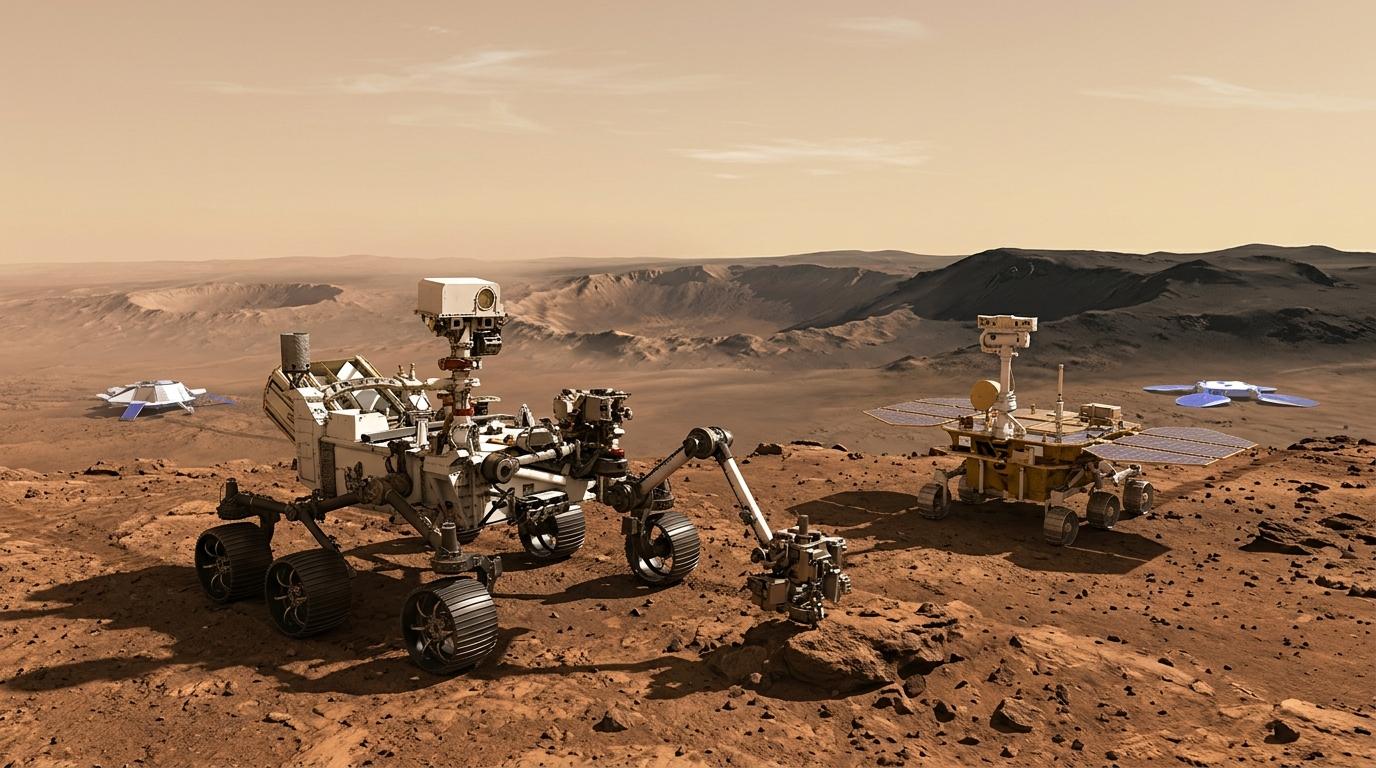
Recent Mars exploration has emerged as a crucial frontier to address two monumental scientific and anthropological challenges: expanding humanity's survival potential and searching for environments similar to Earth. By comparatively analyzing current and future key Mars exploration missions, each with distinct scientific objectives and technological approaches, we can gain a clear understanding of the challenges and opportunities humanity faces, from searching for traces of past life on Mars to securing the possibility of future human habitation.
1. Evolution of Mars Exploration and Analysis of Scientific Achievements from Key Missions
The evolution of Mars exploration is a process of resolving fundamental questions initiated by past missions, building deep understanding through the history of continuous inquiry into Mars, the 'Earth's twin.' Mars, having long stimulated human curiosity due to its Earth-like environment and the possibility of life, has become an object of scientific truth-seeking beyond simple exploration. Past orbiter, lander, and rover missions served as vital stepping stones, deepening humanity's understanding of Mars by exploring its atmosphere, geology, and traces of water. These explorations contributed to uncovering the hidden history beneath the Martian surface and its water cycle, providing the scientific foundation for current advanced missions.
Current Mars exploration focuses intensely on ancient Martian water and organic matter to search for signs of life. One of the primary scientific motivations for ongoing Mars exploration is the search for evidence of past life. In particular, the focus is on finding traces of liquid water, presumed to have existed in ancient Mars, and organic compounds essential for life's activity. To this end, rovers explore regions believed to be ancient lakebeds or riverbeds, collecting and analyzing soil and rock samples in an effort to find direct evidence or indirect clues of life.
Concurrently, efforts are underway to reconstruct Mars's changing geological chronology through the exploration of its geological diversity. Mars has a highly dynamic geological history, and current exploration missions play a significant role in elucidating this diversity. By analyzing rock composition, volcanic activity traces, and crater distribution across various regions, scientists aim to understand the geological evolution of the Martian surface and gain universal insights into planetary formation and evolution through comparison with Earth's geology. This is an essential process for understanding Mars's past climate and environmental changes.
Concrete examples from the modern era include NASA's Perseverance rover, which is at the forefront of exploration, focusing on the search for life and future sample retrieval. NASA's Perseverance rover's primary objective is to search for signs of past life, specifically looking for organic matter and potential biosignatures in the ancient lakebed terrain of Jezero Crater. Equipped with state-of-the-art analytical instruments, it collects samples on-site, which are designated for future missions to be returned to Earth. Furthermore, the successful operation of the helicopter Ingenuity has proven the feasibility of flight in the Martian atmosphere, opening new horizons for future exploration technologies.
China's Tianwen-1 mission has achieved independent accomplishments through integrated exploration by an orbiter, lander, and rover. China's Tianwen-1 mission operated an orbiter, lander, and rover simultaneously within a single mission, conducting comprehensive exploration of Mars's surface and atmospheric environment. Notably, the Zhurong rover explored the vast plains of Mars's northern hemisphere, studying geological structures, soil characteristics, and subsurface ice distribution. Tianwen-1 represents a significant achievement demonstrating China's space exploration capabilities and has contributed unique data on the Martian surface environment.
The European Space Agency's (ESA) ExoMars program is expanding the scope of subsurface Martian exploration through future life detection and the development of unique drilling technology. The ExoMars program's core objective is to find evidence of life on Mars, with a particular emphasis on drilling several meters beneath the surface to search for potential organic matter that has not been destroyed by radiation. Although the next-generation rover (Rosalind Franklin), slated for launch in 2022, has been postponed due to technical and geopolitical issues, the program itself presents a unique approach to life detection on Mars through drilling technology. If future mission resumption occurs, it is expected to mark significant progress in the field of subsurface Martian exploration.
2. Scientific Challenges of Mars Exploration and Future Prospects for Humanity
Understanding Mars's current environment and reassessing the possibility of life surviving under extreme conditions are critical challenges facing humanity. Mars currently maintains an extreme environment difficult for life to inhabit, characterized by severe cold, low atmospheric pressure, and strong radiation. However, recent explorations suggest the possibility of microorganisms (extremophiles) that can survive these conditions, prompting a reassessment of the potential existence of life currently in the Martian subsurface or specific localized environments. This has a significant impact on the goal-setting and methodology of future exploration missions.
Evaluating habitability and developing resource utilization technologies in preparation for future human missions to Mars are key steps for the expansion of human civilization. Human exploration of Mars embodies a long-term vision for the expansion of human civilization. To achieve this, it is essential to create habitable environments by utilizing local Martian resources (water, minerals, etc.) and develop technologies necessary for long-term mission operations. Landing technology, life support systems, and In-Situ Resource Utilization (ISRU) technologies are keys to enabling humans to stay on Mars permanently, and ongoing robotic exploration missions provide valuable data for these future preparations.
Finally, it is important to understand the dynamic relationship that shapes the future direction of Mars exploration amidst international cooperation and competition. Mars exploration requires substantial budgets and technological prowess, making international cooperation increasingly vital. While combining the strengths of various nations can enhance efficiency and maximize achievements, competition among spacefaring powers is also intensifying. Within this dynamic of cooperation and competition, it is crucial to predict what the next phase of Mars exploration will be and how humanity will find answers to the questions about the 'Red Planet.'